The Abstractionist’s Toolkit
Abstractionism is the art of modeling spaces in a context-agnostic fashion. We find and build the relationships that give rise to forms.
The work requires tools. Over years of patent work and through creating Natural Reality, I’ve built a number of them.
These tools now belong to a new discipline.
Contents
A.1 Ways of Seeing
A.2 The Boundary Model
A.3 The Bipolar Model
A.4 The Selection Model
A.5 The Reality Model
A.6 Closing Remarks
A.1 Ways of Seeing
Every patent attorney knows the feeling.
An inventor walks in with something you’ve never seen, a circuit or an algorithm or a process, it could be anything under the sun, and you have to find what makes it work before you can write a single word.
To you, the invention is a dark space, sometimes the whole technical area. You know nothing about it, and you still have to do the job. Fake understanding and your client will fire you. The patent office will reject vague claims, and competitors will design around them.
So you ask what the invention does, how it differs from what came before, which features matter and which are incidental. You hold it in front of you until what’s essential shows itself. Then you write claims that describe it at the right level of abstraction, broad enough to have value and specific enough to defend.
In that process, you learn to see in different ways; that is, you build models. Good models work anywhere. What explains an invention can also explain a marriage, a market, a mind. It’s what lets you work blindfolded.
Four models form the basic toolkit:
- The Boundary Model defines what things ARE.
- The Bipolar Model shows how things MOVE.
- The Selection Model shows how things EVOLVE.
- The Reality Model shows how things EMERGE.
Each model adds what the previous one lacks.
A.2 The Boundary Model
The Boundary Model defines what things are. It draws distinctions.
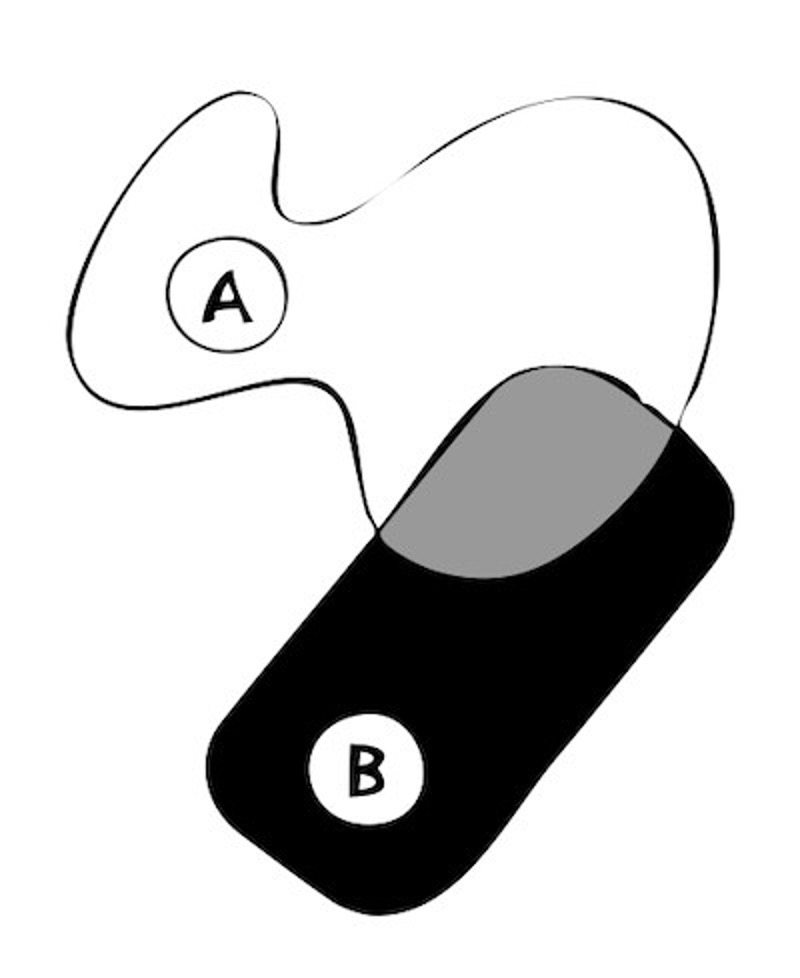
The figure shows two entities, A and B, separated by a boundary. You look at a space, draw a line, and now you have categories.
Is this animal a mammal or a reptile? Is this act legal or illegal? Is this person a friend or a stranger? Is a virus alive? Every question like this invokes the Boundary Model.
The gray zone marks where classification gets hard. A platypus has fur and produces milk, and it lays eggs. Where does it go? The boundary depends on which features you prioritize. Someone emphasizing reproduction draws the line differently than another who cares about body covering.
This is the most common form of thinking. Most problem-solving starts here by necessity: define your terms, categorize the situation, sort things into boxes. Dictionaries work this way. Scientific classification works this way. Medical diagnosis works this way.
You’re deciding what things are, and that’s all. The classifications matter, though, because you act on them. Draw a line between friend and enemy, and action follows.
A.3 The Bipolar Model
The Bipolar Model shows how things move. It introduces dynamics through opposition.
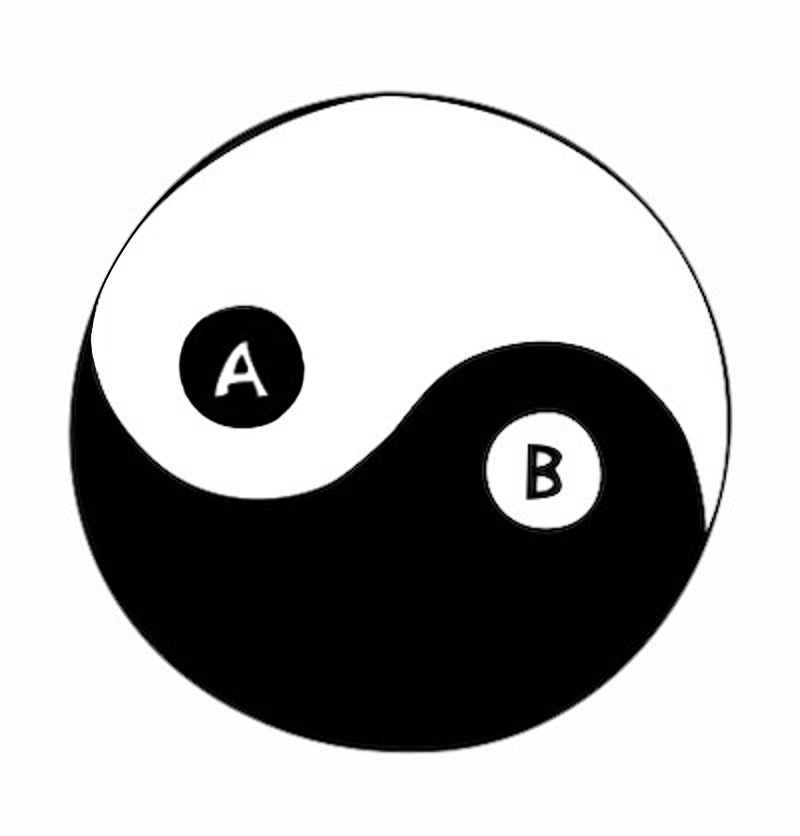
The figure shows A and B as a yin-yang. They’re in tension, each containing a seed of the other, neither stable without its opposite. The boundary between them curves and flows. There’s movement now.
Look around and you see polarization everywhere. Supply and demand. Liberal and conservative. Attraction and repulsion. Action and reaction. Hot and cold. Tension and release. Breathing in and out. Wherever two forces appear to oppose each other, the Bipolar Model applies.
This is more sophisticated than boundary-drawing. You’re describing a mechanism. A thermostat works as heating and cooling signals oppose each other. A market works as buyers and sellers push in different directions. Your body weight works as energy in and energy out compete.
Understanding polarization is an advance. Most arguments, most conflicts, most stuck situations involve people who can only see one pole. The person who sees both poles and understands their interaction has a more complete picture.
The model has limits. It shows forces in balance at a moment without showing how that balance evolves.
A.4 The Selection Model
The Selection Model shows how things evolve. It wraps the bipolar dynamic in a cycle.
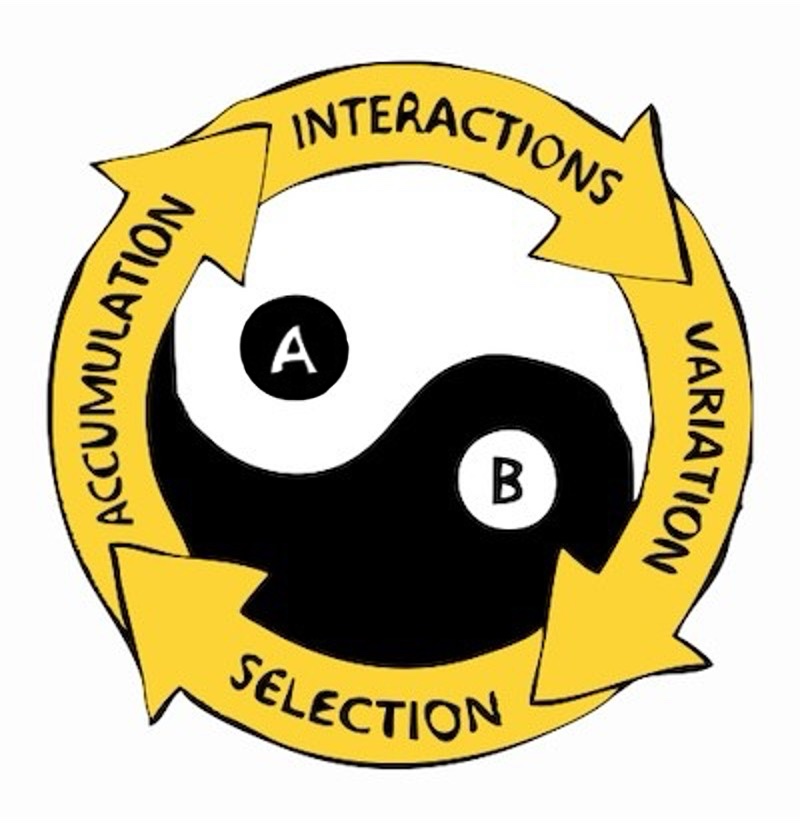
The figure shows the yin-yang from before, now surrounded by four operations: Interaction, Variation, Selection, Accumulation. Things interact, producing variation. Some variants persist while others decay. What’s left is what you see.
In the natural world, species interact with environments, vary through reproduction, face selection through survival and mating, and accumulate successful traits over generations.
The same cycle runs beyond biology. Languages evolve. Technologies evolve. Institutions evolve. Anything that persists against decay, anything that competes for continuation, follows this.
Things adapt within a space. The model doesn’t ask where the space came from or how its rules might change. For that, you need something more.
A.5 The Reality Model
The Reality Model shows how things emerge. It handles layered spaces.
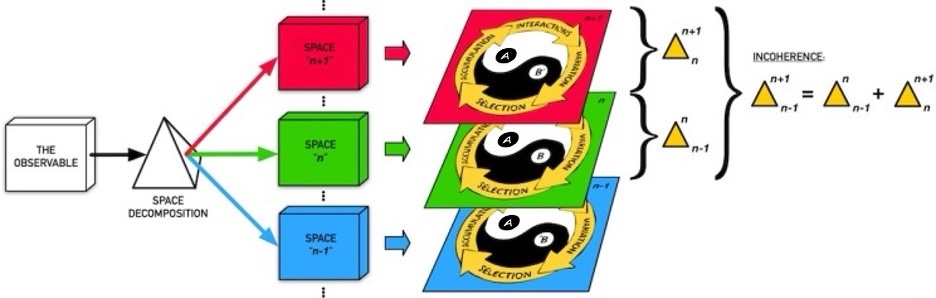
The observable goes through a space decomposition prism that splits what you see into multiple natural spaces, labeled n-1, n, and n+1. Each space runs its own selection cycle. The yellow triangles mark Incoherence, the Δ that appears when spaces follow different rules.
Chapter 3 used this model for the mind: a Base Layer handling sensory input and motor output, a General Reality Layer holding general knowledge, a Self-Reality Layer organizing identity and core beliefs. Each layer follows its own rules.
Chapter 4 uses the Reality Model twice. First, to explain how Natural Spaces emerge through harmonized Incoherence. Second, to show Purple Space (physical processes), Green Space (biology), and Red Space (cognition) as distinct layers orthogonal to the Causation Domain.
Incoherence is where novelty comes from. When harmonized Incoherence accumulates past a threshold, processes reorganize.
A.6 Closing Remarks
The Boundary Model is ancient; humans have been classifying since we could speak. The Bipolar Model shows up in every culture that noticed opposition. The Selection Model is 150 years old and still contested.
Natural Reality is an application of the fourth Model with one addition: the discovery that meaning and happening are orthogonal. It’s the largest abstractionist undertaking ever attempted.
Years ago, long before The Papers, I’d tell my friends that the work we do isn’t really about law or engineering, or even patents. But I couldn’t articulate what it was.
It all came together when I started working on reality, and suddenly twenty years of patent practice turned into something else entirely.
 The Abstractionist’s Papers