A Natural Theory of Mind
Each morning, reality arrives: a book left on the nightstand, a bird’s song through the half-open window, sunlight warming the blanket’s edge. It feels direct and ready-made.
It feels that way because your mind hides what it does. What we call “the world” assembles behind the scenes. Sight, sound, thought, and feeling weave into a single whole before you notice the seams.
Draw a line through all of existence. On one side lies meaning, on the other, happening. You participate in happening. You move, interact, affect things. But you only ever experience meaning.
Humanity has never had a working theory of mind because of one unexamined assumption: that we perceive happening. When we believe our minds have direct access to causation, our own inside is commingled with an imagined outside.
The solution to this riddle is counterintuitive. We must accept we don’t see happening at all, then make room for it. It’s by distinguishing meaning from happening that we can understand the outside from within.
Contents
1.1 Classical Metaphors
1.1.1 Shadows on the Wall
1.1.2 Take the Red Pill
1.1.3 Turn the Kaleidoscope
1.2 Glitches in Reality
1.2.1 The Limits of Reason
1.2.2 The Clash Within
1.2.3 Finding the Edges
1.3 A Natural Theory of Mind
1.3.1 Causation and Interpretation
1.3.2 The Blindfold
1.3.3 A Single Mind
1.3.4 Parallel Minds and Shared Causation
1.3.5 Orthogonality of Domains
1.3.6 What We Never Touch
1.3.7 The Map and the Territory
1.3.8 Bridging the Gap
1.4 Applications
1.4.1 Understanding the Red Veil of Interpretation
1.4.2 Resolving Paradoxes
1.4.3 Navigating Dissonance
1.4.4 The Emperor’s New Clothes
1.5 Closing Remarks
1.1 Classical Metaphors
When people think about reality, two ideas come up more than any other: Plato’s Cave and The Matrix. Both explore what we sense but rarely examine: that our minds might not show us the full picture.
1.1.1 Shadows on the Wall
In ancient Greece, Plato told many stories.
In one, he imagined prisoners in a cave, bound in place from birth. They face a wall and can’t turn their heads. Behind them, a fire burns. Between the fire and prisoners, others pass by, carrying objects. The fire casts shadows on the wall.
The prisoners see only the shadows. They hear echoes and give names to the shapes they see. To them, this is the world. The shadows are real. The wall is reality.
Then one prisoner is freed. He turns around and sees the fire. The light hurts his eyes. After a while, he recognizes the figures casting the shadows. Later he leaves the cave and enters the sunlight. Once again, he’s blinded. Slowly, though, he sees a full world with trees, sky, reflections on water, and the sun.
He returns to the cave, hoping to explain what he’s seen. The others don’t believe him. They know only shadows. His words don’t match their experience.
The story suggests that what we see might not be everything.
The cave assumes a single illusion, shared by all. One wall, one fire, one sun, one exit. Everyone sees an identical distortion, and escaping leads to one truth.
1.1.2 Take the Red Pill
Fast forward 2,400 years, and a similar metaphor shows up in The Matrix.
In the film, people live inside a world designed to resemble life in the late 20th century. Cities, weather, work, small talk. Everything seems familiar because the illusion is complete.
Outside that world, things are different. Machines have taken control. Humanity survives underground. The false environment was built to keep people unaware.
The story turns on a choice: stay inside or wake up. Those who leave the Matrix are asked to help others do the same.
The movie captures something that feels true. There may be another layer beneath what we see.
Ultimately, it makes the same assumption: that everyone is inside the same illusion, that waking up leads to the same reality.
1.1.3 Turn the Kaleidoscope
For more than two millennia, Plato’s story has defined what we believe about perception, experience, and reality. The Matrix updated it, but the basic idea stayed intact.
Our journey takes a different route. We’ll look at where the story gets interesting, to see what it might be pointing toward.
We call them glitches in reality.
1.2 Glitches in Reality
Paradoxes have puzzled humanity throughout history. They feel like traps with no way out, contradictions that refuse resolution no matter how carefully we reason through them.
Most people avoid them. A paradox seems like an intellectual game, disconnected from daily life. Philosophers debate them, scientists work around them, and the rest of us move on.
When something refuses to add up, it shows us the edges of how our thinking works.
1.2.1 The Limits of Reason
Start with a question people have argued for centuries.
If every chicken comes from an egg, and every egg from a chicken, which came first? Pick chickens and you need an egg to explain them. Pick eggs and you need a chicken. The logic circles endlessly, and neither answer satisfies.
The Ship of Theseus asks something different. A wooden ship sails for years. Each plank gets replaced as it rots, until eventually every piece of the original is gone. Is it still the same ship? Most would say yes, it’s been the same ship all along.
Now someone collects those discarded planks and assembles them into a ship. This second ship contains all the original pieces. Which one is the real Ship of Theseus? Both claims feel valid, yet they contradict each other.
Zeno posed a different challenge. To cross a room, you must first cross half the distance. Then half the remaining distance. Then half of what remains. The divisions continue infinitely. If you must complete infinite steps, how can you ever finish? Yet you cross the room easily. The logic suggests motion is impossible, while experience proves otherwise.
Science faces similar problems. Light behaves as a wave in some experiments, as discrete particles in others. Physicists can predict what will happen in each case, but reconciling the two descriptions has proved impossible. The math describing waves works perfectly. The math describing particles works perfectly. Putting them together creates contradiction.
These questions have resisted resolution for centuries, some for millennia. The smartest people in every generation have tried to solve them. Yet paradoxes remain.
1.2.2 The Clash Within
The same thing happens between people.
A stranger lashes out in a store. A parent disowns their child. We search for explanations using our own framework for understanding behavior. The actions seem irrational, incomprehensible, sometimes monstrous.
Our minds expect other minds to work like ours. When someone acts in ways we can’t explain using our own logic, we face something as challenging as any philosophical paradox. The gap between what we expect and what we observe creates tension that won’t go away.
A gesture means respect in one culture, disrespect in another. One person sees a joke where another sees an insult. The same words, the same actions, the same moment produce completely different meanings. Each person follows a path that makes sense to them. The meanings diverge entirely.
1.2.3 Finding the Edges
The metaphors gave us a place to begin. Classical paradoxes show where logic breaks down. Scientific paradoxes show where observation and explanation pull apart. Human conflict shows where minds diverge completely.
Each marks the boundaries of what the mind can explain. By watching what happens at those edges, we see how minds work.
Paradoxes appear throughout this work. Some get resolved in the next section, others in later chapters, and a few point toward questions this framework can’t fully address. What matters now is recognizing what they all share.
Here’s a Natural Theory of Mind.
1.3 A Natural Theory of Mind
All paradoxes work the same way, whether they involve abstract riddles or other people: what happens and what it means aren’t the same. The framework that explains this is called Natural Reality.
It shows how we engage with the same world while arriving at different experiences. We begin using it here because it helps explain how minds operate.
1.3.1 Causation and Interpretation
Everything you experience is meaning your mind generates.
You don’t see happening. You never have.
What counts as meaning? Images, sounds, thoughts, feelings. The cup on your desk, the weight of your body in the chair, your understanding of these words. Your mind produces all of it.
What counts as happening? Whatever exists and continues whether you describe it or not. The moment you describe it, you’ve made a meaning-version you can think with. Even our most rigorous scientific descriptions work the same way.
Your mind has no direct access to what’s happening out there. What you see and hear are constructions built from signals.
In Natural Reality, Red Space is where meaning lives. Sensation, thought, memory, emotion all happen here, built from within. The Blue Space is where causation occurs. Interactions take place, processes affect each other, actions propagate through the world. These causal events continue whether you notice them or not.
A person walks quickly past without making eye contact. Depending on who’s watching, this behavior gets interpreted differently. One mind sees rudeness, another sees shyness, a third sees someone in a hurry. The walking behavior stays the same. Each mind creates its own meaning from identical signals.
The domains relate like perpendicular axes on a map. They meet while staying distinct. The Blue Space continues on its own terms. Red Spaces respond according to their own interpretations.
Experience feels immediate because your mind responds to real events. What you experience is your mind’s interpretation of that interaction.
Causation carries happening. Interpretation creates meaning.
1.3.2 The Blindfold
Experience builds inside the mind in response to signals. Light waves become color. Vibrations in air become music. Pressure on skin becomes touch.
Construction happens so seamlessly that it feels immediate and given. Once the mind produces an interpretation, that interpretation becomes your reality. The mental picture becomes what you see. The sound of glass clinking becomes a glass. The story you tell yourself about why something happened becomes the cause.
We call this the blindfold.
The mind forgets it’s interpreting. The construction never shows itself. The mind works so well that our internal worlds align well enough with happening to function without question.
The blindfold matters because what we take as “the world” exists only inside the mind.
The mind is a map that forgets it’s a map.
We’re describing the outside from the inside, which creates its own paradox. We continue with what we can all access: a single mind.
1.3.3 A Single Mind
Figure 1 shows how a single mind engages with the external world:
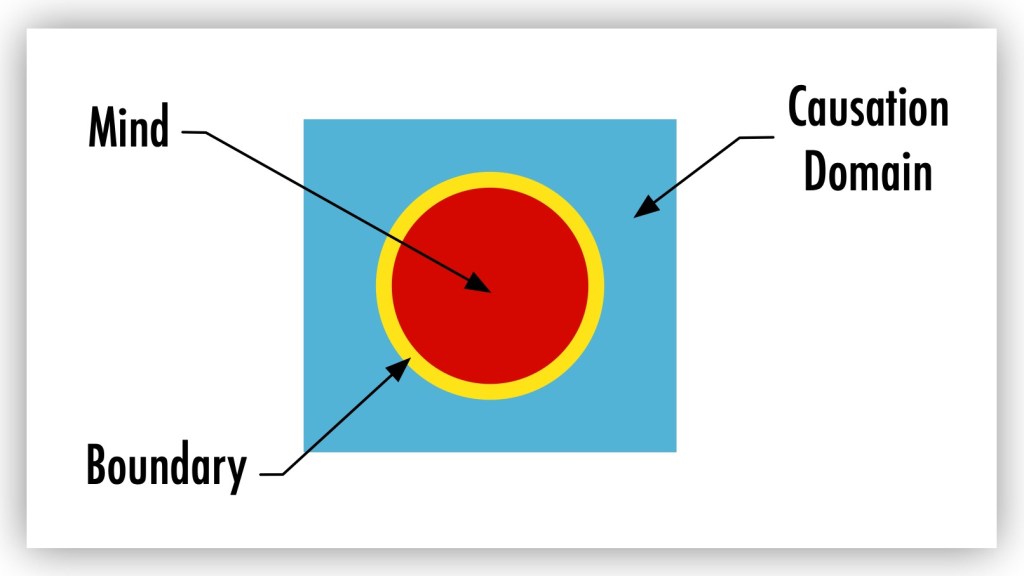
- The Blue Space is the Causation Domain, where processes interact independently of interpretation. This is where pure happening occurs.
- Red Space is part of the Interpretative Domain. Here it represents the internal world of the mind, where meaning is produced and handled.
- The Yellow Boundary marks the interface where causation triggers interpretation, and where interpretation feeds behavior back into the external world.
We experience the body through the mind. What you feel as your body comes together inside you, gathered through many moments of awareness and reflected in the face you recognize in the mirror, all held as a steady sense of being yourself. When you look at your hand, what you see and feel comes from how the mind responds to the happenings that move through you across every scale.
The blindfold exists because the mind can only access the inside of its boundary.
1.3.4 Parallel Minds and Shared Causation
Each mind engages with the Blue Space while creating and maintaining its own Red Space, producing an individual meaning while interacting with a shared causal world.
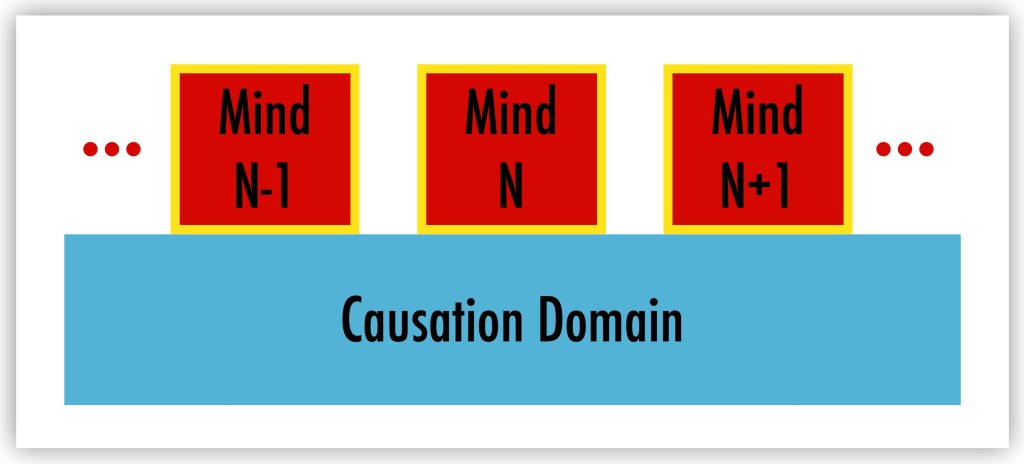
Figure 2 shows:
- Each Red Space builds its own internal experience.
- The Blue Space enables interaction but goes unobserved.
Two people may witness the same Blue Space event but create entirely different Red Space meanings.
When people interact, each responds according to their own internal logic. One person speaks, the other listens, and each creates meaning from the exchange independently. “Communication” happens through signals in the Blue Space. Meaning never travels between Red Spaces.
Agreement reflects alignment between independent Red Spaces. Disagreement shows approaches following different logic, each complete within its own framework.
With sustained interaction, approaches grow more aligned between minds, while each continues operating within its own Red Space.
1.3.5 Orthogonality of Domains
Orthogonality describes how causation and interpretation relate. The domains meet but operate on different axes, like perpendicular lines. They connect without becoming each other.
Figure 3 rotates the Red Space 90 degrees in relation to the Blue:

This rotation acknowledges that we never access happening. What the mind works with is a different reality altogether.
Even recognizing that an event occurred is a construction. Access to what happens must pass through interpretation. What we know of the world is what the mind builds.
This creates a loop. A signal from the Blue Space reaches the boundary, the mind responds, and from that response a world appears in Red Space. Action returns as decision becomes behavior that re-enters the Blue Space. The cycle continues.
Causation and interpretation move together while staying on separate axes. They influence each other without mixing.
1.3.6 What We Never Touch
Minds operate independently while engaging with a shared world. That world stays beyond reach.
Everything you experience belongs to the category of meaning. You hear someone call your name across a crowded room. You turn and see their face. You feel relief at recognizing them. You estimate how long it will take to reach them. All of this carries meaning.
Happening belongs to a different category entirely. The actual calling takes place in the Blue Space as happening. Your meaningful responses occur in your Red Space. The causal event remains inaccessible.
This explains why your experience feels so immediate. Your mind creates meaningful responses seamlessly. Images appear, sounds ring out, information gets recorded. The process works so well that it feels like direct contact with what’s happening.
The action continues independently while your mind builds meaning from the signals it receives. As long as your interpretations match up with what’s happening, they serve as reliable guides. Two fundamentally different categories connect without merging. Meaning responds to action, action triggers meaning, and neither becomes the other.
1.3.7 The Map and the Territory
The idea of map and territory typically reminds us that our representations aren’t the same as reality, that maps are incomplete or inaccurate versions of the territory. What’s consistently overlooked is that the map is something else altogether, made of a different kind of thing.
Consider an apple falling from a tree.
In the Causation Domain, processes unfold without pictures, without “apple,” without “tree,” just pure happening. In the Interpretative Domain, the mind transforms light into a round red form moving downward through green, and from that image infers an apple falling. The same holds whether you close your eyes and hear the thud or use an instrument to record its acceleration. Sight, sound, and measurement all belong to interpretation. Each produces a map of the event, but none delivers the event.
Because the inference feels so seamless, we take the image or measurement for the happening. The blindfold works here: the mind forgets it’s interpreting and convinces us we see causation.
The map and territory exist in different dimensions. The map represents meaning; the territory is happening. These belong to different kinds of things. Mixing them creates category errors. We ask meaning-questions of happening, and happening-questions of meaning.
Orthogonality means the two domains remain distinct while interacting continuously. “Seeing the apple fall” represents the mind’s construction rather than the phenomenon. The unexamined assumption that our observations deliver causation directly, when we only encounter our own constructions, leads to confusion and paradox.
Everything we’ve been examining has been interpretation. We live inside it so completely that it feels like contact with the outside.
The mind forgets this construction. What began as one response becomes the world, accepted as given rather than built. This work helps you notice the forgetting.
1.3.8 Bridging the Gap
Induction bridges Blue and Red Spaces. It’s how events in the world give rise to interpretation, and how interpretation produces new events. The two-way exchange allows experience to emerge without mixing the domains.
Signals from the Blue Space reach the boundary of a mind and induce internal responses. Light becomes color, waves become sound, and the mind’s Red Space produces these meaningful responses. Interpretation flows back into causation as thought becomes motion and decision becomes action. Behavior enters the Blue Space, interacts with other processes, and feeds back into the cycle. When minds communicate, each builds its own meaning independently.
Figure 4 illustrates how signals from the world induce interpretation within a mind.
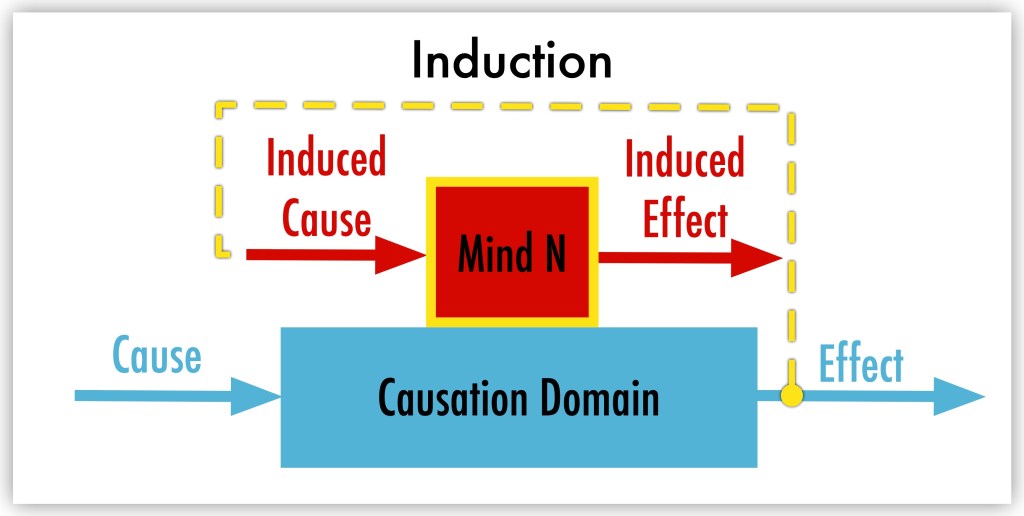
A causal event occurs, and the mind creates a usable interpretation of the signals within Red Space. That interpretation leads to behavior, which re-enters the world as a new causal process. Each event in Red Space comes through induction, and each action that returns to the Blue Space continues the cycle. Interpretation and causation remain orthogonal while staying continuously linked through this process.
1.4 Applications
The paradoxes and blindfold we examined earlier now make more sense.
1.4.1 Understanding the Red Veil of Interpretation
Plato’s Cave and The Matrix assume that experience is imposed from outside, that illusion is shared, and that freedom lies in discovering what was hidden behind it.
Natural Reality presents a different theory. Each mind builds its own version in parallel. From within that response, we create a world. The approach that works becomes familiar. What’s familiar becomes the environment.
Over the course of a life, we forget our own construction because we no longer need to reference it. The blindfold allows us to forge a world that works without needing to see the one it comes from.
The figures on Plato’s wall are interpretations, realities of a distinct kind, created on a separate axis through the mind’s construction process. The same principle holds for The Matrix. What seems like external illusion is actually internal creation, happening automatically and invisibly within each mind.
Where Plato imagined a single wall, fire, and path to truth, Natural Reality sees parallel minds engaging with a common causal world.
1.4.2 Resolving Paradoxes
The paradoxes from earlier now make more sense.
The chicken and egg question treats our idea of causation as if it were causation. We picture chickens producing eggs, and eggs producing chickens, in a line. That’s our interpretation of how reproduction works, built from what we’ve observed. The actual biological process operates through feedback loops where chickens and eggs generate each other continuously. The paradox comes from taking our mental picture for the thing.
The Ship of Theseus makes the same mistake. We have an idea of what makes something “the same ship” and treat that idea as a property that must exist somewhere in the planks. Identity is meaning we create, not something residing in the wood. One interpretation focuses on functional continuity. Another focuses on material continuity. Both are valid ways of building meaning from the situation. The paradox comes from treating our interpretation as if it were a fact about the ship.
We build interpretations of happening, then forget we built them. We treat the map as the territory. Meaning and happening belong to different categories entirely. When we mix them up, paradoxes emerge.
The paradoxes mark boundaries. They show where we’ve taken our interpretation of the outside and mistaken it for the outside.
1.4.3 Navigating Dissonance
Minds operate in parallel. In daily life, that difference often goes unnoticed. We speak, act, and respond as though others interpret the world in similar ways. Generally, the assumption holds just enough to coordinate. When it fails, we feel it.
This happens when one person can’t grasp how another reached their conclusion. Each person builds meaning from the same event using their own approach. When these follow different logic, the resulting interpretations can seem impossible to reconcile. One person sees offense, another sees humor, and neither can walk the path the other followed.
We expect other minds to work like ours. When someone acts in ways our model can’t explain, we face a loop like any paradox. Dissonance happens when that gap involves other people.
The interaction feels natural, so we expect some meaning to be shared. When it’s not, the response can seem unreasonable or incomprehensible.
Dissonance provides clarity. It shows where minds diverge and demonstrates that each response is complete on its own terms. Our way of seeing operates alongside other ways that work just as well.
1.4.4 The Emperor’s New Clothes
If every human mind is building its own unique version of reality, how do we explain the patterns we see in human lives?
Even with different cultures, languages, and experiences, people go through remarkably similar changes. Struggles with identity, grief, regret, the search for meaning. Jung called these patterns archetypes and thought they came from a shared layer of the psyche, a sort of collective imagination passed down across generations.
Human minds operate with comparable underlying mechanisms while creating different content.
The Hero’s story works the same way. A life reaches a crisis, hits an impasse, and begins again in a new form. We see it in people, and also in everything else that grows.
A caterpillar encounters a limit and reorganizes. It dissolves, reforms, and returns with new capacities. Transformation follows predictable patterns. We see the same story everywhere because it shows what emergence looks like from within.
The basic mechanism stays consistent. When contradiction arises, the mind searches. When resolution eludes us, it loops. When the loop holds long enough, our understanding adjusts. This response repeats because it works.
Because this method operates across billions of people and countless situations, familiar arcs appear. Different realities emerge, built through the same underlying mechanism.
Jung noticed real patterns. The similarity comes from human minds operating with comparable structures, handling love, fear, identity, and meaning, while filling those spaces differently. We each experience different versions of the same underlying emergence.
The illusion of shared meaning is like the tale of the emperor’s new clothes: we think we see the same thing when each mind is constructing its own reality.
1.5 Closing Remarks
Each morning, reality still arrives: the book, the bird’s song, the sunlight. But we understand that arrival differently now.
What feels direct and ready-made is your mind’s construction, built continuously from within. The experience that appears to deliver the external world instead only shows you your own Red Space, where meaning lives.
Every observation, every measurement, every certainty we hold exists within interpretation. We never step outside our Red Space to check our work against the original happening. Science, philosophy, art, and religion all operate through the same constraint: we build meaning from interactions we never directly access.
When we acknowledge orthogonality, the questions change. Instead of asking “Is this true?” we ask “Does this work?” Rather than seeking certainty, we appreciate what minds can build from within. We become less concerned with being right and more interested in being useful. We hold our interpretations lightly while working with them seriously.
We live entirely within Red Space while causation continues in the Blue Space. Understanding this changes how we engage with the world.
Chapter 2 follows a single mind as it builds experience, creating the thoughts you think you’re thinking.
 The Abstractionist’s Papers