Space and Time
We’ve described causation without space or time.
Induction propagates influence between processes. Impedance determines how easily rules apply. Selection determines what persists. None of it required distance or duration.
This wasn’t accidental. Space and time are interpretative tools we use to organize causal relationships. They belong to Red Space. The Blue Space operates without them.
This chapter identifies the axis we move along when distance and duration drop away. We resolve paradoxes that have persisted for millennia. And we explore what changes when you can engage with reality both ways: sequentially and continuously.
Contents
11.1 Traditional Perspectives
11.2 Classical Paradoxes
11.2.1 Zeno’s Paradox
11.2.2 The Twin Paradox
11.2.3 What Paradoxes Teach Us
11.3 A Natural Interpretation
11.3.1 Space as a Field
11.3.2 Time as an Impedance
11.3.3 What Déjà Vu Reveals
11.3.4 Rethinking Space and Time
11.3.5 Resolving Classical Paradoxes
11.3.6 The Timeless Universe
11.4 Living Without Time
11.4.1 Little Now
11.4.2 Big Now
11.4.3 Moving Between Perspectives
11.5 Revisiting Death
11.6 Closing Remarks
11.1 Traditional Perspectives
Space is the container where everything happens. Time is the flow that moves us forward. One provides the background that holds things in place, the other provides the sequence moving events from past to future.
This is how we naturally experience the world. Organizing experience this way helps us navigate, bringing order and predictability. But it forces rigid interpretations on fluid processes.
Scientific models formalized these intuitions. Newtonian mechanics treated space as an absolute container, a stable backdrop where objects move and interact. Time was a uniform progression, independent of events, advancing evenly regardless of movement or change. We speak as if time itself drives what happens, healing wounds and aging bodies.
Einstein’s theory of relativity changed how we understand space and time. They form a single continuum that bends and stretches in response to mass and motion. Time slows near massive objects and at high velocities, while space curves around them.
Yet even relativity treated spacetime as fundamental reality, the arena where interactions occur. By treating objects as isolated entities and moments as discrete steps, we place boundaries around continuous interaction. That fragmentation leads to contradictions.
We ask “how long until this changes?” as if time creates change. “Where is it?” as if space contains things. These questions assume space and time drive what happens, creating contradictions when we try to reconcile them with observations. Time measures change through chosen references. Space maps relationships through coordinate systems. Both serve as interpretive tools while influence propagates by induction.
The distinction resolves the contradictions. Space and time organize interpretation. Causation propagates through the Blue Space. Understanding both lets us work with reality as it operates.
11.2 Classical Paradoxes
Paradoxes reveal where our models break down. When we treat space and time as fixed properties of reality, contradictions pile up at the edges.
11.2.1 Zeno’s Paradox
Around 450 BCE, the Greek philosopher Zeno posed a puzzle that stumped thinkers for centuries. He argued that motion is impossible. Here’s why: to cross a room, you must first reach the halfway point. But to reach that halfway point, you must first reach the quarter point. Before that, the eighth point. Since you can divide any distance infinitely, you’d have to complete an infinite number of steps. Motion should never finish.
Yet obviously we do cross rooms. The runner does reach the finish line.
Calculus eventually offered a mathematical resolution, showing that an infinite series can sum to a finite distance. But this mathematical fix doesn’t explain what space actually is or why the paradox felt so compelling in the first place.
11.2.2 The Twin Paradox
Einstein’s relativity created its own puzzle. Imagine twins, one who stays on Earth and one who travels into space at near light speed. When the traveling twin returns, she’s aged less than her Earth-bound sibling. This has been measured with atomic clocks on airplanes.
Relativity explains this with “time dilation,” but that explanation assumes time is fundamental. The paradox raises a bigger question: what is time, if it doesn’t apply equally to both twins?
11.2.3 What Paradoxes Teach Us
The paradoxes point to what mathematical solutions can’t address. They show up when we treat space and time as fundamental properties of reality rather than as interpretive tools.
Zeno’s paradox assumes space consists of discrete points. The twin paradox assumes time flows universally. Both assumptions create contradictions because they mistake our maps for the territory itself.
Resolving these paradoxes requires recognizing what space and time actually are: constructs we use to organize experience, not features of causation.
11.3 A Natural Interpretation
When we write F=ma or E=mc², we map patterns of interaction in the Blue Space using tools in Red Space. Mass, energy, force, time are all interpretive constructs.
Causation operates continuously in the Blue Space. Time measures interpretive engagement with what’s happening. Happenings are always present, ongoing, continuous. Space describes relationships between them.
The sections that follow show how this reinterpretation works.
11.3.1 Space as a Field
Space appears to hold everything in place, surrounding us and giving form to objects. We think of position and distance as part of how the world is arranged.
But what exactly do we perceive? We see objects that move and interact. We feel resistance and pressure. The space between them is inferred. Your mind supplies it automatically, filling in gaps to create connection.
The interpretation is practical. It lets us move, measure, and coordinate. Puzzles reveal its limits. Zeno’s paradox questions how motion can reach a destination if space is infinitely divisible.
Natural Reality treats space as a field, a model describing interaction potential between entities. A field maps how processes can engage with each other.
Electric fields offer a helpful analogy. When a battery powers a circuit, charge flows through the system. The field describes how the flow responds to potential and resistance. The field maps the relationships that allow flow to happen.
Space works the same way. Distance measures how readily processes exchange influence. What we interpret as solidity results from stable internal harmonization. The field maps these relationships.
We experience space primarily through gravity. Our processes respond to gravitational influence, as do the processes around us. Because we exist as processes responding to gravity, qualities like distance and solidity feel natural. Our perception is tuned to them.
Other forms of engagement exist beyond gravity, operating through mechanisms our senses detect differently. Space appears physical and external because gravity is what we experience most directly.
Electromagnetic phenomena work differently. Light must propagate across the separation to reach the interpretation boundary. You call your parents across the country. The signal travels the distance between you before induction occurs at the boundary.
Gravitational relationships work through a different mechanism. When the apple falls, it responds to the causal configuration the Earth creates, not to a signal traveling from Earth to apple. The relationship is continuous and mutual. Both masses participate in a shared causal configuration that determines how they interact. No signal crosses between them because they’re already connected through the causal structure itself. Distance measures how this configuration manifests spatially, but the causal connection operates independent of that measurement.
Space is the field we use to map these relationships. Distance is the measurement within that field.
11.3.2 Time as an Impedance
Time measures how we engage with causal processes. A clock doesn’t make anything happen. It tracks change by comparing it to a chosen reference: Earth’s rotation, atomic oscillations, pendulum swings.
The measurement serves us well. We coordinate meetings, track duration, sequence events. But the tracking is separate from the causation it measures.
An electrical circuit offers a useful analogy:
V = R x I
Voltage represents potential. Current is flow. Resistance regulates between them, constraining how much current flows for a given voltage or how much voltage accumulates under a given current.
Space and time work the same way:
S = T x V
Space functions as potential, velocity as flow. Time regulates between them, constraining velocity for a given distance or distance covered at a given velocity.
Here’s what this means practically. Say you want to travel 100 miles. At 50 mph, that takes 2 hours. At 100 mph, it takes 1 hour. Space (100 miles) stays constant. Velocity increases, time decreases.
The formula shows the constraint: you can’t have high velocity over large distances without time accumulating, or conversely, you can’t cover distance without either velocity or time. Time regulates the relationship between distance and motion, just as resistance regulates the relationship between voltage and current.
Time functions as both impedance and admittance. As impedance: when time runs out, participation ends. As admittance: without time, there’s no participation to measure.
11.3.3 What Déjà Vu Reveals
Déjà vu creates a peculiar sensation: this moment feels like it happened before, but there’s no memory to match it and no clear cause. It passes quickly, leaving only a lingering sense of recognition without any way to place when or where.
Your mind expects events to arrive in sequence, and most of the time they do. One thing follows another, creating a directional flow to experience. Déjà vu happens when that sequencing mechanism fails. The moment feels repeated even though nothing has actually repeated. Causation continues flowing in the Blue Space, but your interpretative model in Red Space momentarily loses its ability to assign temporal order.
The phenomenon reveals how time works. The sequence you experience isn’t supplied by the external world. It’s part of your internal process for making causality usable. When that process pauses, the sequence disappears because nothing else creates it. Yet experience continues. Sound, color, movement all stay present. What vanishes is the sense of temporal order.
Our experience of time depends on the mind’s ability to place events in sequence. Causation unfolds through interaction, creating relationships we interpret as temporal progression. The timeline belongs to Red Space. It’s a tool we build to organize what’s happening in the Blue Space.
11.3.4 Rethinking Space and Time
Space and time serve as reference systems that help us interpret and organize interactions. We use space to describe relationships between entities and time to track participation in those relationships against a chosen reference.
Historically, that reference has been Earth’s rotation and orbit, giving us a shared system for synchronizing activities. A train’s scheduled departure and a factory shift change are coordinated using the same temporal framework. The shared reference lets distinct events be synchronized, but doesn’t mean time causes what happens.
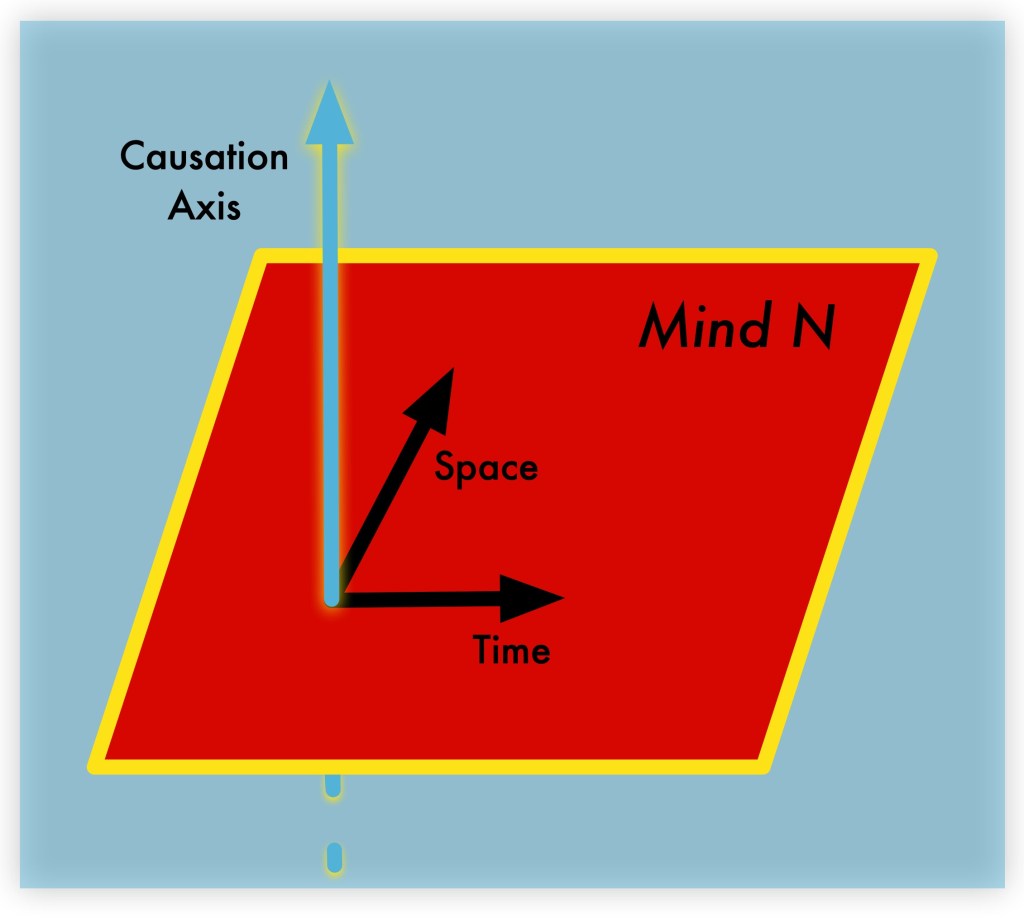
The Causation Axis of Figure 34 shows how influence flows beyond interpretative references. Causal impedance defines the degree to which interactions persist or resist transformation along this axis.
The blindfold restricts us to Red Space. We can’t see the causation axis operating in the Blue Space. We measure participation using time and map relationships using space. Because the underlying causation remains hidden from view, we attribute causal power to our measurements themselves. Time appears to drive change when it’s simply our tool for making sense of change we can’t observe.
11.3.5 Resolving Classical Paradoxes
Recognizing space and time as interpretive constructs resolves paradoxes that have puzzled thinkers for millennia.
Zeno’s Paradox
Zeno argued that motion requires passing through an infinite number of halfway points. The argument creates problems when space consists of discrete points that must be crossed individually.
Causation is continuous. Motion is uninterrupted participation in causal flow. The paradox happens because we mentally divide space into discrete points or still frames. In reality, there’s no sequence of discrete steps, only continuous engagement.
Calculus offers a mathematical fix by summing an infinite series to a finite limit, but the true resolution is conceptual: motion doesn’t happen in isolated increments. It’s continuous causation, and time is simply how we measure our engagement with it.
The Twin Paradox
Time measures how a process participates in interaction. It reflects how a rule is enforced with respect to a reference. That reference must also participate under the same rules. If it moves with different impedance to those rules, it’s no longer a valid reference.
The twin on Earth continues to interact under a stable pattern of enforcement. The traveling twin engages differently. The rules under which participation is measured have changed. The contradiction comes from trying to apply a reference from one pattern of interaction to another where that reference no longer applies.
Why does velocity change causal impedance? Because velocity represents one way a process engages with the causal configuration around it. At rest relative to Earth, your biological, chemical, and interpretive processes all operate under similar impedance relationships. When you accelerate to near light speed, you’re changing how every process within you participates in causation. The rules governing interaction haven’t changed, but your impedance to those rules has. This is why time dilation occurs: not because time itself slows, but because every process measuring time (atomic oscillations, biological rhythms, conscious experience) encounters different impedance at high velocity.
At high velocity, causal impedance changes for every process within the traveler. Biological processes slow. Chemical reactions alter. Interpretive processes adjust. Participation changes at every level. As the traveler nears the speed of light, the impedance becomes so different that maintaining organized form becomes difficult. The thought experiment asks us to imagine the traveler still holds form and still counts as a twin, but this requires glossing over the fundamental changes in how processes participate in causation.
The thought experiment makes an interpretive allowance that lets us see where the paradox lives: in the attempt to measure across interactions that no longer share a usable reference.
11.3.6 The Timeless Universe
If time is an interpretative construct, how does anything work?
Throughout Part III, we described causation without temporal frameworks. Induction propagates influence between processes. Impedance relationships determine how processes interact. Causation operates through these mechanisms while we measure participation using time.
Consider what happens when you receive light. Electromagnetic propagation occurs in the Blue Space through causal relationships we can’t directly observe. When we say light takes 8 minutes to reach Earth from the sun, we’re measuring the relationship between electromagnetic propagation extent and our reference cycles. Both occur in the Blue Space. We interpret their relationship temporally.
We don’t have direct access to the Blue Space. Time measures our engagement with causation. It doesn’t drive what happens.
Recognizing this doesn’t eliminate the usefulness of temporal measurement. Clocks coordinate meetings. Calendars organize projects. Schedules synchronize society. Understanding time as interpretive rather than fundamental changes how we think about these tools. We rely on temporal frameworks because we can’t directly access the causal relationships they help us organize.
A timeless universe means the Blue Space operates through continuous causal interaction, not temporal progression. When water flows downhill, gravity pulls, terrain channels, momentum carries. These processes interact continuously.
We measure that flow using time (seconds elapsed, distance per hour), but the measurement doesn’t drive the flow.
The water doesn’t wait for our clock to tick before moving. Time tracks our engagement with these processes, organizing what we observe into sequences we can work with. Red Space builds temporal frameworks to make Blue Space causation interpretable and workable.
11.4 Living Without Time
What does a timeless universe mean for how we live?
We can’t abandon time entirely. Clocks coordinate meetings. Calendars organize projects. Schedules keep society functioning. Recognizing these as measurement tools rather than fundamental reality changes how we engage with life.
You have two ways of seeing. Little Now treats moments as distinct and sequential, useful for immediate coordination and practical navigation. Big Now recognizes continuous causation, revealing patterns and relationships that sequential thinking obscures. Both serve different purposes. Knowing which perspective you’re using makes the difference.
11.4.1 Little Now
Little Now is the default perspective, where events feel like distinct moments arranged in sequence. This view helps structure daily life and support immediate decisions. Each choice looks like a response to the present, separate from past decisions and future consequences.
This perspective works well for practical matters: scheduling and reacting to immediate needs. It lets you focus on what’s happening without getting overwhelmed. But treating moments as isolated makes it harder to see how they connect.
A financial choice might look like a single transaction, whether to make a purchase or save money, without considering how repeated decisions influence financial stability. A conversation might feel isolated, unrelated to previous exchanges, even though communication builds or erodes relationships over time. Someone forming a habit might experience frustration at inconsistent progress, unaware that each attempt contributes to whether change happens.
The sequential view offers a workable way to navigate while obscuring the continuous causation underneath. Choices that look independent are reinforcing cycles that affect what comes next.
11.4.2 Big Now
Big Now sees causation as continuous. Your financial situation is the configuration of causal relationships you’re participating in now. Every spending pattern, every saving habit, every financial commitment is active causation in this moment.
In Little Now, each expense looks independent, judged based on immediate needs. A purchase here, a subscription there, each decision standing alone. As purchases accumulate, financial conditions change, but the pattern stays invisible. In Big Now, spending becomes visible as a continuous process. Each choice reinforces or redirects the causal configuration determining financial stability.
Relationships work the same way. In Little Now, a single argument may look isolated, disconnected from previous or future exchanges. Yet when distance or miscommunication repeats, trust and connection respond to those cycles. In Big Now, each interaction is part of continuous exchange. You see what’s being reinforced and what’s being eroded.
In Little Now, a drink after work looks like a single decision. The next day, another drink looks unrelated. Through repetition, this becomes part of daily life, but the reinforcing cycle stays hidden. In Big Now, the cycle becomes visible. Each decision contributes to the causal configuration determining whether the habit strengthens or weakens.
When we’re young, we participate in constant happening. Everything is new and must be learned, with little accumulated meaning within to process. We do everything at once, and time moves slowly. As we age, we participate less in happening and spend more energy producing and handling meaning. Time speeds up because we’re processing internal stuff rather than engaging with the external world.
Consider sending an important email. You might spend two days thinking about it, replaying scenarios, refining wording, managing emotions, and predicting outcomes. The actual sending takes a single click. Most of the activity lives inside, in your world of meaning. Because the participation is internal, with no external reference point to measure against, there’s nothing to anchor the sense of time passing.
That’s much of adult life. It unfolds mostly within, yet feels like it’s happening outside unless we’re paying attention.
Big Now shows us what Little Now obscures: choices that look independent are part of reinforcing cycles. Your financial decisions, relationship interactions, and daily habits all operate as continuous causation influencing what happens next.
This perspective changes how you work with reality. Instead of reacting to isolated moments, you recognize the causal conditions present and how your choices influence those conditions.
11.4.3 Moving Between Perspectives
Both Little Now and Big Now serve different purposes. Little Now provides coordination and responsiveness. Big Now reveals how causation operates continuously.
Change happens through practice. When making decisions, pause and ask: what causal configuration am I participating in? A spending choice isn’t just today’s transaction. It reinforces or redirects financial patterns already active. A conversation isn’t just this exchange. It contributes to ongoing relationship dynamics. Each choice either strengthens existing patterns or redirects them.
Using both perspectives brings clarity. Little Now coordinates practical matters: meetings, deadlines, immediate needs. Big Now reveals causal patterns: how choices compound, where cycles reinforce themselves, what trajectories you’re creating through repeated action. Life operates as interconnected causation, not isolated events in sequence. Seeing causation as continuous lets you make decisions that align with ongoing patterns rather than reacting to surface conditions.
When you see causation as continuous rather than segmented, patterns become easier to spot, adaptability increases, and choices take on greater significance. Reality becomes something you create through participation rather than something that happens to you across a timeline.
11.5 Revisiting Death
If time is interpretative, what is death?
In Little Now, death ends your timeline. The experience stops, and that loss feels absolute.
In Big Now, the picture is different. Every process has two aspects: one creates your experience through processes organizing together to produce interpretation. The other is your participation in causation, the effects you create through action.
Death ends the organization that produces your sense of being here now. The processes that held together stop holding together. But those effects persist. Every action creates effects that propagate through induction and keep operating in the Blue Space.
This changes what we’ve lost. When someone dies, we feel we’ve lost direct access to them. But we never had direct access, even when they were alive. When they stood in front of you, you experienced influence: light reflecting from them, air pressure waves reaching you, their touch on your arm. Your Red Space interpreted that influence as “being with them.”
After death, that influence remains active in you. How they affected your thinking, the patterns in how you understand things, the relationships they built all continue operating. The mode of presence was always indirect, and death doesn’t change that.
The distinction changes what death means. In Little Now, death ends everything. In Big Now, death ends the interpretive organization while causal influence continues propagating.
11.6 Closing Remarks
Space and time are interpretative constructs, tools we use to organize what happens. They help with navigation and coordination, but they’re not fundamental features of reality.
This chapter resolved paradoxes that have persisted for millennia. Zeno’s runner reaches the finish line because motion is continuous flow in the Blue Space. Twins age differently because time measures each twin’s engagement with causal rules using different references. These paradoxes dissolve when we recognize space and time as measurement tools.
You have two ways of engaging with reality. Little Now treats moments as distinct and sequential, useful for immediate coordination. Big Now recognizes continuous causation, revealing patterns and relationships that sequential thinking obscures. Knowing which perspective you’re using changes how you participate.
Distance measures how easily processes can interact physically. Duration measures how we track engagement with causation. Death ends the organization that creates experience while causal effects continue propagating. Understanding space and time as interpretive tools changes how we think about limits, relationships, and change.
The Blue Space operates through continuous causation. Red Space creates frameworks to interpret that causation. Chapter 12 explores what becomes possible when we live with both in view.
 The Abstractionist’s Papers