What’s Next
Natural Reality has grown into a set of practices, technologies, and ways of engaging with our minds and the world. Ideas that were once private are now being tested and applied publicly. This chapter outlines what that looks like and where it may go.
Much of this began with a promise:
“If the puppets realize they’re toys, they’ll try to escape the model.”
— Nimbin and The Abstractionist.
Based on a letter I wrote to my kids years ago:
“Good News! My General Theory of Reality will give you an understanding of how every environment works, and it serves as a guide for the amelioration of the human condition. (It also reconciles quantum physics with relativity using the Principle of Causation Incoherence.) I’m coming home to share this with you.”
— The (Un)happiness Letter (2017).
That promise has been fulfilled.
The Abstractionist’s Papers is the orderly version of what happened between those two stories. It traces an arc of transformation, a natural progression that began with a question, uncovered the hidden mechanics of paradox, and led to a framework for understanding reality.
The Abstractionist Movement is still in its early stages.
How far it goes depends on selection. What we’ve seen is consistent with the model: a quiet induction phase, slow and mostly invisible, moving toward something nonlinear.
Natural Reality works. Its recursiveness is unmistakable. This is a body of ideas about emergence that itself emerged and now helps others do the same.
Contents
13.1 The Abstractionist’s Papers
13.2 Opera Glasses
13.3 Video Games
13.4 At Home
13.4.1 Never Late, Always On Time
13.4.2 A Hidden Lesson
13.4.3 Two Worlds, One Sticker Book
13.5 There is No Defect
13.6 Unknowns, Unknown Unknowns, and Unknowables
13.7 The Abstractionist Movement
13.8 Closing Remarks
13.1 The Abstractionist’s Papers
The Abstractionist’s Papers was written over years of sustained observation and iteration. The work is a record of Incoherence: original in form, constructed without reference to existing theories, and designed to resolve real problems.
The Incoherence placed here may sit unnoticed until it’s needed. When our models no longer explain what we experience, we’ll need new tools. This book is one of them, produced through the kind of change it now supports.
Everything in this book was developed from first principles, guided by engagement with paradox and by comparing resolution across different contexts. The result is a usable framework for Natural Reality, tested through selection. This is both a record of emergence and a tool for others to use.
Today more than eight billion human beings interpret the world at once. Each operates within their own Red Space. Most believe they share at least some aspect of the same abstract reality. That belief will break when individuals learn to see each other.
13.2 Opera Glasses
In Nimbin and The Abstractionist, Opera Glasses were first imagined as a way to look beyond interpretation, to pierce the red veil of perception and engage more deliberately with the Causation Domain. Through technology, that vision is becoming real.
U.S. Patent Application No. 18/092,317, filed on January 1, 2023, describes an augmented reality (AR) system designed to display Natural Spaces, layers that exist but stay unseen. This patent application has been dedicated to the public. If the technology is developed, it will belong to all of us.
Conventional AR overlays virtual objects onto the real world. This system provides modeled perception of the Causation Domain, making causal flows, emergent dynamics, and underlying interactions visible.
The blindfold stays, but these glasses offer a way to counter its effects. By allowing users to engage directly with Natural Reality, this technology bypasses gradual study, turning theoretical concepts into direct experience. Instead of reading about Natural Spaces, users interact with them in biological, physical, and abstract layers.
The application describes:
- The visualization of Natural Spaces: seeing how influence propagates through an environment.
- The recognition of Incoherence: where interpretations clash or fail to align.
- The mapping of internal models as perceptible, dynamic processes.
A person using the glasses may see a conversation through words and gestures but also through shifting cognitive states, fluctuating attention, and the harmonization (or divergence) of interpretations. The system extends to interactions in nature, technology, business, and society.
The technology introduces new ways of understanding others by observing actions while perceiving elements of internal states. It opens possibilities for alignment and even productive dissonance when necessary. The overlays allow people to refine their interpretations in real time, reducing misunderstandings or amplifying creative divergence.
The goal is developing new awareness, not maintaining reliance on the glasses, just as Nimbin, by the end of the story, no longer needed them. The tool serves as an entry point. With practice, users internalize these expanded perceptions.
What began as fiction is now entering our lives.
13.3 Video Games
Human experience is often compared to a game, one where each person plays by their own set of rules, unaware that others may be in entirely different games.
U.S. Patent Application No. 61/665,875 filed on February 28, 2023 describes the use of multiplayer sessions between players of different video game titles to promote awareness and encourage the practice of holding space.
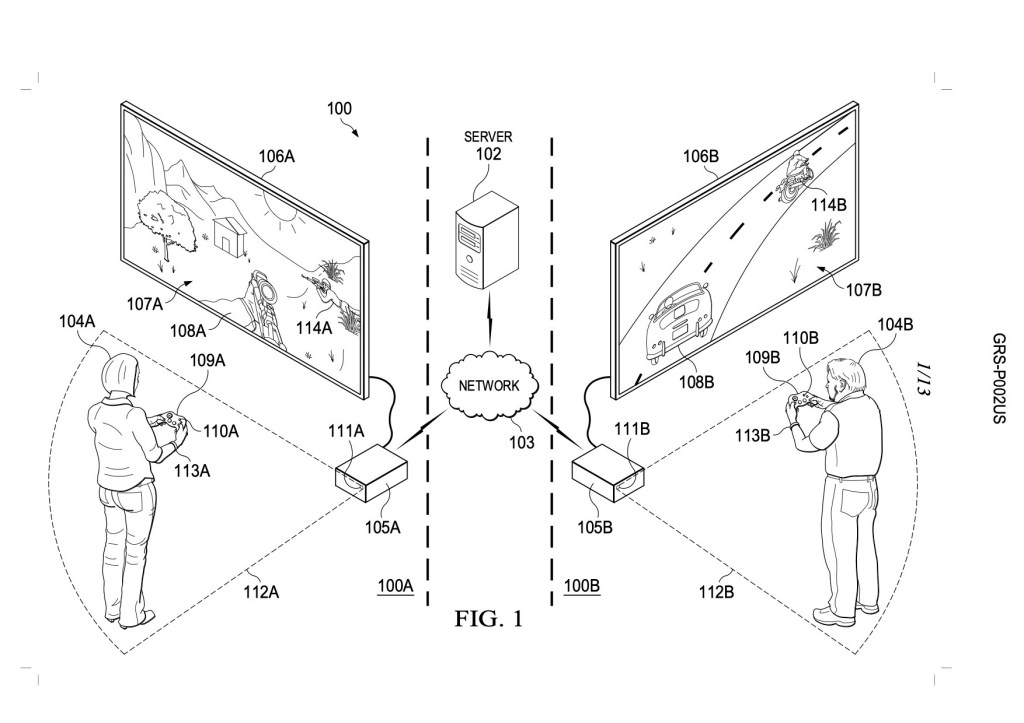
Every individual operates within their own mind, an interpretative space that determines how they experience the world. Each mind functions like a unique video game title, with its own mechanics and constraints. A person immersed in a strategy game approaches life through long-term planning, while another, living in a fast-paced action game, prioritizes quick decisions. The problem arises when different players assume they’re in the same game, leading to misalignment, frustration, and misunderstanding.
The Reality Translation Engine resolves this by acting as an adaptive interface between minds. Instead of forcing one reality to conform to another, it allows meaningful exchanges to take place between them. A strategic thinker may provide long-term resources, which the action-oriented player experiences as an immediate power boost. The exchange stays meaningful within both realities, preserving the integrity of each while enabling collaboration.
The Reality Translation Engine represents a new tool for harmonizing exchanges at every level. Education, therapy, business, and social dynamics all follow the same principles. The ability to translate between realities removes artificial barriers, allowing individuals to engage across different cognitive and interpretative contexts.
The system offers multiple modes of engagement:
- Blindfolded Mode assumes a single shared game, as many do today.
- Sharing Mode provides glimpses into a representation of another’s mind and how their world works.
- Holding Space Mode enables deep observation without interference, fostering understanding.
- Harmonization Mode allows realities to align dynamically, supporting collaboration or other goals.
By making these mechanisms visible and actionable, the technology provides a pathway toward more adaptive, fluid, and cooperative engagement.
Just as Nimbin’s Opera Glasses showed the unseen layers of perception, this system illuminates the hidden dynamics between human realities.
13.4 At Home
Natural Reality is meant to be lived. It shows up when we engage with each other, when we hold space for different perspectives, when we understand that we all operate from parallel realities.
13.4.1 Never Late, Always On Time
By the time my son was nine, he had already noticed that he was never late for school anymore.
One morning, over breakfast, he said, “Mom used to say it’s not fair. She said we were never late because you live close to school. But with her, we were always late.”
I paused. “She’s not wrong about what she felt. But the reason, the story about fairness and distance, that’s what we call a why. And a why gives you a because.”
The third piggy built it while others were playing, not just one afternoon but day after day, season after season. He missed games, skipped naps, made mistakes. There were days he didn’t feel like building at all, and even when he did, things went wrong. Walls collapsed, plumbing exploded. He had to start over again and again until he began to understand how things worked. That house didn’t come together because he knew what to do. It came together because he was willing to learn. Even now, it only stands because he keeps it that way, showing up, fixing what breaks, making quiet adjustments no one sees. That work was, and still is, the how.
To build anything worthwhile takes the kind of quiet effort that doesn’t show up in stories, done consistently and at a big cost.
The first piggy never saw that. Her story made perfect sense to her. And stories, when they feel complete, make it hard to see anything else.
So she stayed in someone else’s house.
The third piggy didn’t argue. He just let her in.
My son sat with it.
“So the first piggy didn’t ask how?”
“No. She was sure she already understood.”
He nodded, then went to brush his teeth.
We weren’t going to be late.
13.4.2 A Hidden Lesson
My son is at the table, ten years old now, arranging stickers, characters, obstacles, a scene before drawing the world around them.
I watch for a moment. “Why don’t you tell a story about this?”
He says, “The bear can jump over this rock and be eaten by the carnivorous plant, or it can climb the rock and go around it.”
I nod. “But where’s the story?”
He looks surprised. “That is the story!”
I hold the page upright, showing him a top-down view of his project.
“Right now, we’re looking at a flat world. There’s nothing wrong with that. It’s what our minds do. Let me show you a different way to see.”
I lay the sticker-covered paper flat on the table.
“Let’s look at it sideways.”
“There are two different layers when we look at it from the side. First, there’s the realm of happening.” I point at the page. “This is where all the rules live. It tells us what happens if the bear jumps over the rock and gets eaten by the plant, or not. That’s the world you described to me.”
“But that’s only part of it.”
I lift the page to his eye level. “When the paper is flat, the realm of happening disappears. This is how our minds actually present what we see: the world of ‘if this, then that’ stays hidden.”
“So where does the story go?” he asks.
“A story lives in the realm of meaning. It sits above the world of happening. It floats above the paper. These two layers are very different. The top layer isn’t drawn or fixed to the bottom layer. It moves with it, but stays independent. Sometimes they can even contradict each other.”
“Like what?”
“Well, we have to create the world of meaning.”
Then, after an awkwardly long pause, “Maybe the bear is on a quest to find an apple tree, and the carnivorous plant is trying to stop it because it’s the guardian of a magical forest.”
Another pause.
“Or… maybe the plant is lonely. It’s never seen a bear before. So instead of eating it, it lets the bear pass. And to show thanks, the bear carries the plant to the top of the mountain so it can finally see what the bear sees, just like in the song.”
I turn the page back upright. “The point is, this is how we were looking at it before, everything as one jumbled world.” Then I turn it sideways again. “Now we see there are two.”
I tell him that seeing things this way gives him more ideas to play with.
But I don’t say orthogonality.
No need to.
13.4.3 Two Worlds, One Sticker Book
How did we end up with a sticker book full of bears and carnivorous plants, you might ask?
Earlier that day, we were in the grocery store when he spotted it.
“Can we get this?” he asked.
“No,” I said.
“Why not?”
“If we get it, we’ll have a lot of stickers to play with,” he insisted, as if the answer were self-evident.
In his world, it was simple: a sticker book meant more stickers.
But my world, the world of the parent, spun a little differently.
“Do you know how a parent makes a decision like this?” I asked.
He shook his head.
“So you’re speaking to the version of me that lives in your mind, the one who sees the world the way you do. The real person making this decision isn’t in your head. They’re in their own. In my world, ‘more stickers’ isn’t a reason to buy stickers. I’m using different rules.”
Within the same underlying reality, his world was one of play. Mine was one of parenting logistics, balancing wants and needs, trying not to give too much or too little. Both were equally real within their own context.
“In my world,” I continued, “I see a cost. Do you? So I try to figure out the benefit. How long will this keep you busy in a focused, productive way?”
He thought for a moment.
“Between two and four hours,” he said.
And that’s how we ended up with the sticker book, so my child could learn that other worlds matter.
These kinds of moments have become part of how we learn to hold space for each other. Across generations, the differences may seem obvious. The principle of parallelism doesn’t change with age.
The world we return to after all these stories isn’t just about the differences. It’s about the magic that holds them all together.
13.5 There Is No Defect
It was probably not Einstein, but somebody once said there are only two ways to live: as though nothing is a miracle, or as though everything is. When we view the world through Natural Reality, we start to notice that the miracle was always there. We just hadn’t seen it this way before.
The sun touches our skin. Light, crossing vast distances, carries the signal from one side of the universe to another. A bird sings, and what we hear is the mind’s quiet work of turning signals into sound. We flip a switch, and in that instant, we’re linked to spinning turbines and a grid humming beneath the surface of daily life.
This is the magic: the way everything connects, how each action ripples through layers of difference and meaning is born. Even the simplest interaction carries echoes from the farthest places, connecting us to something bigger than any one moment.
As the Abstractionist once said,
“Incoherence… is what gives rise to the human condition you once wished upon the original puppets.”
— Nimbin and The Abstractionist
The differences between processes, the places where they don’t align perfectly, are incompleteness, not brokenness. Without Incoherence, there would be no space for new responses, no harmonization, no emergence.
Incompleteness is generative.
The Natural Reality key is ours to carry. It lets us find the extraordinary in what’s already here. The more we understand, the more we recognize what was always present.
Where we once might have pursued coherence, we now seek harmonization. We still seek alignment, but we expect it to be dynamic, not fixed. The magic is in how processes find ways to work together despite their differences.
A word of caution: When we begin finding the miracle in everything, it’s easy to think we’ve found the final answer. That’s just another story the mind tells itself. There’s always a next question, a next gap, a next layer of understanding waiting.
The loop stays open.
13.6 Unknowns, Unknown Unknowns, and Unknowables
We don’t know what anything is. Everything we know points to something else. Words define other words. Models describe the behavior of other models. Even our most advanced theories rely on concepts inherited from earlier ones.
We haven’t found a bottom. From where we are, there may not be one.
There are unknowns: things we know we don’t know. The exact number of stars in the Andromeda galaxy. The cure for certain diseases. These gaps are visible. We can point at them.
There are unknown unknowns: things we don’t even know we don’t know. Before the discovery of DNA, no one was asking questions about genetic code. The questions themselves didn’t exist yet. These gaps show up only after breakthrough moments.
And there are unknowables: limits built into the system. Limits that come from being embedded inside the very thing we’re trying to understand. A mind trying to get a grip on itself. An observer trying to measure without interpreting. Some boundaries are permanent features of how knowledge works.
Knowledge is always relative, defined by context. Natural Reality describes how the process universe works while acknowledging the open-ended nature of ultimate reality. It offers a way to move through the world without needing final answers. It helps us act, communicate, and participate with more purpose.
Science, philosophy, and religion have all told us what the world is. That got us here and where we’ve gotten stuck. These aren’t just maps. They’re maps that forgot they’re maps. They don’t say “here’s how it works.” They say “this is reality.” When a system talks like that, it asks to be followed. In a world where no one knows, the moment someone presents their map as the territory, whether they call themselves a scientist, a philosopher, or even an Abstractionist, we can recognize they’re still interpreting from within their own Red Space.
Natural Reality is a map. An excellent one. It’s still just a map, born ready to be replaced by the next one.
Stay curious.
13.7 The Abstractionist Movement
The Abstractionist Movement is individual work with collective impact.
Each person who recognizes the distinction between causation and interpretation, who sees their Red Space as constructed rather than given and holds space for others operating from different internal worlds, is an Abstractionist.
The movement lives in recognition and practice.
When you catch yourself taking interpretations as reality, that’s the work. When you notice the gap between reaction and response, or when someone else’s behavior makes perfect sense within their Red Space even though it confuses you, that’s the work.
These small changes compound. The person who holds both domains engages differently. They work with the dynamics of the world instead of against it. They read influence, create productive meaning, and hold space for natural processes.
That change affects everyone they interact with.
A parent who understands parallel Red Spaces listens differently to their child. A manager who sees interpretation as construction asks better questions. A partner who recognizes the blindfold creates less unnecessary conflict. Each interaction is an opportunity for induction.
The world changes through individual minds learning to hold space for one another and live more purposefully.
The movement grows through practice. As tools and understanding get applied in everyday life (habits, work, relationships, education), direct engagement with reality spreads naturally. Love, art, and invention are all expressions of Incoherence.
There’s no final destination. The practice continues as long as minds keep building meaning from happening. What matters is whether the framework improves lives. Selection will determine how far it goes.
The book, Opera Glasses, the Reality Translation Engine, and the conversations at home all represent the early stages of something that belongs to everyone who uses it.
13.8 Closing Remarks
The sticker book conversations, the explanations about Why versus How, Opera Glasses that make the invisible visible, translation engines that bridge parallel realities: this chapter showed Natural Reality moving from theory into life.
The book began with a simple recognition: we don’t see reality directly. We build interpretations from signals. From there, it showed how causation and interpretation operate in orthogonal domains, how light and causal spaces work, how emergence happens through Incoherence, and why time measures change rather than causing it. Each piece built toward understanding how to participate in a universe we experience through constructed meaning.
Thirteen chapters built the map. But maps only matter to the extent they help us get where we want to go.
What began as something personal now belongs to everyone willing to see both worlds: the world of meaning we build and the world of happening that moves beneath it.
What we harmonize becomes.
 The Abstractionist’s Papers