How the Mind Works
“I need to call Sarah.”
The thought interrupts whatever you were doing. You don’t remember deciding to think it or recall the chain of associations that led here. It carries its own conviction.
Where did it come from? The construction process remains invisible. This happens constantly. We experience only the results, unaware of the mechanism beneath.
That mechanism works through contradiction. The mind creates gaps between interpretations: two ideas that don’t fit together, an expectation that doesn’t match what we see, a fact that defies belief.
Sometimes one interpretation gives way. Other times the mismatch persists and a loop begins.
When existing logic can’t resolve what clashes, the mind reorganizes under self-imposed pressure. What seemed impossible to reconcile forces new perspectives.
Everything you experience happens inside an internal model that presents itself as external reality. This chapter explores how that model works, its limits, and what changes when you see it for what it is.
Contents
2.1 Living Inside the Model
2.1.1 The Nature of Paradox
2.1.2 The Paradox Spectrum
2.2 Behind the Curtain
2.3 Learning Through Paradox
2.4 Between Blue and Red Spaces
2.4.1 Red on Red
2.4.2 The Illusion of Objective Truth
2.4.3 The Human Condition
2.5 Attaining Perspective
2.5.1 In Relationships
2.5.2 The Mind’s Eureka
2.6 Emergence of the Mind
2.6.1 How Change Happens
2.6.2 The Long Path
2.6.3 The Process of Becoming
2.7 Transcendence
2.8 Closing Remarks
2.1 Living Inside the Model
Your experience right now happens entirely within an internal model, a Red Space your mind produces. Reading these words, sitting where you are, aware of your surroundings: all of it exists in this model. The model is everything you can access: thoughts, sensations, memories, the feeling of being somewhere.
The model doesn’t announce itself. You take it to be the world. You don’t experience “my visual interpretation of text on a screen.” You experience text on a screen. The construction hides while the result feels direct and real.
It operates by detecting and resolving contradictions. Small ones adjust quickly. Larger ones create loops where you search for resolution. When existing logic can’t resolve the gap, reorganization occurs.
Learning happens through comparison of meaning. You compare what you expect with what you observe, both interpretations built within. When they don’t match, change begins. Paradox starts that process.
2.1.1 The Nature of Paradox
Paradox is usually treated as a logical oddity, a riddle that resists resolution. In Natural Reality, it works differently.
Paradox is the ordinary condition of a mind at work.
A paradox appears whenever there’s a gap between what you expect and what you encounter.
This happens around the clock.
Most paradoxes close immediately. The model adjusts a reference or reinterprets a cue without awareness.
Some persist. When the model can’t resolve the gap with what it has, the contradiction lingers. The model then reorganizes because its current logic no longer supports what it’s trying to understand.
Some paradoxes return again and again. You can’t answer them, but you can’t let them go. These signal that the mind has reached its edge.
Every mind works by comparing what it expects with what it encounters. When these don’t match, paradox opens. You notice these mismatches and respond to them. Once you recognize that every sensation, belief, decision, and movement comes through this comparison, you see it everywhere.
2.1.2 The Paradox Spectrum
Paradoxes range across a spectrum.
Some resolve instantly without conscious awareness. You reach for a cup and your hand moves slightly too far. The adjustment happens before you notice.
Others make you pause. A light switch doesn’t work. Your mind searches for explanations. Is the bulb burned out? Did the breaker trip? The power might be off. The expectation adjusts, the logic recalculates, and the next move accounts for new information. From outside it looks like hesitation. Within the model a full comparison has taken place.
Some of the hardest ones involve identity. A husband believes working harder will strengthen his marriage. He takes on more hours, provides more security, manages more responsibilities. Yet his wife grows more distant. He keeps thinking more effort equals more connection. The belief touches his understanding of love, his whole sense of how relationships work. Questioning it doesn’t occur to him.
The spectrum shows how far the contradiction reaches. Automatic paradoxes resolve through immediate adjustment. Testable paradoxes resolve through new information. Identity paradoxes won’t resolve from within.
When paradoxes touch identity or belief, they carry emotional weight. The model keeps trying to close them with what it has, but what would resolve them is exactly what the blindfold conceals. These are the paradoxes that change us.
2.2 Behind the Curtain
You produce a Red Space and engage with happening through your internal model. This creates perception, guides response, and sustains a usable world.
The model doesn’t show itself as a construction. It is the world. Meaning arrives from outside, already built into what we see and hear. The mind doesn’t indicate that it’s interpreting. It simply experiences.
The blindfold creates this effect.
The model stays satisfied as long as its expectations are met. When the world behaves in ways the model can’t predict or explain, a mismatch opens. To resolve the paradox, the model reorganizes.
Figure 5 shows that process.

- Interpretation creates internal experience. It produces sensation, perception, concept, memory, and thought. Each builds in response to signals from the world or to other interpretations within the model. The signals don’t carry meaning. They induce it. What interpretation produces gets compared against expectations.
- Expectation is what the mind assumes will happen or has happened. It contains predictions about what comes next and assumptions about past events. Expectations guide behavior and influence how new information gets interpreted.
- Logic evaluates mismatches between observations and expectations. It determines what kind of contradiction has opened and what type of response might resolve it. This is how the model reasons through problems and decides what to do next.
- Perspective determines the model’s viewpoint and what gets attention. It sets which aspects of experience matter most and how situations get framed. When perspective changes, the same information can produce entirely different meanings and possibilities.
Together these components respond to mismatches. In Red Space, interpretation builds observations. Expectation provides reference points. Logic evaluates the differences between them. Perspective sets the terms of operation. When perspective changes, the same signals yield new meanings.
You go to sleep with a problem on your mind. The next morning, the solution is there. We say the subconscious was working on it, treating conscious and subconscious as separate processors. But there’s no handoff. Part of the model kept running while sleep got much of your interpretations out of the way.
The mind compares and reorganizes continuously, whether you notice or not. The same mechanism that runs while you’re awake keeps running through the night.
The light switch from earlier is flipped and the mind expects the room to brighten, but nothing happens. Comparison happens between what was assumed and what occurred. The model searches for explanations: perhaps the bulb is out or the power is off. The expectation adjusts, the logic recalculates, and the next move accounts for this new information. From the outside it looks like hesitation. Within the model a full comparison has taken place.
The same activity handles larger contradictions.
Thira sees an apple fall and wonders why the Sun doesn’t also fall if gravity pulls everything downward. Her model can’t resolve this contradiction between what she observes about gravity and what she sees in the sky. Eventually she encounters Newton’s laws and learns that the Sun and Earth pull on each other, but the Sun’s much greater mass means the Earth orbits around it rather than both falling in the same direction. Now she understands why apples fall but the Sun stays put.
A person grows up believing that happiness follows progress. Grades, promotions, and milestones all confirm this rule, but later the achievements stop feeling rewarding. The model searches for explanations and tries harder work or bigger goals, yet the mismatch persists. Progress continues but happiness doesn’t follow. Eventually the model adopts a new understanding that progress and happiness operate independently. The person realizes that achieving more doesn’t guarantee feeling better, and the paradox resolves.
Each example shows the mind finding mismatches and adjusting, from the trivial to the seemingly impossible.
2.3 Learning Through Paradox
When mismatches can’t be immediately resolved, four types of adjustment are possible.
⓵ Expanding Interpretation (New Meaning)
You read a word you’ve never seen before. The context suggests a meaning, but you’re not certain. Later, in a different situation, you encounter it again and suddenly understand. When you see the word after that, you recognize it immediately. Eventually, you read it as naturally as any familiar word.
Interpretation expands by building new responses to signals that previously meant nothing. The mind creates meaning through repeated encounters. With each encounter, the response strengthens and quickens.
⓶ Adjusting Expectation (Refining References)
A musician presses a piano key harder, expecting the note to last longer, but the sound is only louder. This mismatch between expectation and result creates a small contradiction the mind notices. The expectation adjusts quickly: pressure affects volume, not duration. The next attempt works as intended.
You constantly update expectations based on what actually happens. When predictions no longer match reality, they revise.
⓷ Modifying Logic (Revising Reasoning)
A child believes that everything that goes up must come down. Balls fall and people jump and land, confirming this rule. Then they see a helium balloon rise and keep rising. More than a new reference point is needed. A new explanation is required. The child learns that gravity still pulls on everything, but some gases are lighter than air and can overcome that pull. With this understanding, the contradiction resolves.
Logic changes when you develop new reasoning to explain mismatches.
⓸ Attaining Perspective (Reframing)
A young child runs a lemonade stand with a friend. They split everything 50-50. One day the friend doesn’t show up to help. The child does all the work alone but still splits the money when the friend comes by later. The next week the friend skips again. The child splits it. Week after week, the friend takes half without helping. Each time the child divides the money, something feels wrong, but fairness means equal shares. Then one day, handing over half after working alone again, understanding reorganizes. Fairness means proportional return.
Sharing toys with siblings, dividing chores at home, judging arguments between friends: all of these now operate through this new understanding of fairness.
The child didn’t start at 50-50. As a toddler, everything was “mine!” Every toy, every snack, every space belonged to them. When a sibling reached for something, the response was immediate: grab it, hold it, protect it. But parents and siblings kept making the child share anyway. Each time, the child complied but held onto “mine” internally. Contradictions accumulated with every forced sharing, building pressure that had nowhere to go. Then one day the child wanted something another kid had, and that kid wouldn’t share. The unfairness hit from the other side, and that was the final straw. Fairness became “sharing is caring.”
Perspective changes when contradictions accumulate pressure beyond what the current logic can handle. The model reorganizes not just its content, but how it sees. Figure 5 marked this change as transformation ⓸.
2.4 Between Blue and Red Spaces
Figure 6 shows Natural Reality from the inside, overlaid upon the world as it appears to you.
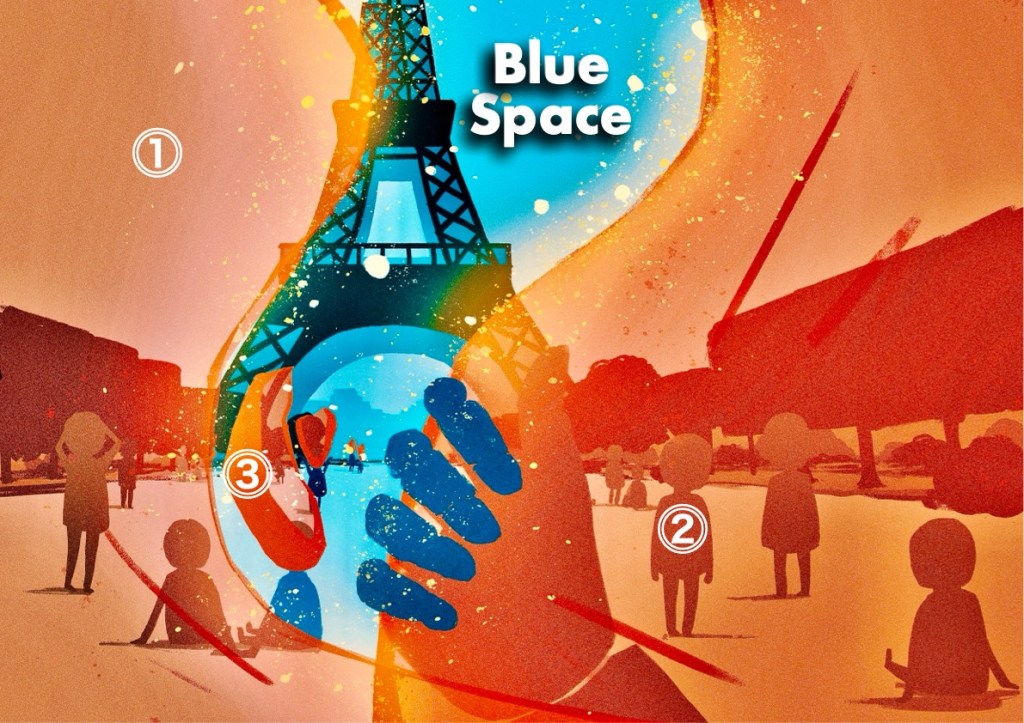
Red Space fills the frame, your total field of experience. From the first-person view, it feels direct and real.
At the center of the image, a blue hand reaches in and peels back a portion of Red Space. Behind it, we see the Causation Domain, the activity the mind responds to and acts upon but does not directly experience. This Blue Space is shown with shapes for illustration, but in reality it contains no form, only happening.
Red Space ⓵ contains your complete internal experience: sensation, perception, memory, belief, thought, and emotion. Everything comes already interpreted. The image of a tree, the sound of a voice: both arrive with meaning already attached. These sights and sensations feel external, but they are built inside.
Red Persons ⓶ are other people as they show up within the first person’s Red Space. They are visible as bodies, speech, and behavior, but always through interpretation. These are projections created by the internal model.
Your internal model responds to movement, voice, and expression, then constructs a presence from that interaction. That presence exists in your Red Space, orthogonal to the actual person in Blue Space.
We experience the mind’s construction of other people, not the people themselves. That construction may carry insight, care, familiarity, even love. The construction exists in our Red Space while the person operates in the Blue Space with their own internal Red Space.
Other Red Spaces ⓷ are the most subtle and most important elements. Within the revealed Blue Space, they show as the internal worlds of other people, distinct from the observer’s yet constructed through the same kind of model. They show only in the peeled-back section of Figure 6.
To recognize another mind as real is to see it as a world running in parallel, made visible through contact with what lies beyond one’s own interpretation. From here, the rules of human engagement change.
The blue hand at the center of Figure 6 is a metaphor. It marks how the model becomes aware of itself through deliberate attention. The hand shows a moment of contact with the Causation Domain, the beginning of a new relationship to it.
2.4.1 Red on Red
Every encounter with another person happens inside the model. What we see, including gestures, posture, and expression, is constructed from the signals that reach us. Their body shows in full color. The vibrations they produce turn into their voice. Their presence feels real. Every part of that experience is built within us.
In Figure 6, these are the red persons labeled ⓶. They show as bodies because that is what the mind builds from what it hears, sees, and registers through interaction. That figure is a projection, produced inside Red Space, formed by interpretation in response to signals from the actual person in the Blue Space.
We call this red on red.
The distinction determines how the mind relates to others. What you see is your experience of them, produced inside your own model. Their gestures and words arrive already interpreted, already yours.
2.4.2 The Illusion of Objective Truth
Some experiences feel personal. Others feel shared. From inside the model, these shared constructions appear self-evident. They belong to the world itself.
When interpretations match across people or cultures, they reinforce what individual models already expect. Repetition makes them familiar, and familiarity gives them weight. The result moves beyond agreement to conviction. This is how things are, not how we interpret them.
Every part of experience comes from Red Space, including what we call objective. The line between subjective and objective is itself an interpretation produced within the model. What we call objectivity measures the degree to which interpretations align across minds. That alignment makes them useful and reliable.
Figure 6 shows this distinction. In the large Red Space, the world feels complete and whole. The portion revealed at the center is the only part that reaches beyond the model’s rendering. Even what feels shared, what seems obvious, remains internal.
“Truth” works as a practical tool for human understanding, located within the model where interpretation takes place. What we take to be external truth comes from tightly aligned minds, interpretations that work well together.
2.4.3 The Human Condition
Loneliness, anxiety, depression, controlling behavior, chronic criticism: these familiar struggles share a common source. They’re features of how minds work.
Loneliness
You can be with others and still feel alone. We share the Blue Space, interacting through the same causal world, yet in Red Space, no other world appears. The people around us are visible in movement, voice, and form, but their inner life doesn’t arrive. What we engage with are our own interpretations of their presence, not their actual selves.
The mind doesn’t know this distinction exists. It doesn’t natively account for the separateness of other minds.
Loneliness is expecting to be met where you are.
Our inner worlds are not shared. Something stays out of reach, and the mind doesn’t understand why.
Connection begins when we stop responding to our projection and start responding to the person. To hold space for someone is to treat them as a process we can’t see, recognizing their Red Space exists parallel to ours.
When we understand how the model works, the solitude of Red Space becomes natural. We share a world of happening while our inner worlds remain apart.
The Others
Anxiety compares what might happen with the mind’s ability to control future outcomes. The distance between wanting certainty and recognizing that many things are unknown creates ongoing tension. The mind keeps running scenarios, trying to close a gap that can’t close. The tension feels like a real threat requiring constant vigilance.
Controlling behavior tries to maintain internal stories about how situations should unfold. Your Red Space contains interpretations and expectations about how events will develop, and you naturally try to influence circumstances to match those narratives. Since gaps between expectation and reality appear constantly, the mind seeks to eliminate them by managing and directing outcomes. Every deviation from your expected story feels like a problem requiring correction.
Depression compares what has already happened or what seems unchangeable with what was hoped for or expected. When the mind can’t find a path from current reality to desired outcomes, it gets stuck in that comparison. The energy that usually goes toward problem-solving gets absorbed by the gap itself. The stuck feeling overwhelms.
Chronic criticism spots what’s wrong in any situation. The mind operates by detecting differences and gaps because that’s how it makes sense of things. When you take these mental assessments literally without realizing that finding problems is just what minds do, every perceived flaw becomes significant. Over time, this hardens into contempt. You respond to your own interpretations as if they show objective truth about others.
Each of these is a reaction to gaps that can’t close from within. Anxiety seeks certainty the mind can’t provide. Control tries to eliminate gaps that keep regenerating. Depression compares what can’t change with what was hoped for. Criticism finds problems because finding problems is what minds do.
Each tries to resolve a contradiction using the same logic that created it. The gaps stay open until perspective changes.
These reactions feel immediate and real. We respond to them as though they are the situation itself. But a space exists between reaction and response. When you recognize the mind’s natural gap-closing mechanisms, you can work with them instead of being controlled by them. That space changes everything.
2.5 Attaining Perspective
Perspective changes when the mind reorganizes itself.
It begins with contradiction, a difference that can’t be resolved. The old logic no longer works. The internal model loops until a new perspective appears.
A woman carries resentment for years, believing forgiveness requires the other person to deserve it through apology or change. Then she realizes forgiveness has nothing to do with them. It’s about releasing the weight she’s been carrying. The anger that felt righteous is a choice. She lets it go.
When the model sees differently, the person can do differently.
2.5.1 In Relationships
At first the relationship thrives. The husband shows up, works hard, and provides support. The bills get paid, the schedule stays full, and the house runs smoothly. He believes this is how love gets shown, through responsibility and effort.
Slowly things change. His wife grows distant and joy feels harder to find. Even with everything in place, something is missing. He feels confused because he’s doing more than ever and believes that should bring them closer.
The effort increases while the connection fades.
He expects that more doing will lead to more feeling, but it doesn’t. What he offers isn’t what either of them needs. He has mistaken one kind of contribution for another. He has not understood that providing and connecting are different things.
The activities that keep life afloat aren’t the same as the ones that make it feel alive. Support holds things together. Connection requires attention and emotional availability. These follow different rules.
His mind resists. He doubles down, trying to repair the bond through the only tools he knows: more work and more effort. The mismatch doesn’t close and frustration builds.
The marriage ends, but the paradox doesn’t. It continues to echo in his mind, turning over memories and searching. Reorganization begins here. He revisits what happened again and again until he sees it.
2.5.2 The Mind’s Eureka
Scientific breakthroughs work the same way. Faced with paradox, understanding leaps forward.
A physicist studies light. Classical physics describes light as a wave, but experiments show it behaves like a particle. Tests repeat, theories get revised, no explanation fits. The paradox lives inside the model, the physicist’s Red Space. Reality hasn’t changed. What changed is the account of it. The earlier logic no longer works.
Light propagates as a wave in the Causation Domain. When it interacts with another process (an atom, a detector, a mind), it induces a discrete event. That event is the entity’s own response to the wave. We call this response a photon.
When this idea clicks, the physicist’s thinking transforms completely. The contradiction resolves. For this physicist, the question is no longer a puzzle. It’s part of a broader account of reality that touches the most basic principles of nature.
Other physicists wrestle with the same paradox. Each mind resolves it within its own Red Space. The external world is shared, but the path to clarity remains personal.
2.6 Emergence of the Mind
Perspectives change through accumulated paradox. Contradictions build until existing logic fails and the mind grows.
But where do these new perspectives come from?
Here’s one way to see it: resisting how you apply your logic changes the logic. Your logic is a mechanism taking causes to effects. Apply that mechanism with different resistance and you get what looks like completely different logic.
Perspective determines how much resistance you apply. When perspective changes, the same logic operates with different resistance, producing what looks like entirely different logic.
Resistance to one way of responding creates space for another. Contradictions accumulate and either force reorganization or get avoided. Some of us keep reorganizing while others hold the same responses most of their lives.
2.6.1 How Change Happens
Earlier we saw a child learn fairness: from “mine!” to automatic 50-50 splitting, then later to proportional return when equal shares stopped making sense.
Where did proportional return come from?
The child started applying their fairness logic with more resistance. At first, moderate resistance meant pause and split evenly. Higher resistance meant pause longer, consider the situation, dampen the immediate impulse to split equally.
Same underlying mechanism, different resistance levels producing what look like different logic.
That’s one path. Another child might go from “sharing is caring” to “whoever needs it most gets it” without the same stops along the way. A third might land on “take turns” or “whoever worked for it keeps it.” The mechanism is the same (resistance altering how you respond) but the paths branch like a tree growing. No natural progression everyone follows, just growth happening through accumulated contradictions forcing reorganization.
When you resist applying your logic one way, you change. How much resistance you apply determines what response surfaces.
A toddler learns to resist the immediate grab. A teenager learns to resist the defensive reaction. An adult learns to resist the assumption that effort equals connection. Each time, more resistance to the application of some unspoken logic allows novelty to appear. Contradictions accumulate until the current way of responding costs more to maintain than reorganizing.
2.6.2 The Long Path
A young girl’s parents divorce and she develops logic about how this works: when a parent leaves their spouse, they leave their children too. The logic makes sense from where she sits.
This logic frames how she interprets her father’s calls, his visits, his attempts to stay close. When he shows up, her logic says he shouldn’t have left in the first place. When he doesn’t show up, her logic says see, he left you. When he tries to explain, her logic says excuses don’t change what happened.
Unlike fairness, this logic applies only to dad-related situations, situations she can control and minimize. Contact at holidays, occasional phone texts, moments she can’t fully avoid. Contradictions accumulate, but slowly.
Years pass.
Then one day she holds her own child. The feeling is immediate and absolute. Nothing could make her stop being this child’s parent. Even if things with the child’s other parent fall apart completely, that wouldn’t change. The love is separate.
Her perspective changes. Leaving a partnership and leaving a child are different things. Her father left her mother, not her. All those years of slowly accumulated contradictions finally exceed the cost of change, and the disruption brings it home.
2.6.3 The Process of Becoming
The fairness response changed through constant testing. The father-left-me response changed slowly through limited exposure. Same mechanism, different conditions.
Every response you have came from somewhere. The toddler who learned to share. The teenager who learned perspective-taking. The adult who learned that connection requires vulnerability alongside effort. Each reorganization happened when contradictions accumulated past some threshold, when maintaining the current response cost more than letting it reorganize.
Minds can avoid this entirely. Minimize situations that test your responses, retreat when contradictions start building, hold the same responses for decades by rarely facing situations where they break down.
Growing up happens through accumulated experience with sustained conflict. Some people at sixty respond to situations the same way they did at sixteen because they’ve spent forty years avoiding situations that would force reorganization. Others keep reorganizing throughout their lives because they stay engaged with situations that generate contradictions.
2.7 Transcendence
Transcendence begins when the mind notices its own behavior from beyond interpretation.
A contradiction forms, bringing the possibility of a new perspective. Something that once confused now makes sense. The moment passes, yet after enough of these the model sees how it learns. It recognizes what changed and how. That awareness opens new possibility.
Transcendence is operating with your own learning process instead of just going through it. You notice how you get stuck and how you search for answers.
From this point, you relate to your mind differently. You notice when an interpretation settles too quickly or when a story lingers past its usefulness. You become fluent in projection, watching how it starts and what it costs to maintain. You distinguish between asking why and noticing how. You use perspective as a navigation tool, changing position when needed.
2.8 Closing Remarks
Thoughts appear without warning. Now we know how this happens and what that means for everything else.
When you recognize that the mind’s contents are constructed through constant comparison and gap-closing, you can catch yourself taking interpretations as reality. You can notice when you’re stuck in unresolvable loops. You can work with your own learning process instead of being trapped by it.
Loneliness is understandable rather than personal failure. Anxiety is trying to cross an unbridgeable divide. Depression is getting stuck in unchangeable comparisons. Contempt is taking your problem-finding literally.
You transcend. Instead of waiting for accidental insights, you can participate in your own transformation. You can use perspective as a navigation tool. You can build meaning with openness to new possibilities.
Understanding how your mind works is just the beginning. Your thoughts and interpretations stay private, but they lead to actions and behaviors that other people see and respond to. Those people interpret your actions through their own mental models, just as you interpret theirs.
Chapter 3 explores how these individual construction processes interact to create shared patterns and the different realities we inhabit together.
 The Abstractionist’s Papers