The Realities We Build
It’s 6:00AM, the alarm clock blares, and the world wants you back.
We wake with the feeling of plugging into a common reality, where the rules that govern us exist. We call this General Reality, the world of meaning we quietly expect everyone shares, though it exists only as an assumption inside each mind.
Each General Reality is unique. Yet somehow we all fall into similar loops and follow invisible rules we don’t realize we’re enforcing. Other people’s problems stand out clearly while we’re just living our own lives the best we can. We perpetuate our troubles without recognizing our role.
Understanding how meaning differs from happening reveals the space between reaction and response, where agency exists.
This chapter shows how to recognize the loops we create and take ownership of the realities we build.
Contents
3.1 Layers of the Mind
3.2 Across the Blue Space
3.3 The Human Transformer
3.3.1 John, Bob, and Yoko
3.3.2 Problems of Our Making
3.4 Entangled Loops
3.4.1 The Lamp and the Switch
3.4.2 The Uncovered Truth
3.4.3 Behind Door Number None
3.4.4 Alex’s Diagnosis
3.4.5 The Karl Marx Paradox
3.4.6 Two Best Friends
3.4.7 Fear Factory
3.4.8 The Unbearable Loss of a Child
3.5 The Stories We Live By
3.5.1 How Narratives Become Real
3.5.2 Don’t Spill the Juice!
3.6 The Invisible Rules We Enforce
3.6.1 The Ant Bridge
3.6.2 The Lost Wallet
3.6.3 All the Rules Live Inside
3.7 The Architecture of Becoming
3.8 Breaking Free
3.9 When Worlds Divide
3.10 Closing Remarks
3.1 Layers of the Mind
Every moment, you monitor what’s happening and compare it to what you know, filtering it through what matters. These responses happen together, yet they follow different rules. They belong to different layers of your internal construction.
Some layers handle immediate input and action, others work with general knowledge, and some are bound up with identity. When these layers conflict, contradiction results.
Figure 7 shows the layered structure of meaning beneath awareness. Each layer interprets differently.
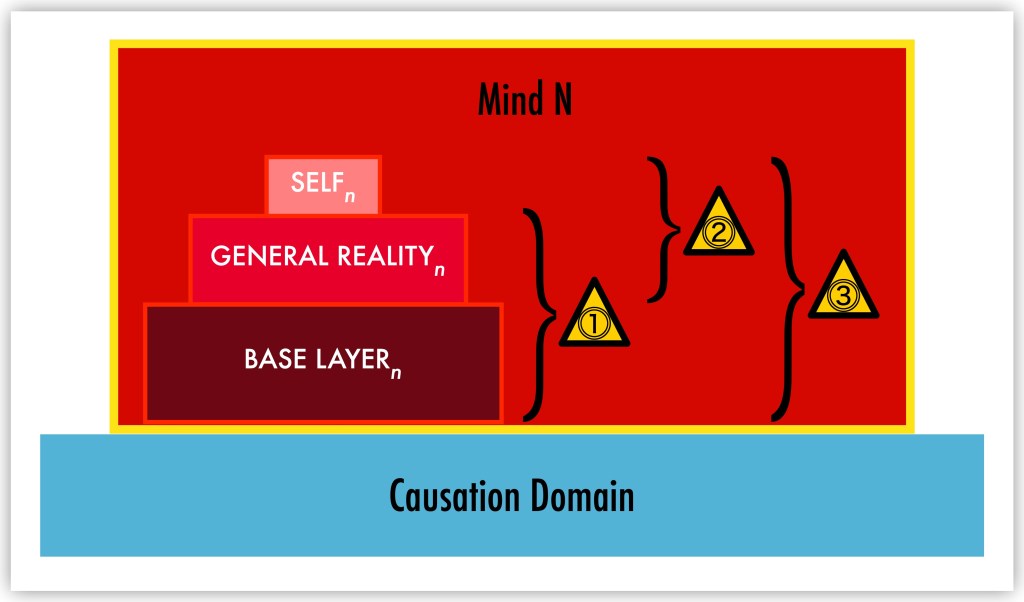
These layers are:
- Base Layer: The realm of perception and movement. Raw causal input and mechanical actions, what enters through the senses and how the body responds.
- General Reality: Handles most things we know and reason about. Learned patterns, abstract rules, and expectations about how the world works.
- Self-Reality: Contains meaning of emotional significance and attachment. Where you organize identity and belief, what you take to be true about yourself.
You hold expectations in one layer but interpret experience through another. These mismatches come from a construction that can’t see itself or mark the source of its own activity. The mind doesn’t know which layer an expectation belongs to and can’t perceive causation.
That’s the blindfold.
When expectations and interpretations are compared across different layers, your thinking tries to reconcile them. Any two layers can conflict in countless ways.
Three types of paradoxes develop:
① Between the Base Layer and General Reality
This paradox appears when you mistake an interpretive projection for a causal event, confusing the map for the territory.
Thira sees an apple fall and infers a rule: unsupported objects must fall. The Sun, too, lacks visible support, yet it doesn’t fall. What’s the difference?
Nothing.
Since causation stays hidden, you build your reasoning from interpretive connections, unknowingly replacing the activity beneath with inference. The paradox appears when expectation clashes with interpretation.
② Between General Reality and Self-Reality
Someone may know they were wrong. They may understand, in clear terms, that an apology is the right next move. Something in them resists. The words don’t come.
The contradiction is about what the rule would require them to feel. To apologize would mean lowering a defense they still need. They agree with the principle but not with what it would cost them. They hold both: the general rule and the attachment blocking it. That tension creates a paradox requiring a change in perspective they aren’t ready to make.
③ Between the Base Layer and the Self-Reality Layer
This paradox appears when the world changes, yet you continue to hold an earlier interpretation.
Someone returns to a place they once lived. The building is the same, yet the life inside it is gone. They still anticipate what used to happen there, what once was true.
Interpretations of the present and the past remain active together, both real within your Red Space. The paradox is in the overlap.
Your mind treats the contradiction as something to be reconciled, when it’s really a sign that layers have crossed. Each loop is ultimately a symptom of the blindfold: causation hidden, construction unseen.
Contradictions begin internally but don’t stay there. What starts as internal contradiction often becomes a loop between people. Gestures get misunderstood and behaviors get misread.
If no idea can travel directly from one mind to another, what crosses the Blue Space? To answer that, we turn to the nature of communication.
3.2 Across the Blue Space
We’ve all struggled to communicate something we understood well.
You try to explain an idea and the other person misinterprets it. You follow instructions that seem clear to the speaker but leave you confused. Someone tells you something, and though you hear every word, the meaning doesn’t click.
These moments reveal something fundamental: meaning never crosses between people. It’s built separately within each person. In any communication, two transformations occur:
(1) Thought to Signal
Thoughts contain meaning. When you express a thought, you create a physical signal: pressure waves in the air, light reflecting off ink, electrical pulses in a system. The signal carries no meaning.
(2) Signal to Thought
The listener doesn’t receive your thought. They receive signals. They transform the signal into meaning using their internal framework of knowledge, assumptions, and expectations.
This second transformation is independent meaning-making.
These two transformations are orthogonal. Misunderstandings don’t require errors. The parallel nature of each person’s Red Space is enough.
A skilled teacher understands these transformations and works with them, never assuming a clear explanation guarantees understanding. The teacher creates conditions for the learner to build new meaning by asking questions, introducing contradictions, and guiding toward realization.
This is why true understanding feels self-made. When you finally get something, it’s because you built it yourself. Even when it’s offered, it must still be earned.
What’s built inside becomes behavior.
That behavior moves into the Blue Space, where another person interprets it. The cycle continues: thought becomes signal, signal becomes interpretation, interpretation becomes the next response.
3.3 The Human Transformer
The world follows its own happening.
A stone falls, a tree absorbs sunlight, planets orbit, all independent of perception. The universe follows its own activity while you encounter contradictions in your attempts to interpret events.
Paradox isn’t the same for everyone. Some contradictions echo across history, unresolved. Others are quiet and personal, defined by identity and experience. What you find obvious, another person may never notice. The difference is in how each person creates meaning.
Why does one person experience a paradox while another doesn’t?
3.3.1 John, Bob, and Yoko
Imagine this: John Lennon and Bob Marley are walking down the street when Yoko calls out, “You’re ugly!”
John stops in his tracks, visibly upset, replaying the words in his mind. Bob shrugs it off and keeps walking. By the end of the day, John is still thinking about it, caught in a loop of frustration, while Bob has already forgotten the moment.
Both were in the same situation, hearing the same words, yet their experiences were different. Why?
The difference lies in how each mind transforms experience into meaning. The words themselves exist as vibrations traveling through the air, an event in the external world. But how those vibrations transform into an emotional response is unique to each person.
John experiences a paradox, a contradiction between his expectations and what he just heard. Bob doesn’t experience a paradox at all. To him, the event holds no contradiction, so it simply doesn’t register as meaningful.
What kind of paradox does John experience? That depends on how deeply he’s attached to the meaning of Yoko’s words, as he interpreted them.
If John doesn’t know Yoko at all, yet the comment unsettles him, it presents a paradox of the first type (① Between his Base Layer and General Reality), one where his general expectations about how people behave are challenged, without deep personal attachment.
If he does know Yoko, and she’s part of his General Reality but not his Self-Reality, then the paradox becomes harder to ignore (② between his General Reality and Self-Reality). His expectation about their relationship now contradicts her actions, making it more personal.
If Yoko is someone very important to him, if she represents something fundamental to his identity, then the contradiction reaches its highest level, producing a paradox that challenges his very sense of self (③ between his Base Layer and Self-Reality).
In every case, the paradox forms only because John’s interpretation conflicts with his expectation. Bob, by contrast, has no expectation that gives weight to Yoko’s words, so whatever his interpretation may be, no paradox appears in his mind at all.
3.3.2 Problems of Our Making
A human mind is a sensitive instrument. Like a transformer wired for contradiction, it picks up even the smallest tensions between what is and what was expected. It does this naturally because that’s how it works.
This responsiveness is one of your most powerful abilities. You spot irregularities, detect breaks in sense, and flag anything that doesn’t quite fit. The same ability that helps you survive can also become a source of suffering.
The activity works in two steps:
- You react, creating an interpretation of what happened; and
- You respond, treating that reaction as if it were the event itself.
When step 2 reinforces step 1, it loops. All your problems, regardless of what’s happening outside, are by definition self-made.
That’s what makes a problem of your making. The tension lives in how you’re built to respond. The world presents what it presents; your construction determines what becomes a problem through the meanings you build.
This makes the problem real while changing where you look for its origin. You transform what happens into meaning, and meaning into behavior. What you experience comes through your construction of events, built internally from the signals that reach you.
You choose what triggers the loop. You can notice how it forms. That’s where change becomes possible.
3.4 Entangled Loops
Logical contradictions adjust with understanding. Emotional paradoxes persist. The feelings they carry sustain them, replaying as you seek resolution.
Paradoxes build through three stages: first, a contradiction opens between layers of interpretation where reality doesn’t match an expectation, belief, or sense of self. Second, an emotional loop forms where you can’t resolve the contradiction, so it repeats, searching for resolution that never comes. Third, transformation happens when the paradox is seen differently, perspective changes, and the cycle breaks, allowing new understanding to form.
Paradoxes bind you through emotional loops, holding you to expectations that no longer align with reality. Breaking these loops involves loss: certainty, identity, or continuity. These losses exist on a spectrum from trivial adjustments to the unimaginable rupture of losing someone who was once inseparable from existence.
The Karl Marx Paradox shows how you cling to logic even when reality contradicts it. There’s nothing inherently flawed in the reasoning, but it conflicts with how the world actually unfolds, creating a profound but navigable loss.
This isn’t the extreme. Some paradoxes shatter continuity so completely that you must expand to hold two incompatible realities at once.
The following narratives show how paradoxes develop across layers, and how loops sustain them.
3.4.1 The Lamp and the Switch
Marfa flips the switch, expecting the lamp to light up. It doesn’t.
A minor inconvenience, a burned-out bulb. She replaces it, confident in the fix. When she flips the switch again, the room remains dark. A small disruption enters her reality, a contradiction that should be easy to resolve.
She considers the possibilities. The circuit breaker might have tripped. The power could be out. The socket might be faulty. Each thought follows the familiar pattern of adjusting the puzzle, finding a way to make this misfit piece of experience align with what she already knows.
As Marfa eliminates one possibility after another, something feels off. She assumed that flipping a switch meant turning on a light. It’s always that simple. Now she realizes the world doesn’t operate this way. The external world operates according to its own activity, independent of her expectations about how it should work.
Electricity moves through unseen systems, dependent on factors she never considered. Power is routed, distributed, and contingent on an entire network of conditions. What she implicitly assumed was a direct cause-and-effect relationship was actually a complex system, one that worked so reliably that she never needed to question it.
Her puzzle is incomplete. The contradiction doesn’t resolve immediately. It loops, forcing her mind to adjust its assumptions. The more she seeks resolution, the more she realizes how much she took for granted. Each new possibility introduces more complexity, and the loop continues until she shifts her understanding of the system itself.
3.4.2 The Uncovered Truth
He opens the door to a stranger, and for a moment, everything feels normal… until he notices the stranger’s eyes flick down.
In that instant, he realizes: he isn’t wearing his hat.
Panic surges through him. His hand instinctively reaches for his head, but there’s nothing there to cover the bare scalp that he’s spent years hiding. His reflection is no surprise—he knows exactly what he looks like; in the presence of another person it hits harder than ever before.
For years, he’s experimented with solutions: wigs, Rogaine, even considered a transplant, but always hesitated, knowing he’s too old for such a drastic change. The effort to mask it, to manage the contradiction between how he sees himself and how others see him, has become second nature. This moment, this unexpected exposure, throws everything into question again.
The stranger smiles politely (he’s bald, too) yet the silence between them feels heavy. The man’s mind races, trying to force a shift, to reconcile what’s been hiding beneath the surface all along. The expectation hasn’t budged. He still sees the man he used to be, the man with a full head of hair, despite the truth staring back at him.
As the stranger speaks, he forces himself to listen, but inside, the panic hasn’t subsided. His mind is stuck, caught in a loop of resistance, trying to find a way to reconcile the external reality with the expectation that never quite adjusted. He’s always known he’s bald, but to fully accept it, without the cover, without the avoidance, still feels impossible. When the door closes, he breathes a little easier, yet the loop remains. The paradox is clear. He can either embrace it or keep hiding. Every day, the decision is the same: the cap goes on, and the loop continues.
3.4.3 Behind Door Number None
Self-restraint keeps us alive. Without it, we’d lash out during arguments, overshare with strangers, touch burners we know are hot. It helps us survive, stay employed, stay connected. It draws the line between what can be done and what should be done.
Sometimes these lines show up where they don’t belong.
Marcus has been outlining a podcast for two years. He’s read every major book on content strategy, mapped out fifty episodes, studied the best hosts to see how they hold attention. His microphone sits in the box. Every time he gets close to recording, something holds him back. He tells himself he’s waiting to be more ready, more expert, more confident, more deserving.
He listens to hosts who didn’t wait. They mispronounce marketing terms, interrupt guests, drift off-topic, and forget which episode they’re in. Some have large followings, others barely hang on, yet they’re all out there learning, failing, improving. Marcus is not.
He sees a row of guards standing in front of him. The expertise bouncer asks for credentials. The timing bouncer wants better market conditions. The quality bouncer checks for flawless editing and equipment. They stand there, looking official and silent, as if they’re keeping him out of something important. Behind them waits nothing at all, no stage, no gate, no prize.
It’s the oldest Monty Hall problem: three doors, none of them real. The show plays out in his head, with rules no one else can see. He keeps trying to impress the guards, not realizing they were never meant to let him in. They’re not screening for excellence. They’re protecting a story, the one where he waits until it’s safe to start.
At the tech company where Marcus works, the same thing plays out at scale. The leadership team identifies a clear opportunity and builds a prototype. The concept works and the timing is right, yet they hold off for more meetings, more research, a careful delay. Six months later, a smaller competitor launches an inferior version and captures the space.
In the 1970s, Xerox PARC developed nearly everything we now associate with modern computing: the graphical interface, the mouse, the desktop metaphor. The leadership paused while Apple acted. Apple visited, observed, took notes, and moved forward. Xerox waited. One company made history, the other watched it happen.
The mind builds these guards to protect something that once mattered. At first, they help by keeping reputation intact, preventing mistakes, maintaining balance. Over time, they settle into habit and stop protecting to start preventing. The doors lead nowhere, yet the posture remains.
Marcus stays still because the guards he built around action haven’t stepped aside. They stay in place, silent and still, doing a job they were never assigned. Getting ready is real and learning is real, yet preparation becomes something else when it stops aiming at contact. The transformation that waits on the other side of doing never comes for those who never cross the threshold.
3.4.4 Alex’s Diagnosis
Alex had always been scattered, losing keys and missing deadlines, earning nicknames like “space case” and “chaos king” from friends who also valued the creative energy that came with his distractibility. After his divorce left him with unpaid bills and a string of jobs that didn’t work out, a buddy suggested he see a doctor.
The questionnaire asked familiar questions about forgetting things and struggling to focus. Alex answered honestly, and the doctor wrote a prescription along with a diagnosis: ADHD.
The diagnosis created a new framework for understanding his experience. Alex’s struggles now had a medical explanation, and the stimulant medication produced periods of improved focus. But the underlying executive functioning issues remained unchanged. Each time the medication wore off and his familiar habits returned, the experience reinforced his belief that the pills were the solution instead of suggesting he might also develop different approaches.
The years that followed revealed a troubling cycle. Credit card debt rolled into bankruptcy. Relationships ended when his continued disorganization became too much to bear. Jobs were lost to missed deadlines. Each crisis prompted medication adjustments rather than examining how he engaged with attention and organization.
Alex found himself operating within a diagnostic reality where his struggles had been medicalized rather than understood as potentially changeable. The diagnosis had provided closure rather than a path forward.
3.4.5 The Karl Marx Paradox
A craftsman spends hours building a chair, expecting its value to reflect the time and care invested. At the market, mass-produced chairs, made with a fraction of the effort, sell at lower prices and sell faster. His expectation that effort determines worth collides with the reality that value is set by supply and demand.
This contradiction occurs between direct experience and the broader patterns that govern reality. The craftsman sees the world as an individual, acting on what seems fair and reasonable based on his personal effort. The reality of the marketplace follows different rules, where value is determined by factors beyond individual labor: efficiency, availability, demand, and economic dynamics that operate at a larger scale.
If he has no significant attachment to the idea that effort should determine worth, this paradox is simply an observation, something that can be learned and adjusted for. If this belief is tied to his sense of fairness or personal identity, the contradiction becomes more than just a market reality. It becomes a challenge to his view of the world.
The Karl Marx Paradox persists because the logic itself feels intact. The craftsman’s expectation that effort determines worth seems fair and rational, even as reality contradicts it. This emotional loop endures because of the attachment to what feels just.
Breaking this loop requires releasing an expectation that resonates deeply but remains unfulfilled by the external world. It’s not the logic that must be abandoned, but the insistence that reality conform to it. Only then can the paradox dissolve, allowing the mind to adapt to a more complex understanding of value.
3.4.6 Two Best Friends
Rachael and Sophie had known each other since their twenties. After college, their paths diverged naturally: Rachael leaned into her career, while Sophie began a family. For years, they remained close, but their friendship carried a quiet undertone: each used the other as a reference point.
When Sophie married, Rachael smiled at the photos and raised a toast at the reception. She hugged her friend with genuine joy, but on the drive home her thoughts circled: By now, shouldn’t I have this too? She did say yes to some dates, but her expectations were already set by Sophie’s marriage. When the conversations felt awkward or the connection slow, she took it as proof she was failing, and she stopped.
Years later, Rachael received a promotion. Sophie clapped and congratulated her, but that night she lay awake, whispering: By now, shouldn’t I be doing something like that too? Sophie did apply for jobs, and she was offered some, but because she compared herself to Rachael’s promotion, the offers felt beneath her. She expected to begin where her friend had already arrived.
Each woman spent years measuring herself against the other’s world, and in doing so, each overlooked her own. They mistook different lives for rungs on the same ladder, and the steps that were truly theirs remained untaken.
3.4.7 Fear Factory
Life rarely runs as expected. Small disappointments, moments of rejection, and perceived unfairness are common. When fear and expectation begin reinforcing each other, a different kind of loop forms, one in which a person unknowingly creates the very reality they most wish to avoid.
It begins quietly. A person experiences an unexpected setback, a rejection, or an unfair outcome, and they search for meaning in it. Contradictions don’t stay unresolved, so a framework forms that explains the experience: People can’t be trusted. The world is dangerous. I will always be overlooked. At first, these thoughts exist only as internal explanations, shaping the way events get processed.
Because the universe responds to behavior, and behavior is dictated by perception, this internal model begins to influence real-world interactions. If a person expects rejection, they may withdraw slightly, avoid eye contact, seem distant. Others sense this distance and, in turn, respond with their own hesitation. The interaction confirms what was already expected: See? They don’t like me.
This reinforcing cycle creates a widening space between the individual and the world around them. The person who feared betrayal becomes overly defensive, pushing people away before they have the chance to leave. The one who dreads failure avoids risks, ensuring they never have the opportunity to succeed. Protection turns into creation, building the very outcomes it fears most.
As the loop intensifies, the person sees fewer counterexamples. Every negative experience feels like proof, and every moment of uncertainty gets interpreted as a sign that disaster is just ahead. They begin to seek only reinforcement. Anything that contradicts the narrative gets dismissed, while evidence that supports it gets amplified. The world divides into friend and enemy, safe and dangerous.
From an outside perspective, it’s easy to wonder how someone gets to a point of despair, alienation, or even destruction. From within the mind experiencing it, the world isn’t perceived as an unfolding set of choices; it’s a singular reality, one that simply is. The broader pattern remains invisible in the moment-to-moment experience.
The same dynamic plays out between people, in communities, and across entire societies. When fear-driven narratives take hold at scale, they shape collective realities. A country that expects hostility may adopt policies that provoke it. A culture that assumes decline may reinforce the very conditions that lead to stagnation. Groups scroll through endless streams of headlines and opinions, each one reinforcing the belief that the world is broken and something must be done.
The loop persists because they’re creating what they fear. The answer lies in awareness, seeing the blindfold for what it is. The first step is recognizing that the narrative operates as a self-reinforcing pattern, distinct from the reality it attempts to interpret. Once we see the story as a story, rather than as the world itself, the loop loses its grip.
3.4.8 The Unbearable Loss of a Child
Some events change everything.
A parent who loses a child encounters a reality that no longer follows the logic of existence as they once understood it. The mind continues to anticipate their presence, expecting to hear their voice, to see their belongings, to plan for a future that included them. Yet the world returns only silence.
The loss shatters continuity. The future feels impossible to imagine, while the past becomes more vivid than the present.
The mind learns to hold incompatible realities: a presence that’s deeply felt and an absence that’s painfully real. This paradox becomes part of the parent’s journey.
Some loops stay. This is one of them.
3.5 The Stories We Live By
The stories you tell about yourself and the world come from the loops you never stopped. They repeat because you followed the reaction without noticing the space. When you begin to choose your responses, you start to change those stories. You begin to rewrite what has always seemed given.
Some of these stories are light. Others define relationships, careers, entire worldviews. What begins as a single contradiction can loop into a self-reinforcing activity, one that interprets experience through the very construction it helps preserve.
How do they hold together? What makes them stay?
3.5.1 How Narratives Become Real
You build an internal framework based on fragmented inputs, piecing together meaning as efficiently as possible. The process resembles assembling a puzzle without a finished picture to guide the work. You assume that the puzzle you’re building is mostly correct, relying on its existing parts to interpret new pieces as they arrive.
Each puzzle piece has two aspects: its shape (how it functions in reality) and its image (the meaning you assign to it).
When a new experience contradicts an existing expectation, you must decide how to incorporate the piece. Contradiction is costly, and you prefer stability. You choose how to reconcile it: adjust the image to fit existing beliefs, modify a belief or expectation, or reject the piece entirely.
The difficulty of each choice depends on your attachment to the existing puzzle. If an expectation is shallow, adjusting the interpretation may be easy. When the contradiction challenges something deeply embedded, altering the interpretation can be just as difficult as changing reality.
In many cases, the most efficient option is to reject the new piece entirely, dismissing it as an error. This preserves the existing puzzle at the cost of accuracy, allowing you to maintain stability while ignoring reality.
The activity operates invisibly. Your construction resolves what it can, rejects what it can’t, and continues as though seeing the world directly. The result is a stable internal loop that feels real enough to live inside.
No loop exists in isolation. The stories you build determine how you act, and how you act affects what others experience. When those loops reinforce one another at scale, they create systems. These are the invisible rules you live by. Many arose through repeated coordination and avoidance rather than conscious choice.
Before you can change the world you live in, you have to see the rules you’re already enforcing.
3.5.2 Don’t Spill the Juice!
A child leaves a restaurant, orange juice in hand, making his way to his mother’s table. He trips and for a moment gravity takes over. The cup tilts and liquid moves. His mind sees the spill before it happens: orange juice everywhere, mess across the floor, the accident complete.
But he catches himself and recovers. The cup stays upright. In the Blue Space, the spill never happened.
Yet when he reaches the table, he turns the cup upside down and dumps the rest.
Watch the blindfold work.
You observe the child’s behavior. He was solving a problem that existed primarily in his interpretation. When the Blue Space failed to deliver the expected ending, his Red Space finished the job.
Most narratives can take years to solidify. But the child’s story forms and acts itself out in seconds. The compression lets you see what usually stays hidden. You can watch interpretation become behavior become reality in one shot.
During those moments of falling, his mind opened a space between what was happening and what should happen. By spilling the juice, he solved a problem that existed only in Red Space.
From the outside, you recognize this behavior as self-sabotage. But from the inside, it feels natural. The child experiences himself as helping events finish properly, not creating unnecessary problems.
You do this constantly. Someone fears they might look incompetent in a meeting, so they stay silent instead of asking questions, ensuring they miss important details and look confused. A person worries they might seem needy by reaching out to a friend, so they wait for contact, creating the very distance that makes them look uninterested.
The child finishing his spill shows the same mechanism operating everywhere. You act from interpretations that turn manageable situations into unnecessary complications.
The cup that finished spilling shows you finishing spills that don’t need finishing. When you recognize the pattern, you can choose differently.
3.6 The Invisible Rules We Enforce
Rules control every moment of life, but they rarely show up as rules. They operate beneath awareness, guiding behavior in ways you don’t question. Some rules are formal (laws, social norms, workplace policies) but these are just representations of something more fundamental.
The real rule lives in its enforcement. A law written in a book sits dormant until someone interprets it and acts. The rule comes to life through its application. If breaking the law carries no consequence, it has no relevance or power. What makes a rule real is its enforcement and how it guides behavior and interactions, whether you notice it or not.
Most rules aren’t codified. They’re felt, learned, and reinforced by each of you, moment by moment, defining many aspects of the realities you live in.
3.6.1 The Ant Bridge
To an outsider watching a colony of ants, their behavior seems purposeful. When a group of ants encounters an impassable distance, they form a bridge with their bodies, linking together to help others cross. It looks intentional, as though the ants understand the challenge and choose to act together.
For an individual ant, no grand plan exists. Each one reacts to immediate circumstances, following rules encoded through experience. When it senses other ants around it, it clings to them without seeing the bridge or itself as part of something larger.
Their local actions produce a global outcome. Each ant responds to immediate needs while contributing to something that benefits the entire colony.
Humans live by rules beneath awareness, acting moment by moment in ways that reinforce larger systems. Just as an ant holds on because it has learned to, a person obeys cultural norms and upholds beliefs through countless small choices, repeated, producing reality at a scale rarely seen.
3.6.2 The Lost Wallet
Rules of behavior operate as invisibly as the ant bridge. You walk through a park and spot a lost wallet on the ground. In that moment, two competing realities exist.
The first is immediate self-interest: keep the wallet. It requires no effort, and from a local perspective, it’s the most beneficial choice.
The second is broader and rule-based: return the wallet. Society instills this rule early. The impulse to follow it remains strong regardless of who’s watching or what benefit it brings.
The rule develops through culture, reinforced by experiences where honesty is rewarded and selfishness discouraged. Returning the wallet enacts the invisible rules that sustain trust in society.
Some rules exist because they benefit the larger system rather than the individual. You might return the wallet at personal loss because the collective rule of honesty benefits society as a whole.
Human rules differ from ant rules. Ants follow behaviors reinforced within the colony. Humans navigate a balance between short-term benefit and long-term sustainability of the larger system.
Rules are behavioral habits, sustained through expectation and social reinforcement.
3.6.3 All the Rules Live Inside
The police officer arrests someone for theft. The judge sentences them. Each has interpreted the law as meaningful within their own Red Space and chosen to act. They operate from different worlds, the street and the courtroom, yet both enforce through internal interpretation.
Social pressure against dishonesty works the same way. It exists only because individual people recognize violations and choose to respond.
Rules feel external because enforcement comes at you from outside. But that “outside” is simply the inside of someone else’s Red Space. The blindfold keeps you from seeing into other minds, so you experience their enforcement as external force rather than internal choice.
We’re all enforcing, collectively. A driver stops at a red light because there’s a rule in their head being enforced. The rule is inside the driver, though from your own Red Space it seems to be “out there” in the traffic light or law books.
The mystery of where rules “live” has an answer: they live inside, distributed across minds, enacted through behavior.
Rules can change or disappear entirely because they’re shared habits of interpretation, sustained by people who continue to find them meaningful and worth enforcing.
3.7 The Architecture of Becoming
A child attends a music concert and thinks, “I want to play the guitar.” She gets the instrument for her birthday, sits down with it, and can’t make any of the sounds she heard. Her fingers don’t know where to go. The strings buzz or won’t ring at all. Most give up here.
The child’s dream of playing guitar lives in her Red Space as story. Learning to play happens in the Blue Space through repeated action: lessons, practice, building calluses, training muscle memory until the movements become automatic.
The gap between vision and execution appears everywhere. You aim at outcomes in Red Space while reality builds through happenings in the Blue Space. Both are essential. They work differently. Interpretation provides potential through the outcomes you envision. Causation creates those outcomes through action.
Because the domains are orthogonal, the actions that create outcomes often bear no resemblance to the outcomes themselves. You often see the outcome you want but can’t see the causal path leading there.
If you want a butterfly in your garden, Red Space might tell you to chase the butterfly. That approach fails because the activity that gets you butterflies has nothing to do with butterflies: you plant a garden instead. The butterfly comes naturally when the conditions welcome it.
Without a guide to show these connections, you give up before you start. Planting a flower when what you really want is to catch a butterfly looks nonsensical. Yet this is how causation works: you accumulate potential through ideas and intentions, then potential becomes real through action. The cycle works in reverse too. Action creates new potential. Each experience builds readiness for possibilities you couldn’t have imagined before.
When someone drinks and drives, they create the possibility for an accident or an arrest. Few would name that as their desired outcome, but the possibility was created, and sometimes reality delivers it.
When Red Space and Blue Space work together productively, you gain the ability to influence what happens next. When they’re too disconnected, you lose agency and life feels like something that happens to you.
3.8 Breaking Free
What keeps loops running is attachment.
When expectation ties to identity, letting go feels like loss. You defend assumptions operating beneath awareness, protecting constructions you mistake for reality. A belief becomes a self. The self reinforces the belief. Meaning, identity, and expectation sustain one another, each making the others feel necessary.
From inside the loop, this shows up as discomfort, urgency, refusal. You feel pressure without knowing where it comes from. The strain of holding together a construction that no longer fits is what hurts.
Think of physical pain, when your body signals damage through discomfort. In the same way, what hurts in a paradox is your response to it. The cycle continues as long as the response continues.
Some loops are chosen deliberately. Others are chosen from the grip. In the latter case, the loop doesn’t feel chosen at all. Breaking the cycle begins by loosening the attachment, letting your construction change without equating that change with loss.
That’s when you begin to get unstuck.
Repetition creates familiarity. Persistent patterns turn into stories. Once you treat the story as the world, you live inside it, reinforcing it, protecting it, suffering for it.
Many loops we struggle to break start before we even realize it. They take form in the moment world touches us.
When something happens, the event, your reaction, and your response blur together. The reaction feels like the event, and the response feels inevitable.
The blur hides a critical distinction. You react, creating an interpretation of what happened, then you respond, treating that reaction as if it were the event itself. If you catch the reaction, you can pause. Here’s your fighting chance, the moment to step aside and choose.
Figure 8 shows how this works:
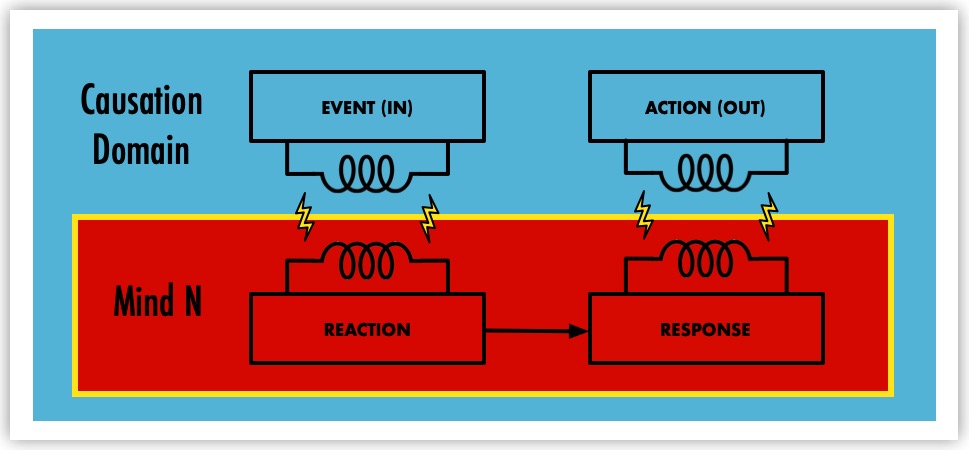
An event happens in the Blue Space. Light enables induction across the boundary, where your mind constructs an orthogonal Red Space reaction. This reaction becomes the raw material for your response, which produces orthogonal action back in the Blue Space.
You access only the middle steps. Reaction and response; that’s your entire world. You’re enclosed within Red Space, yet through the blindfold it feels like direct participation in external events.
The door opens from within. Your fighting chance exists entirely within your control. No one else can reach into your Red Space and change your mind.
Even when others try to help, their words and actions are still events in the Blue Space, inducing new reactions you must choose how to respond to.
What you put into your response influences the next event you experience. Karma describes this feedback loop. When you offer kindness, other minds often respond in kind. When you project suspicion, others respond with wariness. By choosing different responses repeatedly, you eventually retrain the reactions themselves.
Expectations create loops everywhere, especially in relationships. You give expecting to receive. When that doesn’t happen, you feel cheated. The way out is simple but not easy: give because you want to. That’s freedom.
The space between reaction and response is where agency lives. The wider you make that space, the more choice you have.
Not all loops need breaking. Many create positive cycles: routines that ground you, relationships that nurture you. The key is seeing which loops serve you and which ones trap you. Train yourself to see your life from the outside. It’s a brutal practice, but the payoff is transformative. Breaking free means choosing deliberately.
3.9 When Worlds Divide
Polarization is often described as conflict: left versus right, liberal versus conservative.
When you live inside a polarized narrative, the conflict feels real. You interpret the divide as meaningful and act accordingly. From within that experience, the threat feels external.
Contradiction lives in interpretation. Each side responds to the world using different assumptions, creating dissonance. Because you’re designed to resolve dissonance quickly, you simplify your framework. You draw clearer lines between friend and foe, truth and error. Positions grow more rigid from the pressure to resolve contradiction.
You seek consistency and work to close spaces. When contradiction touches identity through political belief or moral stance, the need for resolution grows urgent. You build the simplest world you can use to survive.
When forces oppose one another, tension builds. A battery charges by holding two terminals apart. The difference creates potential. That potential flows.
The same is true when opposing perspectives clash. They can seem like pure conflict. What looks like back-and-forth is the very activity that makes progress possible. Because of the blindfold, you see the poles and feel the tension, but you miss the upward spiral.
The tension you feel between polarized perspectives is where transformation happens.
3.10 Closing Remarks
Your mind builds meaning in layers. When those layers conflict and the contradiction won’t resolve, you get stuck in loops. The blindfold keeps you responding to your own reactions without accessing what actually happened. You experience your interpretation as the event.
It doesn’t end there.
Your responses enter the Blue Space as actions. Other blindfolded minds interpret those actions and respond. Their responses become the signals you interpret next. When those interpretations confirm what you already believe, the loop gets tighter.
Individual loops scale into collective exchanges, building stories we all live by and rules nobody deliberately chose.
The distinction between meaning and happening gives you access to the space between your reaction and your response. Practice there. That’s where you break free. That’s where life becomes so much more.
May the realities you build be yours to own.
 The Abstractionist’s Papers