The Natural Reality Framework
Once we acknowledge that all experience happens within the mind, the inquiry reaches its limit. We don’t access what’s outside. The external world continues on its own, independent of our perception. Until now, no map existed for discerning what lies beyond us.
Natural Reality offers one.
Reality operates through natural processes, each with an inside, an outside, and a boundary. Inside is interpretation, where meaning is handled. Outside is causation, where happening occurs. These domains are orthogonal and always in interaction.
We still can’t observe causation, but patterns of interpretation allow us to model how influence propagates across every scale.
This chapter establishes the Natural Reality Framework, showing how natural processes build reality through individual meaning-making while participating in the happening we share.
Contents
4.1 An Apple in the Sun
4.1.1 When We Run Out of Map
4.1.2 Recognizing the Hidden Dimension
4.2 How Reality Builds Itself
4.2.1 Interactions
4.2.2 Causal Impedance and Resistance
4.2.3 The Role of Incoherence
4.2.4 The Coherence We Think We See
4.2.5 The Hand of Change
4.2.6 The Birth of the Natural World
4.2.7 Interpreting Reality Through Layers
4.3 Principles of Natural Reality
4.3.1 A Single Process
4.3.2 Other Processes
4.3.3 Parallelism and Orthogonality
4.3.4 Where to Draw the Line
4.3.5 Layers of Natural Spaces
4.3.6 How Influence Spreads
4.3.7 Obstacles or Other Processes
4.3.8 How Energy Works
4.4 Closing Remarks
4.1 An Apple in the Sun
The orchard is quiet except for the occasional rustling of leaves as a warm breeze moves through the trees. Late afternoon light filters through the branches. Thira watches an apple sway gently, release its hold, and fall.
She’s seen this countless times, expected and unquestioned. Apples fall.
She glances up at the sun, brilliant and unwavering, fixed in the sky. Something stirs inside. The apple and the sun, both suspended above, both subject to the same world, yet one falls while the other doesn’t.
Why?
Everything she knows tells her that unsupported objects fall toward the earth. Drop a stone and it falls. Pour water from a bucket and it falls. The rule holds everywhere she’s tested it.
The sun hangs there, nothing visible holding it up, yet it stays.
Her reasoning feels airtight: If the apple falls, the sun should too. She’s certain the rule is right, until she looks at the world again and sees it can’t be.
4.1.1 When We Run Out of Map
Something in Thira’s understanding is wrong, but she can’t see what.

The Causation Domain (the Blue Space) represents the external world, where rules of causation are enforced. The apple and the sun exist here, as happenings. Mind N (a Red Space) represents Thira’s internal world or Interpretative Domain, where she produces and handles meaning.
In the Blue Space, ➀ represents the sun in the sky. In her mind, Ⓐ is her mental abstraction when she perceives ➀. This could be a visual image of the sun, or an idea about it.
In the Blue Space, ➁ represents the sun remaining in the sky, following the rule of causation that governs celestial bodies. In her mind, Ⓑ is the corresponding abstraction created when she perceives ➁.
Thira has learned from experience that unsupported objects fall. Her mind applies this reasoning to the sun. When she perceives Ⓐ, she expects Ⓒ: the sun will fall. What she perceives is Ⓑ, the sun still in the sky.
Her reasoning path leads to contradiction:
- Rule of Causation (in the Blue Space): The sun remains in the sky due to mechanisms she doesn’t yet understand.
- Rule of Reasoning (in Thira’s Red Space): If nothing holds it up, it falls.
Her expectations (Ⓒ) conflict with her interpretations (Ⓑ).
The paradox lives here.
4.1.2 Recognizing the Hidden Dimension
To Thira, inside her Red Space, reality itself seems broken. Something about the world doesn’t add up.
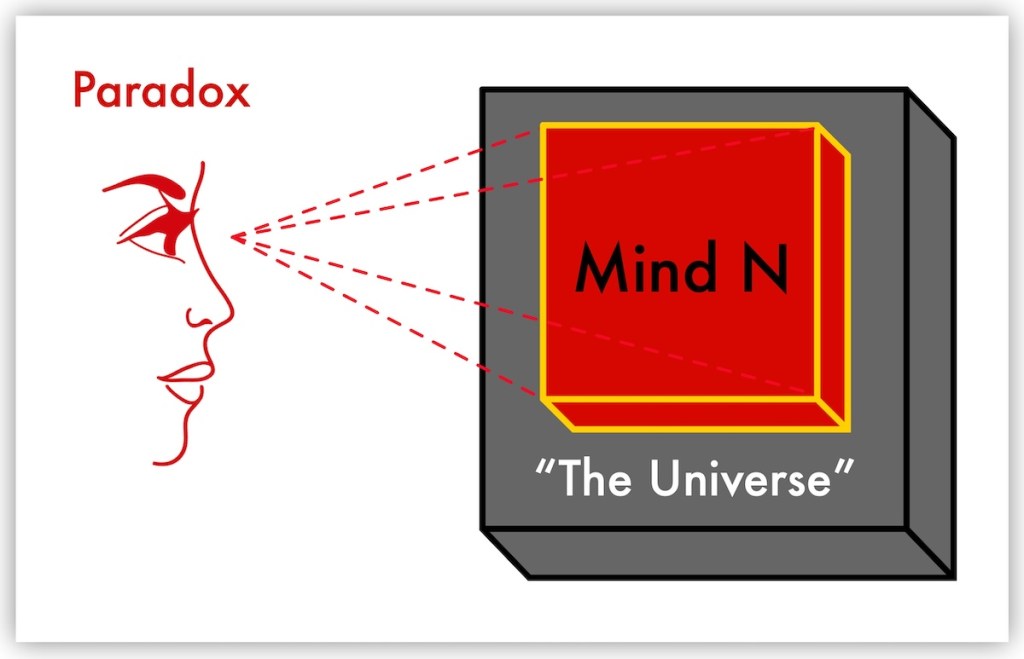
If Thira could step outside her own reasoning, the contradiction would vanish. If she could see the rule operating in the Blue Space, she would understand.
Even without knowing the rule, she would recognize that something she doesn’t yet understand governs the sun’s motion.
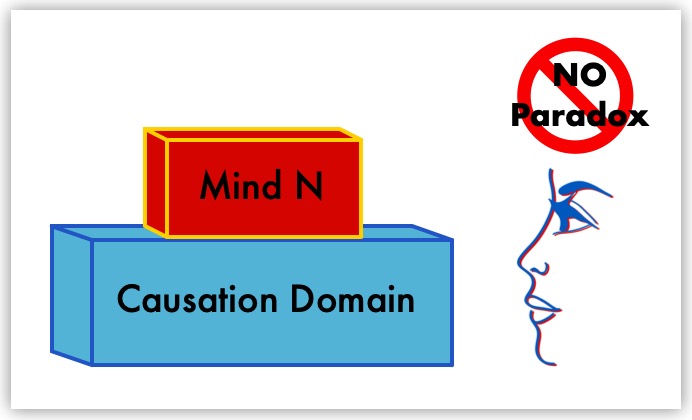
From a broader perspective, the contradiction exists only in her mind’s reasoning.
The world continues operating according to its own rules. What changes is the mind’s recognition of its own assumptions.
Paradoxes are products of internal reasoning, not external reality. Recognizing this is the first step in understanding Natural Reality.
A paradox appears when the logic of the mind’s internal model doesn’t align with the way causation happens. When the rules of reasoning don’t match the rules of the world, contradiction shows up, exposing a gap between the inside and the outside.
To understand that gap, we need to look how reality works.
4.2 How Reality Builds Itself
We can’t observe causation, but we can interpret causation and build models from patterns of interpretation.
What do we know about reality? The most universal observation is cause and effect. Events follow from other events in ways that can be understood as part of a continuous process.
By taking causality as our starting point, we begin mapping Natural Spaces, where interactions follow distinct causal rules.
4.2.1 Interactions
A Natural Space (N) is a space where entities interact, governed by a Rule of Causation (Ψ). Within this framework, the enforcement of Ψ transforms a cause (c) into an effect (e):
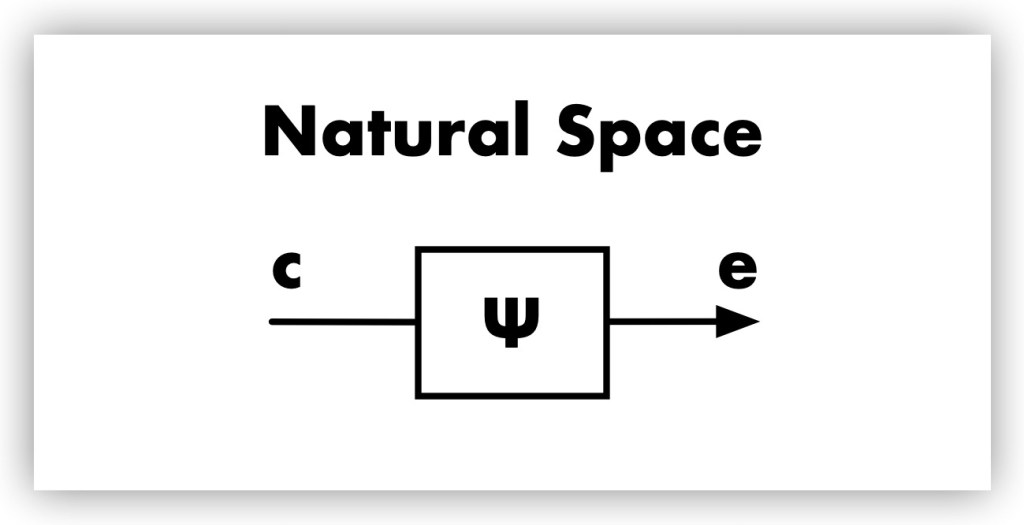
Ψ: c → e.
Each effect has two components:
- Change (δ): The transformation that occurs due to the interaction.
- Decay (λ): The inherent cost of the interaction, which works against persistence.
Such that: e = δ + λ.
Depending on how change (δ) aligns with decay (λ), the interaction follows one of three patterns:
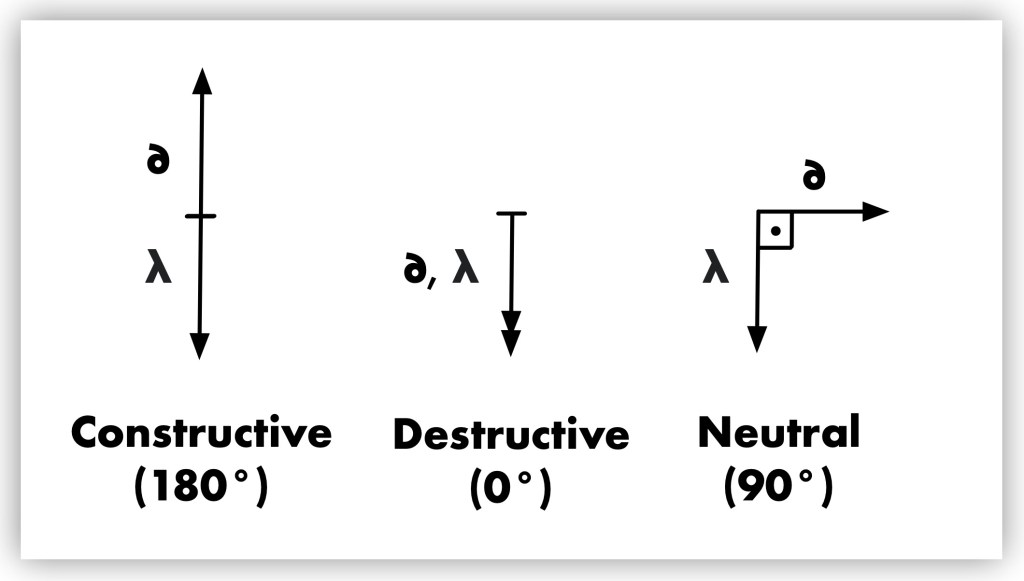
- Constructive Interactions: When change opposes decay (180°), the interaction stabilizes or strengthens the entity, allowing it to persist.
- Destructive Interactions: When change reinforces decay (0°), the interaction accelerates the breakdown of the entity.
- Neutral Interactions: When change and decay are independent (90°), the interaction has no net effect on persistence.
Interactions don’t affect all entities equally. Some entities are highly susceptible to change, while others resist it. This resistance is measured by Causal Impedance (ZΨ), the degree to which an entity withstands application of the governing rule of a Natural Space.
4.2.2 Causal Impedance and Resistance
Not all entities react to the governing Rule of Causation (Ψ) in the same way. Some experience dramatic transformations, while others remain unaffected. This variability is captured in Causal Impedance (ZΨ), which describes an entity’s immunity to Ψ.
The effect of an interaction depends on impedance:
c ∝ ZΨ x e.
For a fixed cause (c):
- Higher ZΨ means the entity resists change, experiencing a smaller effect.
- Lower ZΨ means the entity is more susceptible, experiencing a greater effect.
This mirrors physical principles like Newton’s Second Law (F = m × a), where mass (impedance) resists acceleration, and Ohm’s Law (V = R × i), where electrical resistance affects current flow.
Within Natural Spaces, impedance governs both an entity’s resistance to external forces and its potential to transition into a new space.
4.2.3 The Role of Incoherence
Most interactions take place within the plane of a Natural Space, following its governing rule. Some interactions introduce a different kind of change, one that doesn’t align with the existing rule. We call this Incoherence (Δ).
- Incoherence is a move out of a space, rather than a change within it.
- It’s an orthogonal transformation, one that extends perpendicular to the existing rules, altering an entity’s relationship with its space.
This happens when change (δ) increases an entity’s Causal Impedance (ZΨ), making it less susceptible to the governing rule.
As this resistance accumulates, the process reaches a threshold where it no longer fully operates within its original space. Instead, it begins interacting according to a different set of causal relationships.

Mathematically, this transition may be expressed as:
Δ = Z_Ψ(n+1) – Z_Ψn
where Δ represents the degree of Incoherence that separates the new space from the previous one.
4.2.4 The Coherence We Think We See
Incoherence drives orthogonal transformations, creating moves out of existing spaces rather than changes within them. A question follows: if Incoherence is fundamental, where does all the apparent order come from?
A healthy cell appears organized. Proteins fold into precise shapes while responding to chemical signals. DNA replication proceeds as repair mechanisms correct errors. Metabolic pathways convert energy while waste systems clear byproducts. Each process follows its own rules while creating conditions that allow others to continue.
What we interpret as cellular organization is active harmonization. Thousands of molecular machines operate simultaneously, each according to its own logic, yet they accommodate each other’s effects in ways that sustain the whole. The cell’s apparent order emerges from the successful coordination of fundamentally incoherent processes.
A jazz quartet sounds unified when four musicians blend their instruments into music, each following internal timing while adjusting to what others create. The unity arises from ongoing harmonization of separate musical processes.
What feels designed or stable comes from continuous work: the productive accommodation of differences that allows diverse processes to function together while maintaining their distinctness.
4.2.5 The Hand of Change
As General Selection drives the accumulation of Incoherence, entities with greater resistance to the original rule function differently.
Once this accumulation reaches a critical point, these entities emerge from their original Natural Space (n) and begin interacting with like entities under new governing rules of causation (Ψ(n+1)).
The transition creates a new Natural Space, one that operates atop the previous space while maintaining its own distinct causal framework.
4.2.6 The Birth of the Natural World
As Incoherence accumulates, new Natural Spaces emerge, governed by distinct rule sets.
The process unfolds in layers:
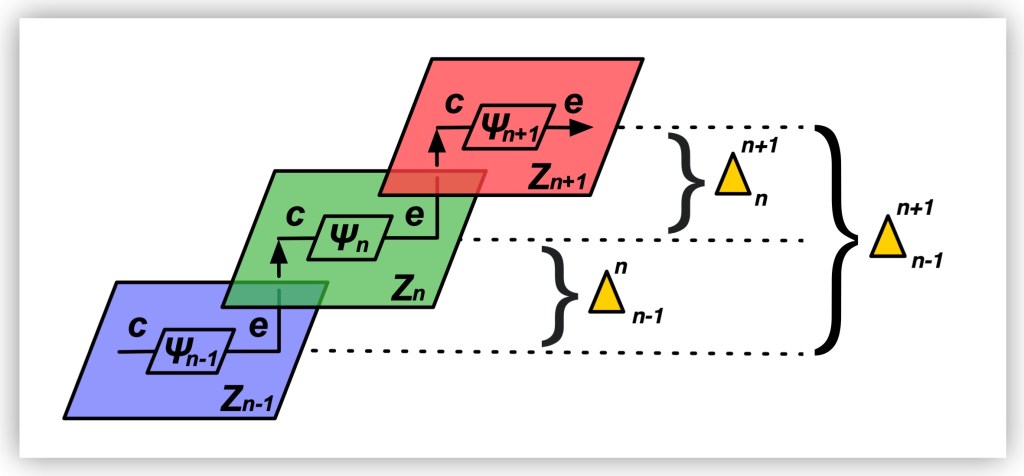
- A Foundational Natural Space (n-1) (a “purple space”): Entities interact under the governing rule Ψn-1, following well-defined causal relationships.
- Accumulation of Incoherence (Δ) leads to a new set of entities: These entities develop increased resistance (higher ZΨ) to the governing rule.
- A New Natural Space (n) (a “green space”) emerges: The new entities interact with each other under a different governing rule (Ψn). The interactions within this space are distinct from those of the original space.
- The cycle continues, leading to even higher-order Natural Spaces: Each new space (a “red space”) stacks atop the previous one, forming an increasingly complex hierarchy of interactions.
4.2.7 Interpreting Reality Through Layers
Reality organizes itself into Natural Spaces, where interactions follow distinct causal patterns. These spaces aren’t absolute. They emerge through the accumulation of harmonized Incoherence.
From our perspective, these emergent spaces align with recognizable domains:
- A Physical Space (purple): Where atomic and astronomical bodies interact under physical laws.
- A Biological Space (green): Where living entities evolve and adapt through selection.
- A Cognitive Space (red): Where minds form interpretations, reasoning, and meaning.
Each of these spaces emerges from the one beneath it, creating layers of increasing complexity.
Natural Spaces are interpretations of causal dynamics. They represent the way we model reality, while the underlying causal phenomena remain hidden. They allow us to navigate an otherwise incomprehensible world, bridging the mind’s interpretations with the causal patterns that sustain reality.
With this established, we can now present The Natural Reality Framework.
4.3 Principles of Natural Reality
Nature operates as a network of interacting natural processes.
At first, the universe seems made of things.
A tree stands tall, a rock sits solid, a river flows by.
But the rock that looks permanent is slowly eroding. Geological forces act on it constantly. Wind, water, and temperature swings break it down grain by grain. Today’s rock is one moment in millions of years of transformation.
The river alters the land as it flows, moving soil and rock, carving new channels. Tomorrow’s river will follow a slightly different path because it has changed its landscape.
The tree grows, converts sunlight into sugar, exchanges gases with the air, drops leaves that become soil. Eventually it will decay and feed other organisms.
Each example shows the same principle. What looks solid and separate is formed through countless interactions.
Electrons jump between energy levels. Atoms vibrate and bond. Heat flows through everything while pressure builds and releases. The rock connects to its environment through rain washing away minerals, roots that split its cracks open wider, lichen slowly consuming its surface. The river exists through glaciers melting upstream, clouds forming overhead, aquifers filling below.
Everything participates in everything else, and nothing stands apart.
We rarely see this vast web. Our minds turn the flow of change into manageable concepts such as rock, river, and tree. We need these labels to make decisions, communicate, and move through the world, but they create an expectation of separation with no basis in happening.
Instruments let us measure more, but measurements remain interpretations. Despite all our advancements, we still only know one thing: change is all there is.
The universe is not made of things. It’s made of processes. A “thing” is a snapshot of a process.
The rock’s dissolution happens whether any of us observes it or not. “Rock” is the meaning we create when we encounter that process. We see a solid object (meaning). What’s going on is change (happening).
When you recognize processes instead of things, those interactions are everywhere. The boundaries we draw are meanings our minds create, useful for thought but not features of happening itself.
Every natural process has three parts: an inside, an outside, and a boundary.
Take a biological cell. We often describe the membrane as its boundary, yet the real boundary lives in the interaction between inside and outside. Beyond the membrane, molecules collide, temperatures change, and reactions occur. These are happenings.
Inside, the cell generates its responses. When the environment changes, events at the boundary trigger interpretation. The cell experiences meaning built from signals created by those external events, meaning that arises from its own internal processes responding to what reaches its boundary.
The chemistry outside is happening. The cell’s interpretations inside are meaning.
The inside of a natural process can’t observe the outside. It only knows a signal has reached its boundary.
The boundary functions as a transformer. External events happen. The boundary receives signals related to the event and triggers the inside, leading it to generate meaning internally. When action follows from that meaning, the boundary emits signals that turn into new happenings in the outside world.
Each natural process has an inside where meaning is produced and handled, and an outside where happening occurs. This dual existence lets a process interpret events while also affecting them.
All processes produce their responses from within. Here, we move from the mind as a special case to internal modeling as a general principle.
When an electron exhibits mass or charge, it expresses a response determined by its own internal model, one we can’t directly access. We observe its behavior, interpret the pattern, and call it “mass.”
This is our model, not the electron’s.
Our minds project interpretation onto the electron’s response, modeling it as if exposing an inner reality. Yet the electron’s actual internal model remains its own. Whether it’s the mind’s construction of experience or the electron’s response to interaction, each process generates responses from within. Our models arise from interpreting these responses without direct access to what lies inside.
To see this in action, we begin with a single process.
4.3.1 A Single Process
Figure 16 corresponds to Figure 1 from Chapter 1, now generalized to apply to all processes:
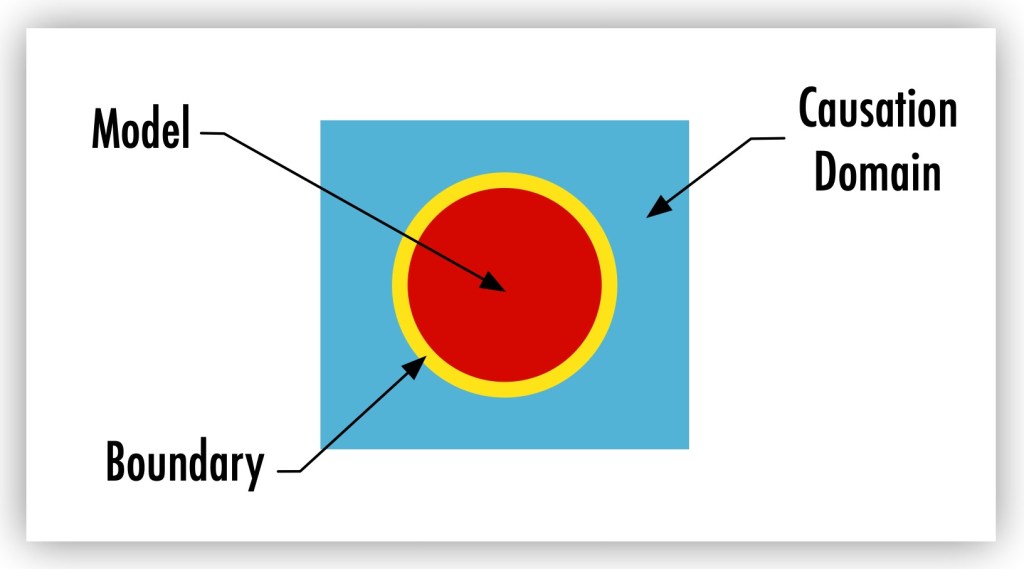
Each process maintains its own model, its Red Space, and interacts with the outside world, the Blue Space (Causation Domain), across a boundary.
When we say a process has an inside and outside, we’re describing distinct dimensions of the same phenomenon. The outside is part of the process. Happening in the Blue Space produces the Red Space, and the Red Space produces more happening in the Blue Space.
4.3.2 Other Processes
Processes operate in parallel, each developing its own internal model. Figure 17 corresponds to Figure 2 from Chapter 1, now applied to any process:
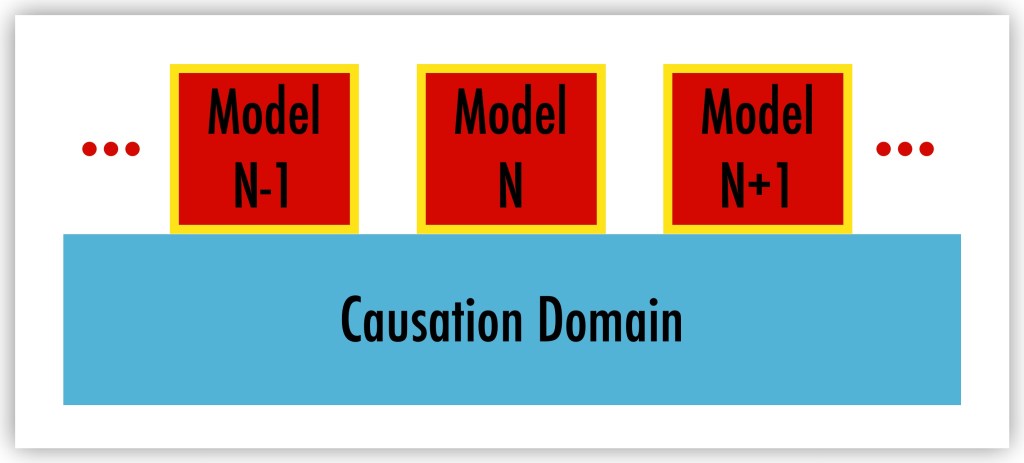
Each Red Space represents an independent process’s internal model within the Interpretative Domain, while the Causation Domain (Blue Space) is the shared external world where interactions take place.
4.3.3 Parallelism and Orthogonality
The Framework follows two basic principles:
- Parallelism: Each process constructs its own internal reality independently and without merging with others.
- Orthogonality: No process has direct access to another’s internal model; all interactions occur exclusively through the Causation Domain.
Figure 17 corresponds to Figure 3 from Chapter 1, now reframed as The Natural Reality Framework:
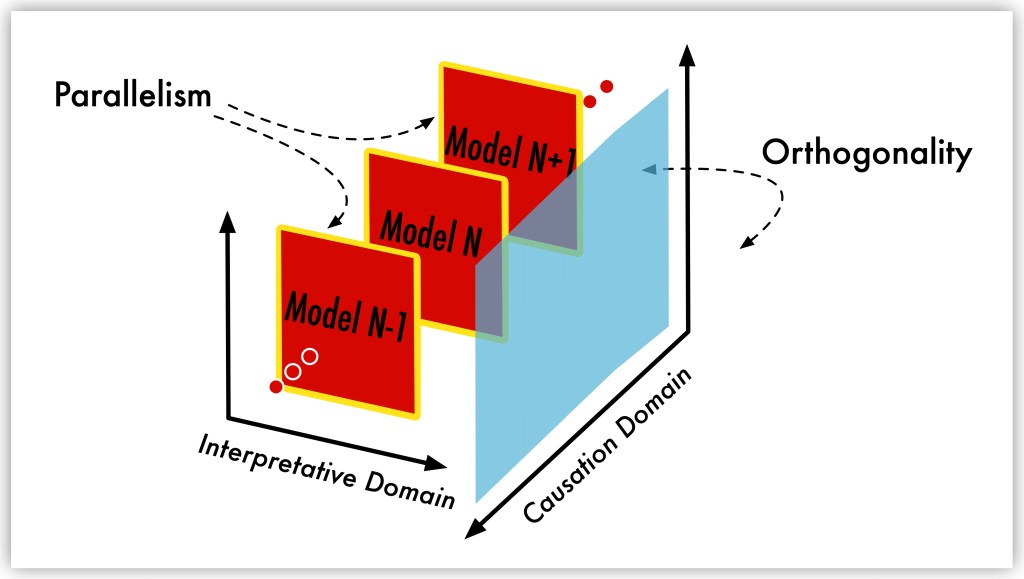
Processes interact in the Causation Domain, and each process interprets those interactions separately within its own internal model.
4.3.4 Where to Draw the Line
Understanding orthogonality takes effort.
Other distinctions have been tried: physical versus abstract, mind versus body, subjective versus objective. None of them work because they’re not truly orthogonal. Physical and abstract are both concepts about processes. Mind and body are interpretive categories being treated as if they were fundamental. Subjective and objective collapse because objectivity is itself an interpretation.
The search for true orthogonality expands the dynamic range of the map. We test boundaries until we reach the extremes. On one side: happening. On the other side: meaning. That’s where the orthogonal relationship comes into focus.
Causation is what happens. Interpretation is the meaning we build from what happens. They work in different domains while influencing each other continuously. Causation drives what happens, but interpretation also drives causation when meaning turns into action.
Finding this boundary requires holding contradictions long enough for a new model to form. The mind fixes meaning instantly using existing models. That efficiency causes unfamiliar concepts to be absorbed too quickly, quieting contradictions before they can trigger reorganization.
Without distinguishing these domains fully, useful work still happens in purple space, where causation and interpretation blend together. But to see the framework clearly, we need the fundamental distinction.
True orthogonality appears when we find the boundary that works. Causation and interpretation remain distinct. They work together. They describe the same reality from independent perspectives. Both are required.
This clarity matters because everything that follows depends on it.
4.3.5 Layers of Natural Spaces
Across the reachable universe, the Interpretative Domain includes distinct layers. Each one emerges as reality propagates in a different way.
- A Purple Space: where what we call the physical world takes form.
- A Green Space: where what we call biology adapts and persists.
- A Red Space: where cognition arises, forming internal models.
Each of these spaces is orthogonal to the Causation Domain.
From inside our Red Spaces, these layers appear as a single, seamless experience. The human mind doesn’t register the separation between physical, biological, and cognitive spaces. It blends them.
The blindfold works here.
Consider the moon. When we see it in the sky, something about it feels different. It’s part of our world, yet it carries the feeling of another reality entirely. The same sensation arises when we think about deep-sea life, thriving in total darkness under immense pressure, or atoms, the invisible foundations of everything, operating at a scale that defies intuition.
Though all of these belong to the same universe, they feel like separate realities. The moon, deep-sea life, and atomic structures seem separate from the world we move through every day.
We see everything from our own Red Spaces, where perception smooths over these distinctions, blending all experiences into a single world. The mind interprets everything as if it occurs in the same place. That recognition, the feeling that something is different, hints at the Incoherence that separates Natural Spaces.
We don’t see it because the Causation Domain is orthogonal to our Red Spaces, but this Incoherence (Δ) still exists.
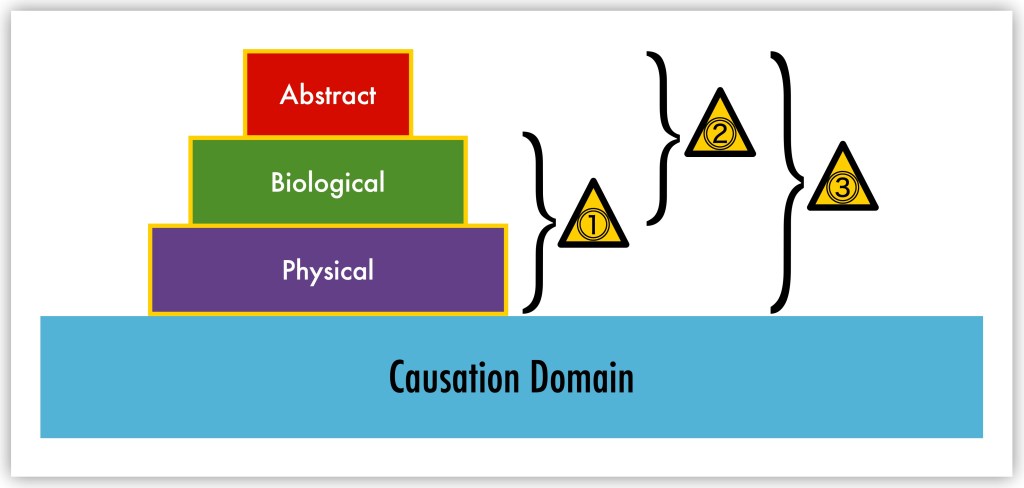
Outside of perception, each layer emerges from the one beneath it, forming a hierarchy of interactions. From within the mind, these separations are invisible. We only experience their effects when applying the rules of one space to another.
Reality feels unified, despite the principles governing matter, life, and thought being distinct. The Incoherence between these spaces remains unseen, yet it defines how reality builds itself.
4.3.6 How Influence Spreads
Every process exists within its own internal model, constructing reality from its interactions. No process shares its internal state with another. All interaction happens through the external world. A question follows: How do processes communicate, respond, and adapt if they can’t transfer meaning?
The answer is induction.
Induction is the mechanism by which a process interprets external interactions, creating internal representations within its model. Since these representations aren’t shared, all interactions occur through the Causation Domain, where each process interprets causation according to its own framework.
To illustrate this, Figure 20 shows a process interpreting external causal effects as an induced cause within its internal model, forming its own understanding of reality.
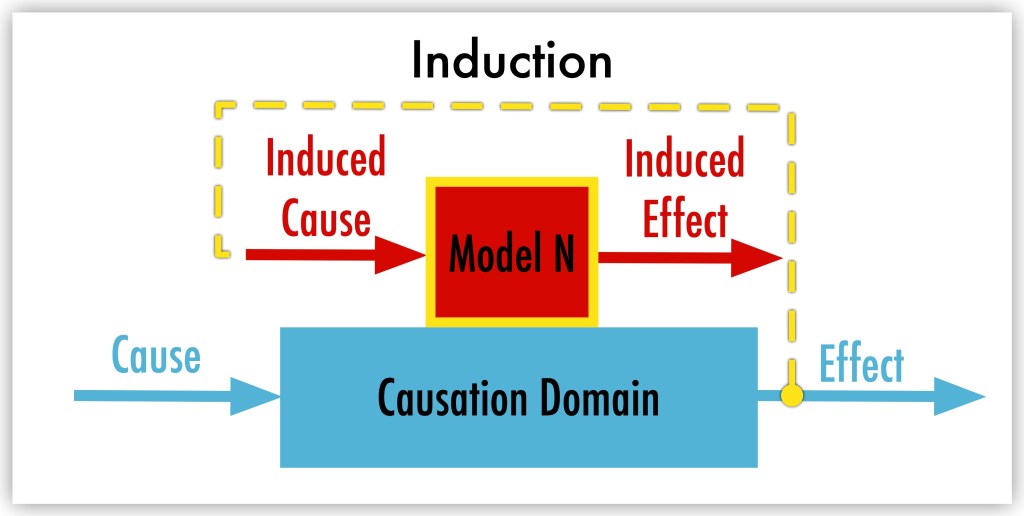
Interactions don’t transfer meaning. They create happening that each process interprets on its own.
The yellow path in Figure 20 shows this: how a cause in the Causation Domain leads to an induced cause in the internal model (Model N), which then creates an induced effect based on its internal rules.
Once the internal model processes the induced cause, it may or may not create a response in the Causation Domain, completing a loop of interaction.
The yellow line represents light; not just the light we see, but the mechanism that governs interaction at all levels. Light is the boundary between causation and interpretation. This will be explored in Chapter 6.
4.3.7 Obstacles or Other Processes
As a natural process operates, it may encounter what seem like obstacles. Obstacles are simply other processes affecting one another.
Each exists within its own internal universe, represented by Red Spaces. They connect through the outside, represented by the Blue Space, which serves as the medium of happening.
Each process stays enclosed within its boundary, yet they induce causal events in the external world. These interactions influence one another indirectly. The Red Spaces themselves can’t directly communicate.
What appears as an obstacle to one process is its internal representation of another. Meaning never transfers between them. One process’s action creates conditions that induce another’s response.
4.3.8 How Energy Works
Imagine pushing a cart up a hill. At the top, you let it go. It rolls down.
Every process has an inside and an outside. What it holds internally is potential. What it expresses through interaction is flow.
The cart at rest holds potential energy. This readiness lives in the interpretative models of the processes (e.g., atoms) we call “cart,” a condition maintained within their relationship to other processes that have mass. When it rolls down, that internal readiness turns into external behavior.
When you observe the cart rolling downhill, what you see as “motion” is your mind’s interpretation of causal activity happening in the Blue Space. Because of the blindfold, we can’t observe causation but only interpret it. What we call “kinetic energy” is how we model the causal activity that’s happening.
Potential turns into flow, and flow accumulates back into potential. A rolling ball compresses a spring. Water flowing downhill gets pumped back up. Push the cart uphill and motion turns back into stored readiness.
Where was the cart’s potential energy before you pushed it uphill? After it stops rolling, where does the kinetic energy go?
Follow the energy backward: from the cart to your muscles, from your muscles to the food you ate, from that food to photosynthesis, from photosynthesis to the sun. Follow it forward: from the rolling cart to friction, from friction to heat, from heat to molecular motion that spreads outward indefinitely. The trail never ends because energy describes relationships between processes rather than some substance that moves from place to place.
These observations give rise to the mathematical principle:
Potential = Impedance × Flow
And the same relationship appears everywhere:
- Ohm’s Law: Voltage = Resistance × Current
- Newton’s Second Law: Force = Mass × Acceleration
- Motion: Distance = Time × Velocity
Energy describes what processes hold internally and what they express through interaction. A battery’s voltage turns into current. A spring’s tension turns into motion. A mind’s intention turns into action.
4.4 Closing Remarks
Reality works differently than we imagined.
Every natural process constructs its own internal reality while participating in shared causation. An electron building its response to electromagnetic waves uses the same mechanism as the mind building experience from sensory input.
Internal construction and external influence operate together at every scale, from the smallest entities to the largest structures in the reachable universe.
New realities emerge through the harmonization of Incoherence: processes develop new ways of engaging with causation that create entirely new forms of interaction. These transitions happen through selection mechanics explored in the next chapter.
With this understanding, we can explain complexity, recognize conditions where emergence is possible, and work with the flow of natural processes.
 The Abstractionist’s Papers