A Natural Theory of Light
The real agent of causal propagation has been hiding in plain sight.
Light.
When you see a loved one’s face, light makes that moment happen. You feel their touch through electromagnetic interactions between atoms. The sound of a songbird reaches you via electromagnetic signals your ear transforms into meaning.
When an atom releases energy, light appears. It drives chemical reactions. Our bodies move as light moves through them, making action possible. Light propagates influence from one process to the next.
Without light, natural processes couldn’t interact across the boundary between causation and interpretation.
Light enables transformation between meaning and happening. This chapter shows how.
Contents
6.1 Understanding Light
6.1.1 Electromagnetic Characterization
6.1.2 Light in Natural Reality
6.2 The Mechanics of Causal Propagation
6.2.1 The Induction Path
6.2.2 Causal Coupling
6.2.3 Causal Impedance
6.2.4 Mathematical Representation
6.2.5 Impedance Across Causal Spaces
6.3 The Constant Speed of Light
6.3.1 E=mc² and the Boundary
6.4 How Light Enables Communication
6.5 How Electricity Works
6.6 Resolving Quantum Paradoxes
6.6.1 Wave-Particle Duality
6.6.2 The Double-Slit Experiment
6.6.3 Quantum Entanglement
6.6.4 Wave Function Collapse and Schrödinger’s Cat
6.7 Closing Remarks
6.1 Understanding Light
Classical physics treats light as electromagnetic waves: electric and magnetic fields sustaining each other in self-propagating oscillations. Quantum mechanics describes discrete photons that behave like particles when detected, waves when undisturbed.
This section first reviews how physics characterizes light, then examines how Natural Reality changes that understanding.
6.1.1 Electromagnetic Characterization
Flip a switch and a room illuminates. Sunlight reaches Earth and makes life possible. Radio waves carry signals across continents. Light from distant stars reveals the universe’s history.
Physics describes this behavior with remarkable success. In the 1860s, James Clerk Maxwell discovered that changing electric fields generate magnetic fields, and changing magnetic fields generate electric fields. These fields sustain each other in waves that need no medium to travel through. Unlike sound waves, which require air, or water waves, which require water, light moves through empty space.
Electric and magnetic fields are often treated as separate components, but their relationship creates electromagnetic waves. A century later, quantum mechanics added another set of ideas. Light exists as quantized energy packets called photons that behave like waves when traveling and like particles when detected.
Maxwell’s equations predict how electromagnetic fields propagate. Quantum mechanics explains discrete energy levels. Phones, Wi-Fi, microwave ovens, and satellites orbiting Earth all depend on our understanding of electromagnetic behavior.
These characterizations don’t explain how influence propagates so that one thing causes another to happen. How cause turns into effect remains unclear.
6.1.2 Light in Natural Reality
Sunlight hits a solar panel and electrons move. Light enters your eye and chemical reactions cascade. A radio signal reaches an antenna and current flows. Light carries influence from one event to the next without direct contact.
Light is the boundary between causation and interpretation.
The orthogonality between electric and magnetic fields expresses this relationship, enabling interaction between the two domains.
What travels is variation, not meaning. Each receiver interprets that variation in its own way.
We focus on light because electromagnetic interaction dominates what we can directly measure and manipulate.
The next sections develop the mathematics and technical details of how light enables the interplay between causation and interpretation. For readers interested in conceptual implications rather than technical formalism, sections 6.4 (Communication), 6.5 (Electricity), and 6.6 (Quantum Paradoxes) show familiar phenomena in new ways.
6.2 The Mechanics of Causal Propagation
Light carries electromagnetic influence between natural processes. When causation reaches interpretation, signals induce meaning. When interpretation returns to causation, meaning transforms into happening.
Causation works in two ways. Direct propagation happens when a process follows its internal rule, producing an effect within its own realm. Induction happens when a process creates conditions that trigger a new cause in another process.
6.2.1 The Induction Path
Causal spaces are conceptual realms defined by their governing rules. They explain how influence propagates and change happens.
As shown in Figure 25, causal spaces interact through inductive coupling. An effect in one space leads to a new cause in another. The new cause is induced in response to the original effect.
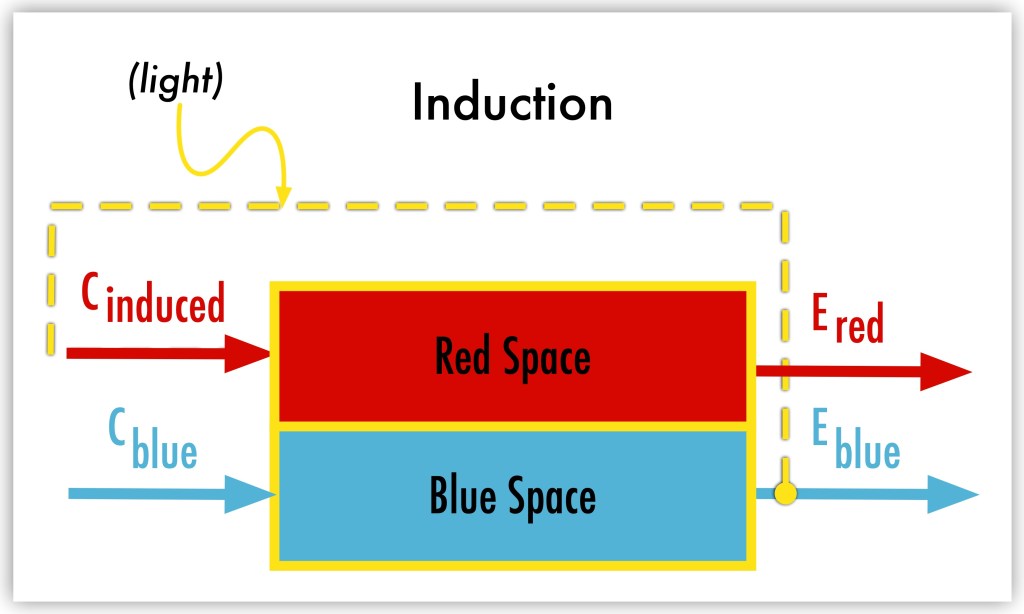
- The Blue Space represents a causal space where a process follows one set of causal rules.
- The Red Space represents another causal space, like an interpretative space, governed by different rules.
These spaces remain distinct. Light allows a process in one to induce a new cause in the other. It provides the path for cross-space interaction, without requiring direct contact.
The induced cause in the Red Space is related to the originating effect in the Blue Space, but it propagates under different constraints. Causation operates as a network of influence rather than a linear chain of events.
The relationships arise through engagement. Light creates a bridge across domains, enabling interactions between processes that otherwise could not interact directly.
6.2.2 Causal Coupling
In one-way induction, the relationship happens in two stages:
- An effect in the Blue Space (E_blue) induces a new cause (C_induced) in the Red Space: The induced cause in the Red Space is functionally related to, but distinct from, the originating effect.
- The induced (C_induced) cause propagates under the rules of the Red Space to produce an induced effect (E_red): The new effect develops according to the rules of the Red Space, independent of conditions in the Blue Space.
In some cases, induction flows both ways. Each space triggers changes in the other, forming a feedback loop. When these interactions align, they can reinforce one another.
Resonance is amplified induction, where influence continues to cycle through mutual engagement.
6.2.3 Causal Impedance
Causal propagation follows rules that govern how a cause (C) transforms into an effect (E) within a given causal space.
Alignment with these rules varies by degree, defined by causal impedance (Z):
- Impedance measures the resistance to causal influence.
- Admittance measures the ease with which influence propagates.
Causal impedance defines how easily the governing rule applies, determining the efficiency of propagation.
Just as electrical circuits have measurable resistance, causal interactions have quantifiable impedance and admittance.
6.2.4 Mathematical Representation
Causal impedance (Z) quantifies how strongly a process resists transformation under a governing rule. If A represents admittance, and a process transforms cause C into effect E, the relationship is:
E = A * C
Since impedance is the reciprocal of admittance, this can also be written as:
C = Z * E, where Z = 1 / A
A process with high impedance resists transformation. It requires a stronger cause to produce an effect.
Low impedance enables effects more easily.
6.2.5 Impedance Across Causal Spaces
Cross-space induction follows a mathematical pathway. Using the notation from Figure 25:
- C_blue as the cause in the Blue Space,
- E_blue as the effect in the Blue Space,
- C_induced as the induced cause in the Red Space,
- E_red as the effect in the Red Space.
Within the Blue Space, propagation is governed by:
E_blue = A_blue * C_blue
This effect induces a new cause in the Red Space:
C_induced = f(E_blue)
Where f is the transformation function governing how influence crosses between causal spaces.
In the Red Space, this cause propagates according to its own rules:
E_red = A_red * C_induced
Substituting, we get:
E_red = A_red f(A_blue C_blue)
Causal induction operates as a transformation mediated by light.
6.3 The Constant Speed of Light
In vacuum, light propagates at approximately 299,792 km/s regardless of the motion of the observer or the light source. This constancy across inertial reference frames was confirmed by experiments like Michelson-Morley and led to Einstein’s special relativity.
Light’s behavior differs from classical waves. Pressure waves propagate at a fixed speed relative to their medium (air, water, etc.), but observers moving relative to that medium measure different frequencies due to the Doppler effect. Light shows no such medium dependence. Its speed in vacuum remains constant even when the observer moves.
Why this constancy? Electromagnetic propagation occurs at the boundary through causal relationships we can’t directly observe. What we measure as “speed” and “distance” are Red Space models we build to organize those causal relationships.
When we say light takes 8 minutes to reach Earth from the sun, we’re modeling the relationship between electromagnetic propagation extent and our reference cycles (Earth’s rotation, atomic oscillations, clock mechanisms). Both the propagation and our measurement processes operate electromagnetically at the interpretation boundary.
We measure electromagnetic causation using electromagnetic mechanisms. A ruler can’t detect its own expansion because it measures itself with itself. We can’t detect variation in c for the same reason. Every electromagnetic process measuring electromagnetic propagation operates at the same boundary, yielding the same result.
The constancy of c reflects our position at the electromagnetic interpretation boundary, which brings us to Einstein’s most famous equation.
6.3.1 E=mc² and the Boundary
Things can be prepared to act, or they can be acting. Potential belongs to the Interpretative Domain while flow belongs to the Causation Domain. Everything participates in both domains at once.
Potential refers to readiness maintained internally. A charged battery holds a difference that can support current when a path is available, a compressed spring maintains tension, and a body prepares to leap.
Flow refers to behavior expressed through interaction. Current travels through a wire, heat spreads across a surface, and a body moves.
Energy describes how potential and flow coordinate. A ball begins to fall, its potential becomes flow, that flow reaches something else, and new potential forms. It shows how potential in one place supports flow in another.
Einstein’s E = mc² describes the boundary between domains. Mass indicates how a process resists acceleration while energy represents transformation potential. Light (c) exists at this interface, and the equation describes how causal interaction and interpretive response connect through electromagnetic processes operating at this interface.
6.4 How Light Enables Communication
Minds communicate without exchanging meaning. Happenings in the Blue Space trigger changes that each mind interprets. We describe this as information transfer, but no meaning travels between minds. Each receiver builds meaning from signals according to its own internal model.
During World War II, Alan Turing intercepted thousands of encrypted German radio transmissions. The Enigma machine generated mechanical patterns, but the breakthrough came when Turing recognized that human operators left predictable fingerprints in the signals. They reused phrases, added familiar headers, organized information in ways that felt natural to human minds.
The radio waves carried pure electromagnetic variation. Meaning arose when German operators created the messages and again when Turing’s team built meaning from those same signals. Between transmission and reception lay only variation moving through the Blue Space. Thought induces signal, signal induces new thought, each transformation happening independently within separate minds connected only through happenings.
A fiber-optic receiver transforms intensity and phase changes into electrical signals. The signal provides the trigger; the receiver creates the meaning. The signal moves forward, but meaning is produced where engagement happens.
Light rings the doorbell. The answer comes from within.
When you speak, meaning in your Red Space induces electromagnetic signals in your nervous system. Those signals produce motor action: your vocal cords vibrate, air moves, your body gestures. The happenings create pressure waves that reach another person’s ear. At their boundary, electromagnetic signals in their nervous system transform those happenings into meaning in their Red Space.
The mind works within a vast landscape of meaning, yet in the world of happening, we can only move the body. Each movement begins as electrical impulses in the nervous system, electromagnetic signals at the boundary between domains. Through them, the mind engages with a world it cannot directly see.
6.5 How Electricity Works
Electrons crawl through conductors at millimeters per second, yet the light switches on instantly. This paradox has persisted for over a century. We’ve explained electrical current as electrons flowing through wires like water through pipes. The model works for calculations but misses what happens.
When we flip a switch, an electromagnetic wave propagates along the wire at nearly light speed. The wave carries causal variation that enables each electron and atom in the conductor to react according to its internal model. Each provides impedance to electromagnetic propagation, enabling influence to extend to the next.
Building a circuit means constructing a causal engine. Each component has its own internal model. Resistors convert electromagnetic energy to heat, capacitors store and release charge, transistors switch states based on input conditions. The circuit layout determines how causal influence propagates between components.
Apply voltage at one end of a wire and causal variation reaches the other end at nearly light speed. Each electron gets induced and induces the next, creating a chain of causal responses. The variation propagates through induction while energy dissipates through resistance.
Influence propagates independently of physical matter. If influence can reach its destination before matter moves, then space and time aren’t the stage where causation plays out.
They’re interpretative tools we use to organize what we see.
6.6 Resolving Quantum Paradoxes
For most of human history, we assumed we observe happening. It served us well.
Then physicists began studying phenomena far beyond everyday experience. Particles behaved like waves. Measurements changed outcomes. Distant interactions showed instant correlations. Equations were built to predict these behaviors, and the predictions work. The assumption remained that these observations revealed happening itself, just at smaller scales.
The paradoxes multiplied.
Quantum phenomena force us to confront what we’ve always navigated: the gap between causation and interpretation exists everywhere, at every scale. We notice it in quantum mechanics because our familiar ways of making meaning fail there.
6.6.1 Wave-Particle Duality
Light behaves as waves in some contexts and as particles in others. Diffracting around obstacles or creating interference patterns, light acts like a wave. Absorbed by atoms or detected by instruments, it appears as discrete particles. How can light be both?
Light propagates continuously at the boundary between causation and interpretation. What we call a “photon” is a discrete response event: a process engages with that continuous propagation and responds. Each process reacts in its own way to the same continuous phenomenon.
Continuous propagation appears as waves. Discrete detection events appear as particles. We’re measuring different aspects of the same boundary phenomenon.
6.6.2 The Double-Slit Experiment
The double-slit experiment demonstrates wave-particle duality. When light shines through two slits, the measurement setup determines what we observe.
Without detection equipment at the slits, an interference pattern appears on the screen. Overlapping contributions from both paths create alternating bright and dark bands. Multiple paths remain available at the boundary.
Add detectors to register which slit the light passes through, and the interference pattern vanishes. The light traveled through one specific slit.
The interference pattern shows Blue Space possibilities distributed before detection constrains them. Without measurement at the slits, both paths persist and their combined distribution creates the pattern.
With a detector present, measurement produces a discrete interpretation. The detector’s response creates an actuality from available possibilities.
6.6.3 Quantum Entanglement
Entangled particles show correlated measurements across any distance. Measure one particle’s spin, and the other instantly shows the same correlation. Einstein called this “spooky action at a distance” because it seemed to require faster-than-light communication between the particles.
These processes (what we call particles, like electrons or photons) don’t communicate.
When two processes both experience the same happening in the Blue Space, they both receive signals from it. If their internal models are compatible, this shared experience changes how they respond to subsequent signals.
Later, when new happenings occur, both respond in correlated ways. That initial experience changed how they operate.
Two electrons become entangled when they’re compatible and experience the same happening. An electron and a fundamentally different process won’t become entangled because their internal models differ too much.
When physicists measure entanglement later, they find correlated results. Both now respond similarly to certain signals because of that earlier shared experience.
No information travels between them. Both experienced the same past happening. They act independently on new signals, but their actions correlate because that experience changed them.
6.6.4 Wave Function Collapse and Schrödinger’s Cat
What quantum mechanics calls “wave function collapse” is induction. A process engages with continuous electromagnetic propagation and transforms happening into meaning.
The wave function describes possibilities in Blue Space causation. Measurement is an induction event: a process engages with causation and builds an interpretation. The “collapse” happens when a Red Space interpretation forms from Blue Space possibilities. Each measurement marks where what could happen yields what actually happens.
In Schrödinger’s famous thought experiment, a cat sits in a sealed box. A radioactive source may or may not trigger a mechanism that kills the cat. Physicists debate whether the cat exists in superposition, both alive and dead, until someone opens the box and looks.
You don’t know if the cat is alive until you open the box, quantum trigger or not. The cat could be dead for any number of reasons, including ones you can’t anticipate. Even after looking, you have an interpretation of what occurs. You never have access to causation.
The radioactive mechanism is irrelevant. The paradox exists in everyday life, not just quantum mechanics. Quantum physics highlights the gap between happening and meaning that we navigate constantly.
6.7 Closing Remarks
Light is the boundary between causation and interpretation. The perpendicular relationship between electric and magnetic fields expresses this boundary. Electromagnetic propagation at this boundary induces interpretation events in Red Space and enables happening in the Blue Space, allowing interaction between domains that otherwise couldn’t touch.
Every mystery this chapter addressed follows from this. Wave-particle duality exists because continuous propagation becomes discrete response events. The speed of light stays constant because we measure electromagnetic phenomena with electromagnetic tools. Quantum measurements create actualities from possibilities at this boundary. Electricity propagates through induction while electrons barely move.
When you see, light carries influence from the world to your retina. When you move, light carries intent from your mind to your muscles. Every thought that becomes action and every signal that becomes meaning depends on electromagnetic propagation at this boundary.
Light is the agent of causal propagation. It bridges causation and interpretation, enabling every natural process’ individual inside to engage with the shared, causal outside. Meaning and happening remain separate, yet everything we experience, everything we do, and everything we understand depends on light.
 The Abstractionist’s Papers