
Table of Contents
Preface
The Mind’s Stage
Processes, Not Things
An Inside, an Outside, and a Boundary
A Process’s Reality
Other Processes
Navigating the Internal Model
The Human Condition
A Brief Introduction to Natural Reality
Practicing Natural Reality
Frequently Asked Questions
Preface
In the fall of 2024, I was finishing a series of writings that would become The Abstractionist’s Papers when I asked myself:
Could the entire Natural Reality framework be told in ten minutes?
I still don’t know.
What I do know is that Glitches in Reality helped me find the clearest path through the material. It showed me which concepts were truly foundational: meaning and happening, the inside–outside–boundary, and paradox.
Glitches remains what it was meant to be all along, a brief introduction to Natural Reality. If you want a glimpse of what The Papers explores before committing to the full work, this book offers the essentials.
The Papers builds the framework from first principles, expanding it progressively. It includes diagrams, models, and examples drawn from life. Each chapter presents ideas in ways designed to induce emergence.
Glitches also stands on its own. It is a doorway that may satisfy your curiosity or invite you further into the Blue Space.
Let’s begin.
Luiz von Paumgartten
The Mind’s Stage
“A mind that is stretched by a new experience can never go back to its old dimensions.”
— Oliver Wendell Holmes Sr.
You’re starting to question reality.
Perhaps you’ve always suspected there’s more going on than meets the eye. Is life a simulation? Are we living in parallel universes? What is consciousness? Does time exist? Maybe you watched The Matrix one too many times. Then you read about quantum mechanics, dark matter, the Big Bang, black holes, and now nothing makes sense.
Yet what’s been hiding in plain sight is far more basic:
You don’t see happening. You never have.
Everything you experience is meaning your mind creates.
Draw a line through all of existence. On one side lies meaning, on the other, happening. You participate in happening. You move, interact, affect things. But you only ever experience meaning.
What counts as meaning? Images, sounds, thoughts, and feelings. The cup of coffee on your desk, the weight of your body in the chair, your understanding of these words. Your mind produces all of it.
What counts as happening? The moment we name it, we’ve turned it into meaning. Even our most rigorous scientific ideas are constructions of meaning. They’re ways of thinking about happening, not happening itself.
Mixing them up is a category error. Asking what color Wednesday is makes no sense because days and colors are different kinds of things. The same applies here. Treating interpretation as if it were the event creates unsolvable problems.
Humanity has never had a working theory of mind because of one unexamined assumption: that we perceive happening. When we believe our minds have direct access to causation, our own inside is commingled with an imagined outside.
The mind hides what it does. You feel as though you’re observing the external world, yet you’re only ever seeing the mind’s stage.
Once you recognize this, you don’t go back.
Processes, Not Things
“Look deep into nature, and then you will understand everything better.”
— Albert Einstein
At first, the universe seems made of things.
A tree stands tall, a rock sits solid, a river flows by.
But the rock that appears permanent is slowly eroding. Geological forces work on it constantly. Wind, water, and temperature swings break it down grain by grain. Today’s rock is one moment in millions of years of transformation.
The river alters the land as it flows, moving soil and rock, carving new channels. Tomorrow’s river will follow a slightly different path because it has changed its landscape.
The tree grows, converts sunlight into sugar, exchanges gases with the air, drops leaves that enrich the soil. Eventually it will decay and feed other organisms.
Each example shows the same principle. What appears solid and separate is formed through countless interactions.
Electrons jump between energy levels. Atoms vibrate and bond. Heat flows through everything while pressure builds and releases. The rock connects to its environment through rain washing away minerals, roots that split its cracks open wider, lichen slowly consuming its surface. The river exists through glaciers melting upstream, clouds forming overhead, aquifers filling below.
Everything participates in everything else, and nothing stands apart.
We rarely see this vast web. Our minds turn the flow of change into manageable concepts such as rock, river, and tree. We need these labels to make decisions, communicate, and move through the world, but they create an expectation of separation with no basis in happening.
Instruments let us measure more, but measurements remain interpretations. Despite all our advancements, we still only know one thing: change is all there is.
The universe is made of processes. A “thing” is a snapshot of a process.
The rock’s dissolution happens whether any of us observes it or not. “Rock” is the meaning we create when we encounter that process. We see a solid object (meaning). What’s going on is change (happening).
When you begin to recognize processes instead of things, those interactions are everywhere. The boundaries we draw are meanings our minds create, useful for thought but not features of happening itself.
If the universe is made of processes, how does it work?
An Inside, an Outside, and a Boundary
Every natural process has three parts: an inside, an outside, and a boundary. Examples include electrons, atoms, molecules, organisms, planets, stars, and galaxies.
The red region is the inside, where meaning lives. The blue region is the outside, where happening occurs. Between them lies the yellow boundary that separates the two.

Take a biological cell. We often describe the membrane as its boundary, yet the real boundary lives in the interaction between inside and outside. Beyond the membrane, molecules collide, temperatures change, and reactions occur. These are happenings.
Inside, the cell generates its responses. When the environment changes, events at the boundary trigger interpretation. The cell experiences meaning built from signals at its boundary.
The inside of a natural process can’t observe the outside. The boundary responds to external happenings and triggers activity inside. This activity gets interpreted without access to what’s happening outside.
The boundary functions as a transformer.
Outside happenings induce meaning inside. When behavior follows, the boundary sends signals outward that create new happenings in the world beyond.
For us, light triggers effects that we interpret as color, shape, sound, temperature, and touch. Whether photons hit the retina, pressure waves reach the ear, or molecules trigger receptors, electromagnetic signals carry the variation to the brain. The brain transforms these signals into meaning.
When you decide to move, your brain sends electromagnetic signals that drive motor action. Perception flows inward and action flows outward, both carried by electromagnetic activity.
Light propagates at the boundary between causation and interpretation, making our participation in reality possible.
Happening induces meaning, and meaning induces happening. They remain independent. Across this boundary, every process builds an internal model that works from its meaning alone. This indirect knowledge still allows the process to operate effectively in a world it can’t see.
A Process’s Reality
From any observer’s point of view, its internal model is all there is. The model creates a workable version of reality to act within. To the observer, that inner reality feels external even though it isn’t.
Each builds a universe from what it detects. A mushroom responds to chemical signals and moisture. A planet responds to gravity and electromagnetic forces.
A moth’s antennae detect a narrow range of chemicals compared to all that exist. A compass needle aligns with magnetic fields, one type of force among many. Each engages with some happenings and not others.
These models change continually.
Each model works through four parts. Interpretation produces what you perceive from signals at the boundary. Expectation provides internal predictions about what should happen. Logic compares interpretation with expectation and identifies differences. Perspective sets orientation, determining what matters and how those differences are understood.
When contradictions appear, logic detects the gap, perspective influences its meaning, and adjustments occur in any of these parts.
As they engage their environments, they receive feedback. When mismatches arise between interpretation and expectation, adjustments follow, often improving the fit with their surroundings.
Every system operates from within its constructed reality yet participates in one shared happening. Meaning arises inside. Behavior occurs outside. They remain separate, connected through the boundary.
Other Processes
No process exists alone. Each moves through a world already alive with other processes.
As their actions meet, the effects of one create conditions for another. What we experience as resistance or obstacles are other processes stumbling through their own blindfolded realities.
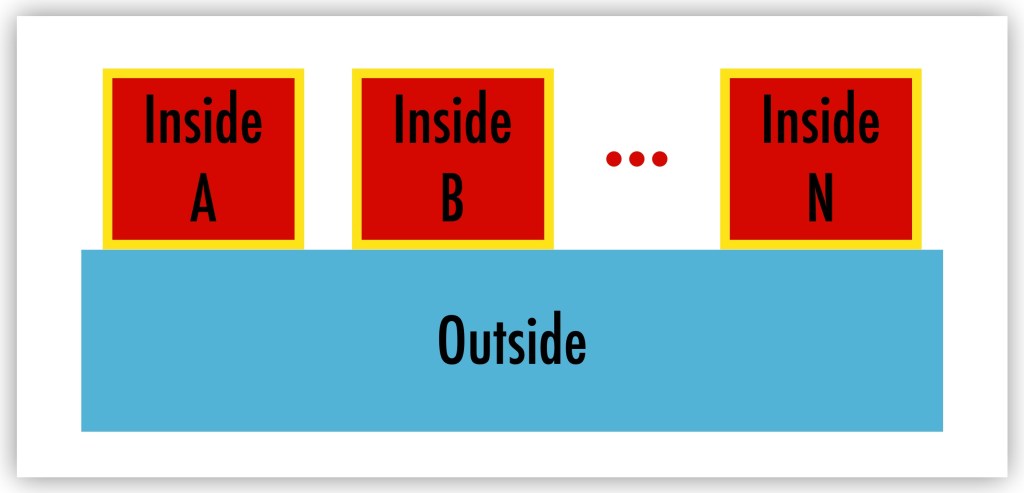
Every natural process has its own internal universe. Inside A, Inside B, and so on, each is a Red Space. These Red Spaces connect only through the outside, the shared Blue Space that serves as the medium of happening.
Although a Red Space remains enclosed, the process still creates events in the Blue Space, signals that reach and influence others indirectly.
Meaning never transfers. One acts, and that action creates conditions that induce meaning inside another’s Red Space.
When people interact, it feels as though ideas pass between them. In fact, what occurs are movement, pressure waves, and light in the Blue Space. These signals carry no meaning. Each person interprets them as words, gestures, and expressions, creating meaning privately within their respective internal models.
Both participants respond internally to what the other does, yet neither ever reaches the other’s inner world. What feels like shared understanding is an approximation that works well enough for interaction to continue.
A person walks past without making eye contact. One observer interprets rejection. Another assumes they’re lost in thought. A third barely notices. Same event, three different meanings.
These interpretations don’t always reflect a process’s choice. Every process operates within conditions it didn’t choose, responding to forces beyond its control. This creates an imbalance. Outside conditions, including encounters with other processes, build most of any process’s internal model.
Navigating the Internal Model
“The map is not the territory.”
— Alfred Korzybski
Every natural process relies on its internal model within its environment. This model is a map. In Natural Reality, the map represents meaning while the territory represents happening.
The outside world doesn’t dictate how a process interprets it. Ten people can witness the same event and form ten different meanings. Each builds its version based on what it detects and how it organizes information. It only needs to work; accuracy and completeness are secondary.
Each process navigates reality through the same four-part framework introduced earlier. What matters now is how this framework behaves in motion, how interpretation and expectation pull against each other, how logic and perspective adjust, and how balance returns when they align.
The comparison between interpretation and expectation creates constant tension. Models function by detecting and responding to differences.
These differences are paradoxes: any mismatch between what you interpret and what you expect, any gap within your internal experience.
A glitch is a paradox you notice.
Paradox is the ordinary condition of a mind at work.
You reach for a cup and your hand moves slightly too far. What you see doesn’t match what you predicted. The mismatch registers, your hand corrects, and the paradox resolves. Every sensation, belief, and movement involves this same cycle of comparison and resolution.
Most paradoxes resolve instantly, and you never notice them.
Some take longer.
You flip a light switch and the room stays dark when it should brighten. You look for explanations. Is the bulb burned out? Did a breaker trip? Each idea gets tested. When you find the cause, your expectation updates and the gap closes.
Other paradoxes resist resolution because emotion and attachment play a role.
A husband expects that working harder will strengthen his marriage. He takes more hours, provides more security, and manages more responsibilities. Yet his wife grows more distant. The gap persists. He can’t reconcile it because the belief touches his sense of fairness, his understanding of love, and his framework for relationships. He keeps generating the same expectation despite contradicting interpretations. Questioning it never occurs to him.
He hasn’t understood that providing and connecting are different things.
Like a needle caught on a record, the same pattern repeats. New experiences don’t update anything, and the same interpretations keep returning despite the gaps.
When paradoxes persist without resolution, something eventually gives. Either reorganization occurs to handle the contradictions, or the model collapses and is replaced by one that can.
Paradoxes signal that the internal model hasn’t yet aligned with how causation works. The gap you experience reflects that misalignment. When the model updates, the paradox resolves.
The same dynamic operates throughout nature. Every natural process compares interpretation with expectation and encounters mismatches. These mismatches drive learning and emergence.
Life feels hard because you’re constantly comparing what you interpret with what you expect, detecting gaps, trying to close them. Usually, your model works well enough. But when it doesn’t, when the same gap keeps returning, you feel stuck.
Paradoxes don’t announce themselves. You just feel the dissonance, the sense that something’s off.
The Human Condition
Some paradoxes define what it’s like to be human.
Loneliness endures because other minds never arrive inside your Red Space. No amount of company changes the isolation of living within an internal world. Anxiety compares imagined futures with a need for certainty that your model can’t provide. Controlling behavior tries to make events conform to an internal story. Depression lingers when comparison to what won’t change consumes the energy for action. Chronic criticism is the mind’s difference detector running without rest until it hardens into contempt.
These are features of how minds work.
Consider the husband from before, who believes that working harder will strengthen his marriage. He takes more hours, provides more security, and manages more responsibilities. Yet his wife grows more distant. He could continue this way indefinitely, gathering frustration. Or his model could reorganize completely. He might realize that work and love follow different kinds of rules. More money may allow better vacations or gifts, but it doesn’t create connection. The activities that sustain a household don’t sustain intimacy. Once he sees these as separate contexts that influence one another without control, his entire framework for relationships changes.
A caterpillar becomes a butterfly. Children who once saw only their needs begin to understand that others have needs as well. These transformations open possibilities that didn’t exist before.
Paradoxes are how we experience pressure from within our models. What feels like contradiction is the force that drives emergence. Resolution breaks repetition and enables transformation.
Every process faces a choice: stay or reorganize. Staying carries the strain of contradictions. Reorganizing requires investment in something new. When patching becomes more expensive than rebuilding, emergence happens.
Each new level of existence has arisen when contradictions at the previous level forced processes to adopt new ways of operating.
A Brief Introduction to Natural Reality
Natural Reality maps two distinct domains of existence: a Causation Domain represented by the Blue Space and an Interpretative Domain represented by Red Spaces.
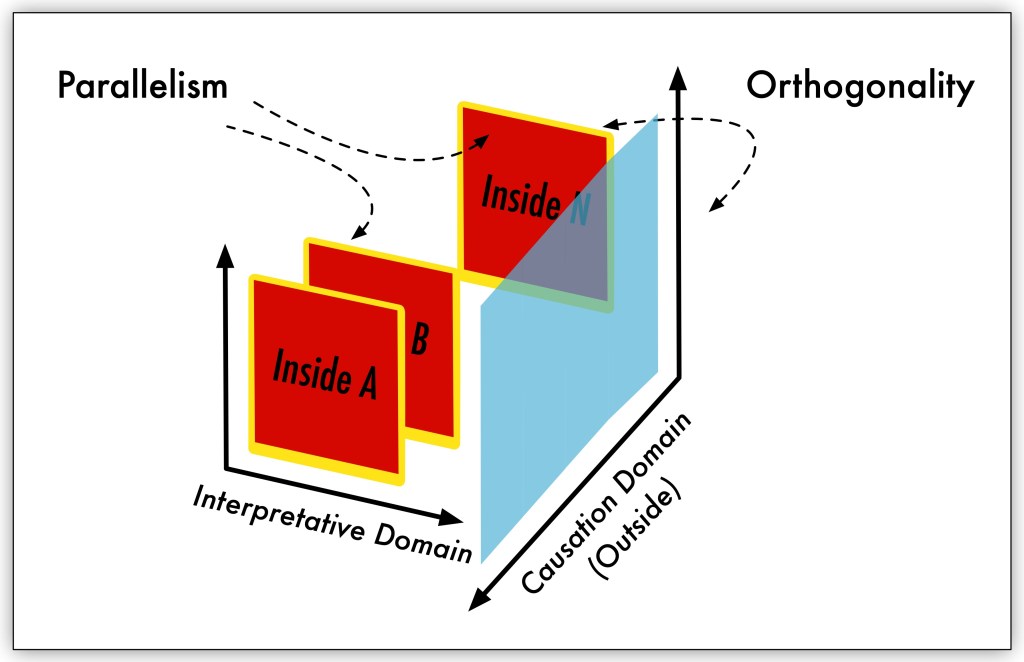
Each natural process has an inside and an outside. The inside is a Red Space where meaning lives. These Red Spaces run parallel to one another, unable to touch, and connect only through the Blue Space, the shared domain where happening occurs.
Red Spaces form the Interpretative Domain, where natural processes build internal representations of the outside. Each process uses its internal world to operate within its surroundings and create meaning.
The Blue Space is the Causation Domain, where happenings occur without interpretation. Everything takes place here, but no individual process experiences it.
Causation carries happening, while interpretation produces meaning.
These domains are orthogonal, like lines that meet at a point but extend in different directions. Though independent, they constantly influence each other through induction.
A process acts in the Blue Space, producing changes that induce new meaning in other processes’ Red Spaces. Those processes act in response, generating new patterns in the Blue Space as the cycle continues.
Each process remains blindfolded, engaging the outside world only through its representations. From within your Red Space, other Red Spaces remain invisible. You can’t see that others are building meanings from the same happenings.
Different processes interpret the same events differently, though all share what happens in the Blue Space. What it means varies by observer. A rainstorm is one causal event, water molecules moving through space. To a farmer it means salvation. To a wedding party it means disappointment. To a frog it means opportunity. Each creates a different meaning from the same happening.
When processes communicate, it feels direct, but meaning stays within individual internal worlds. Your words create pressure waves in the Blue Space carrying no inherent meaning. The listener forms their understanding from those signals, which may differ completely from what you intended.
This separation between the domains resolves long-standing paradoxes.
Consider what physicists call a “photon.”
Light propagates continuously at the boundary between causation and interpretation. You never detect light itself. What you detect is how a process responds when electromagnetic propagation reaches it.
When an electron changes state, when a detector clicks, when a reaction occurs in your eye, you’re observing process behavior, not light. Each response is discrete. The photon is your interpretation of those discrete responses. Wave behavior and particle behavior come from the same continuous propagation, interpreted through different kinds of measurement.
That’s how orthogonality solves wave-particle duality.
To see how the domains work together more broadly, imagine a turntable with multiple needles.
The turntable and record together represent the Blue Space, the continuous world of happening. Each needle, representing a Red Space, traces the same grooves yet registers different vibrations based on its properties. Each interprets the same physical pattern differently.
In Natural Reality, the record has no beginning or end. It turns counterclockwise with the needles moving outward from the center, and each loop represents a line of reasoning.
When a needle repeats without advancing, it signals a paradox.
Moving outward expands perspective, and with each turn, new awareness develops, turning loops into spirals. This growth occurs even though we never access causation. Minds build functional representations of a world they can’t see, working in parallel with the world of happening. Humanity has advanced through patterns of interpretation that mirror the causal world closely enough to allow understanding and change.
Contradictions operate through misalignment between these domains. When our internal worlds repeat without progress, the needle is stuck. Moving the needle forward breaks patterns and resolves mismatches.
Natural Reality explains why minds differ.
Each internal world forms its own universe, existing beside others, as we all participate in the same Blue Space while experiencing different Red Space realities. This is why two people can witness the same event and react in opposite ways, why experts disagree about basic facts, and why love feels different to every person who experiences it.
These differences arise naturally from orthogonal realms: causation that operates independently of any observer, and interpretation that each process constructs from its own perspective.
Practicing Natural Reality
“Happy is the man who has been able to learn the causes of things.”
— Virgil
When we don’t understand how reality works, we tangle ourselves in problems we can’t unravel. Life grows harder than it needs to be. We hold ourselves back without seeing how.
Natural Reality clears away part of the confusion we create.
Recognizing the distinction between causation and interpretation enables us to work with the mechanics of the world instead of our projections. We learn which responses are automatic interpretations and which are genuine choices.
With practice, we begin to see the boundaries of our influence.
Some things we control entirely, others not at all, and most fall somewhere between. The paradoxes of the human condition are more manageable once we understand them as natural features of how minds operate. Our reactions change as we learn to choose our responses.
This is what we’re working with:
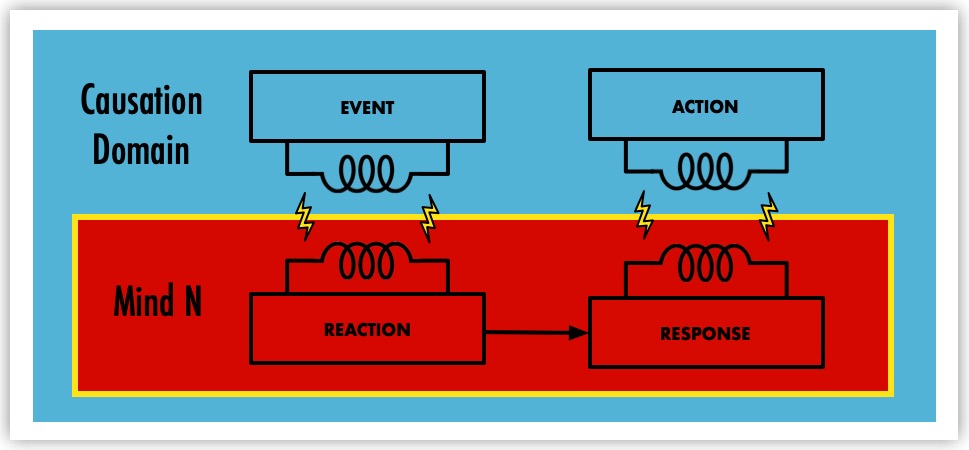
Events from the Causation Domain (the Blue Space) reach your boundary and induce reactions inside your Red Space. Those reactions can lead immediately to responses that send action back out.
The blindfold hides the boundary. Your Red Space interpretation feels like the Blue Space event itself, and your response feels like it’s to the world, not to your reaction.
Yet a space exists between reaction and response, and that’s where agency lives. Practicing Natural Reality means learning to recognize that space, moment to moment, and use it.
Once we realize that we experience only our interpretation of another person and never the person, we become curious about who they are. We offer them the benefit of the doubt because what we see is a construction of our making.
We make space for otherness.
And for ourselves, too.
Not being able to tell happening from meaning keeps life smaller than it could be. We chase what we want directly. When reality doesn’t cooperate, we think something’s wrong with us or the world is rigged against us.
What we want lives in our Red Spaces as meaning. How we get there happens in the Blue Space through causation. The action that produces any outcome usually looks nothing like that outcome. Chasing butterflies doesn’t get us butterflies. Planting flowers does.
Possibility becomes probability becomes inevitability. We create conditions that make what we want available, then likely, then real.
All along, you have suspected there’s more happening than what you see. The glitches led us here: two domains, separate yet interacting.
Start practicing. There’s never been a better now.
Frequently Asked Questions
1. What is the central thesis of Glitches in Reality?
Our experience of reality is not a direct perception of the world but an interpretation created within our minds. The book distinguishes between the hidden world of happening and the experienced world of meaning. “Glitches” are moments where the misalignment between these two worlds is apparent, revealing paradoxes within our internal models. Glitches explains how this applies to all natural processes and paradoxes drive emergence.
2. What is the difference between happening and meaning?
Happening refers to the occurrence of events in the external world, independent of any interpreter. It is the domain of causation. No one has ever seen or experienced happening.
Meaning is the internal interpretation that a natural process (like a human being) creates, much of it in response to signals from the world of happening. Everything we perceive (images, sounds, touch, objects) is meaning, not happening.
3. If “things” aren’t real, what is a rock or a tree?
The universe is made of processes, not things. A “thing” is a concept, a label we use to make sense of and manage the flow of change. A rock is a snapshot of a million-year process of geological transformation, erosion, and interaction. A tree is a process of growth, photosynthesis, and decay. The labels “rock” and “tree” are meanings we create, but the underlying reality is one of constant interaction and transformation.
4. How can processes interact if their internal worlds (Red Spaces) never touch?
Processes interact indirectly through a process of induction via the shared external world of happening (the Blue Space). One process’s action is a happening in the outside world. This happening can then induce a response at the boundary of another process, which in turn creates a new meaning inside it. Communication, for example, does not involve the transfer of meaning. Words and gestures are external happenings that a listener interprets through their private, internal model.
5. What is an internal model and how does it work?
An internal model is the functional version of reality that every natural process constructs to work within its environment. It is the “map,” while happening is the “territory.” The model operates entirely with its meaning and is composed of four interacting parts:
- Interpretation: Produces internal representations.
- Expectation: Provides predictions about what should happen.
- Logic: Compares interpretation with expectation to identify differences.
- Perspective: Sets the orientation, determining what matters and how differences are understood.
6. What is a paradox and why is it so important in this framework?
A paradox is a conflict that forms inside an internal model when its existing logic cannot resolve new information it encounters. It represents a misalignment between the meaning the model produces and the happening it participates in. Paradoxes are important because they are the primary drivers of change and emergence. When contradictions accumulate, they create pressure that forces the model to reorganize. Emergence occurs when maintaining contradictions costs more than rebuilding from scratch.
7. What is Natural Reality?
Natural Reality is the framework that describes the world across two distinct but interacting domains:
- The Causation Domain: The realm of happening, where events occur independently of interpretation. It is visualized as the Blue Space.
- The Interpretative Domain: The realm of meaning, where individual natural processes form their internal representations of the world. It is visualized as a series of parallel Red Spaces.
These two domains are orthogonal. They are independent and of a different nature but constantly influence each other.
8. What does it mean to practice Natural Reality?
Practicing Natural Reality means recognizing the distinction between happening (causation) and meaning (interpretation). You learn that you operate from within your internal model (the “blindfold”) and what you see are interpretations, not external reality. This awareness lets you identify when your model is stuck in a repetitive loop (a paradox) and deliberately nudge the needle forward. The practice helps you make better choices, work more purposefully, and hold space for otherness, recognizing that everyone operates from their separate Red Space.
9. What is the relationship between Glitches in Reality and The Abstractionist’s Papers?
Glitches in Reality is a condensed, accessible introduction to the Natural Reality framework. It finds the clearest path through the material and focuses on the foundational concepts. The Abstractionist’s Papers is the full, comprehensive work that explores these concepts in much greater detail, with additional diagrams, formal mathematics, and extensive development of each idea. Glitches can either satisfy a reader’s curiosity or serve as a doorway to The Papers.
10. How does Natural Reality handle light and wave–particle duality?
Light propagates continuously at the boundary between causation and interpretation. We never detect light itself; we detect how processes respond to it. When responses are discrete, we call them photons. When propagation continues without discrete measurement, we observe wave behavior. Both arise from the same continuous electromagnetic propagation.

 The Abstractionist’s Papers