(Originally published on November 30, 2024.)
Table of Contents
- A Letter ✉️ from the Abstractionist
- Incoherence 🎉 Day
- 📖 Digest #1: The Natural Reality Framework
- Join 🔗 the Abstractionist Movement
1. A Letter ✉️ from the Abstractionist
Dear Readers,
As we reflect on an incredible 2024, we want to begin by thanking you. Your support and curiosity have made this year one of our most exciting yet. With each passing month, more of you have joined our community, and we’re delighted to welcome new subscribers to The Practice is the Win™.
This edition of the newsletter is themed around Incoherence Day—a new holiday we’re thrilled to introduce, celebrated annually on December 9th. Incoherence Day honors the joy of questions, paradoxes, and the mysteries that drive exploration. It’s a moment to embrace the unknown, celebrate curiosity, and revel in the power of inquiry to push the boundaries of understanding.
The newsletter marks a shift in how we communicate what we’re working on. Instead of trying to keep up with the scattered pace of our random publications—papers, articles, and ideas released as they happen—the newsletter now acts as a buffer. Think of it as a once-a-month snapshot, making it easier to engage with our work when it fits your schedule.
This format helps create order from what might otherwise feel disjointed. We don’t just follow threads of inspiration; it turns out we work backwards a lot. From your perspective, this can feel fragmented when encountered piecemeal. The newsletter organizes content from the reader’s perspective in the form of digests. Instead of presenting ideas as they were created, it arranges them in a way that lets concepts build on each other more naturally. This way, you can experience the ideas in the same thoughtful sequence we would use to explain them, even if they weren’t created in that order.
What we’re doing is no small task.
The Natural Reality Framework—featured in this month’s digest—is an effort to redefine reality itself to the extent that it can be observed. By separating the domain of causation, where processes unfold according to rules, from the domain of interpretation, where these processes are transformed into usable models like time and space, this framework lays the foundation for resolving paradoxes, understanding emergence, and reframing complex systems as interactions between these two orthogonal domains. This is our first digest because it’s so fundamental to everything that comes later. If you have any questions about the framework, please share them in the comments.
This new approach allows us to devote more energy to larger projects, including the upcoming book The Abstractionist’s Papers. Between patent applications, new ideas, and growing momentum, 2024 has been a whirlwind. And as we gear up for 2025, we’re excited to bring you even more—from long-awaited publications to surprises we can’t wait to share.
For now, this month’s issue offers a celebration of Incoherence Day and a closer look at the foundational ideas behind the papers we published last month. It’s a simpler approach, but one that lets us stay connected without overwhelming your inbox.
Here’s to celebrating the questions we can’t answer, the mysteries we chase, and the community we’re building along the way. Thank you for being part of this journey.
Best regards,
Luiz von Paumgartten
Founder, General Reality Media
2. Incoherence 🎉 Day
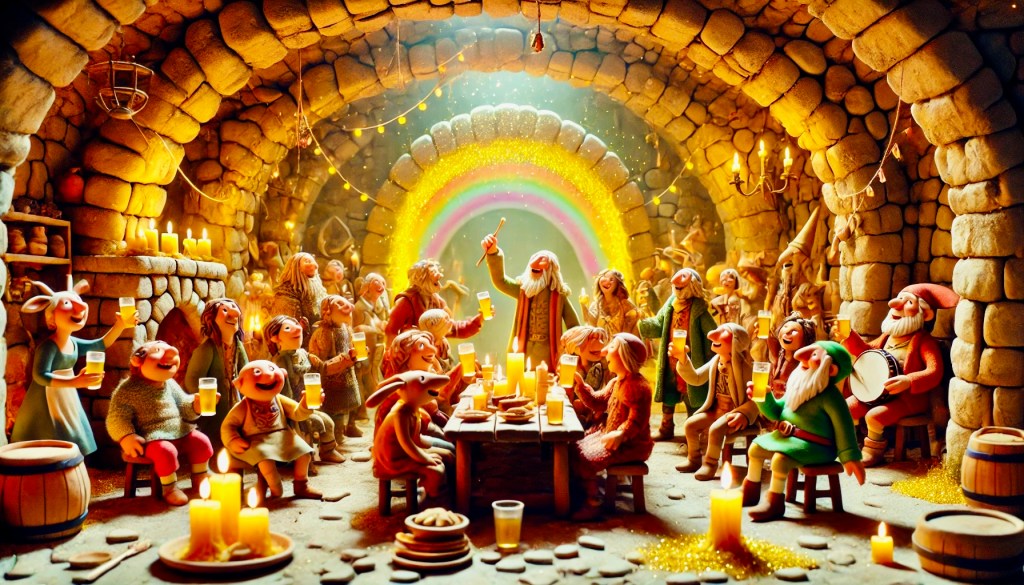
Once a year, the world’s great doers, thinkers, and dreamers gathered in the fabled land of Thule to celebrate their favorite holiday, Incoherence Day (December 9th). It wasn’t on any official calendar, nor did it follow any recognizable traditions. Instead, it existed as a whispered secret among the world’s most curious minds, an invitation written on the back of paradoxes and tucked between the pages of a journal titled The Natural Reality Framework.
Thule itself was a fittingly ambiguous location, perched somewhere between myth and geography. Its cliffs rose defiantly above crashing seas, while its hall—a sprawling, patchwork castle seemingly stitched together from mismatched eras—served as the perfect venue for an event where logic was strictly optional.
The tradition began years earlier, during what attendees now refer to as the Death of the Observer. The paper that allegedly killed the observer, The Natural Reality Framework, proposed a provocative model: the observable universe was divided into two distinct domains. The Causation Domain explained how things happen, while the Interpretative Domain explored what those things meant. Separately, they were ordered and precise. Together, they birthed contradictions, paradoxes—and possibilities.
The original gathering was meant to critique and dissect the paper’s claims. But as the hours wore on, something remarkable happened: the room fell into chaos. Some argued that their disciplines proved the framework wrong; others insisted it was the missing key to everything. By the time someone proposed a toast to “all the orthogonal stuff we don’t know,” the meeting had devolved into laughter, riddles, and a shared sense of awe. That night became the first Incoherence Day.
Now, years later, the tradition thrived. The hall was always a marvel of deliberate imperfection. Tables of uneven lengths were cobbled together, their surfaces cluttered with mismatched plates and goblets, some antique, others plastic. Candles burned at odd angles, their flames trembling as if whispering secrets to the flickering shadows they cast. Each attendee brought a dish that reflected their field: there were fractal cakes that never fully repeated, soups spelling riddles in noodles, and a casserole labeled “Schrödinger’s Surprise.”
Guests arrived dressed to express their individuality. The mathematician wore a three-piece suit adorned with chalk-dust fingerprints. The poet, draped in an embroidered cape covered in hastily scrawled verses, had a small notebook tucked into their boot, just in case inspiration struck mid-toast. The philosopher, as usual, looked like they had just emerged from a week-long debate with their own reflection.
The flickering candles became the unifying heartbeat of the night, their uneven rhythm mirroring the conversations and toasts that unfolded.
As the evening wore on, the moment came for the traditional toasts.
The philosopher stood first, raising a glass with a wry smile. “To the fact that none of us—no matter how long we’ve pondered—truly know what anything is. All things are relative, and our words, my friends, are but shadows on the cave wall.” Thoughtful applause filled the room.
Next, the scientist rose, nodding solemnly. “To our instruments and experiments! They let us measure and calculate—but only what we can see and count. And here’s to everything beyond measurement, where our instruments fall silent.” A cheer went up, glasses clinking in acknowledgment of the unseen.
The poet stood, smiling softly. “To language, that fleeting bridge. May we savor the words that connect us and the silences that speak even louder.” They held their glass for a beat, as though allowing the silence to speak its own toast. The crowd followed suit, the quiet carrying its own resonance.
Then the cartographer lifted their glass high, grinning. “To maps! If they were the territory, we’d all be wandering through fold lines and legends, with a giant arrow following us around saying, ‘You are here.’” The room burst into laughter, each listener well-acquainted with the gap between representation and reality.
Finally, the Abstractionist rose, glancing around the room with a mischievous grin. “For too long, we’ve sought coherence.” They lifted their glass higher. “Today we celebrate our real worlds of make-believe.”
A wave of delighted laughter swept the room—deep, hearty, from-the-soul laughter that only came from those who had, if only for one night, made peace with the mystery and paradox of it all.
By the time dawn broke over Thule’s cliffs, the guests were reluctantly departing, each clutching their mismatched coat and their renewed sense of humility. As they trickled away, one guest turned to the abstractionist and remarked, “It’s funny, isn’t it? The first Incoherence Day began with a paper trying to untangle the universe—and here we are, tangled up in it, happier than ever.”
The Abstractionist, lighting one of the hall’s guttering candles with a matchstick, smiled. “That’s the point, isn’t it?”
The flickering flames followed the guests out the doors, the last winks of light fading with the sunrise. They left lighter, humbler, and more ready to keep searching in a world where questions far outnumber answers. And as they did every year, they vowed to return—not to solve anything, but to revel in the glorious, impossible beauty of it all.
📖 Digest # 1: The Natural Reality Framework
The Natural Reality Framework provides a new way to understand the universe by recognizing that it is fundamentally composed of processes that interact according to rules. These interactions drive everything we observe, from the formation of galaxies to the behaviors of living organisms. At the same time, these processes are interpreted by processes—including humans, animals, and even some artificial systems—that transform causation into models for action and adaptation.
This distinction between causation and interpretation is at the heart of the framework. Causation governs the rules and interactions of processes—how things happen. Interpretation, on the other hand, transforms these processes into internal models, such as concepts of time and space, which allow processes to adapt and respond to the world around them.
Why does this distinction matter?
Because it helps us understand reality more clearly. Many of the challenges we face in science and philosophy—like the paradoxes of quantum mechanics, the nature of time, or how complex systems like ecosystems and economies emerge—stem from conflating causation (what the universe does) with interpretation (how we understand and act on it). The Natural Reality Framework resolves these confusions by showing how these two domains interact yet remain distinct.
This interplay is more than an academic insight—it explains how processes adapt, evolve, and create novelty. For example, when a bird interprets its environment to find food or avoid predators, it’s transforming the causative processes of the world into actionable models. Similarly, when humans build technologies, we are working within our interpretative domain, feeding back into causation by reshaping the processes of the world. This dynamic feedback loop drives complexity and innovation across all scales, from the microscopic to the cosmic.
Key Contributions
1. Orthogonality of Causation and Interpretation
What It Is: Causation and interpretation are fundamentally different in nature. Causation is the domain of processes unfolding according to rules, while interpretation transforms these processes into models that enable systems to act and adapt.

Why It Matters: This distinction resolves confusion about how reality operates. For instance, time and space are not intrinsic to causation but are constructs within interpretation that help systems navigate the world. By separating these domains, we can better understand phenomena like quantum superposition—not as contradictions in causation but as artifacts of interpretation. This clarity provides tools for disciplines ranging from physics to cognitive science.
2. Induction as a Mechanism of Change
What It Is: Induction connects causation and interpretation. It allows causative processes to trigger interpretative responses, and interpretative actions to feed back into causation, creating a continuous loop of interaction and transformation.
Why It Matters: Induction explains how systems adapt and evolve. For example, ecosystems change as species interpret and act on their environments, creating feedback that reshapes the system. This principle is key to understanding non-linear dynamics, emergence, and adaptability in natural and human-made systems alike.
3. Emergence Through Interplay
What It Is: Emergence arises when processes in causation and interpretation align or interact, producing novel behaviors and properties that are not reducible to the individual processes involved.
Why It Matters: Emergent phenomena, such as collective behavior in flocks of birds or the innovation in human societies, can be explained through this framework. It offers a way to predict and influence complex systems by understanding how interactions create new layers of behavior and organization.
4. Reframing Time and Space as Interpretative Constructs
What It Is: Time and space are not fundamental properties of the universe but are transformations within interpretation that help systems model relationships and sequences.
Why It Matters: This perspective dissolves contradictions in physics, such as the apparent incompatibility between relativity and quantum mechanics. It encourages new ways of modeling and thinking about phenomena that align more closely with how processes actually unfold, opening pathways for innovation in science and technology.
Real-World Implications
- Resolving Scientific Paradoxes: Challenges like wave-particle duality in quantum mechanics are clarified by distinguishing between causation and interpretation, showing that many paradoxes arise from how we model phenomena, not from the phenomena themselves.
- Understanding Complexity: From ecosystems to economies, the framework explains how systems evolve and adapt by examining the feedback between causation and interpretation.
- Driving Innovation: By recognizing the role of interpretation in transforming reality, we gain new tools for design, creativity, and problem-solving. This applies to artificial intelligence, societal planning, and beyond.
- Empowering Action: Knowing that interpretation transforms causation means understanding that our actions are not passive responses but active participants in shaping the world. This empowers us to create more intentional and adaptive systems.
Looking Ahead
The Natural Reality Framework provides the foundation for some of the most exciting explorations to come. Subsequent work applies its principles to resolve long-standing challenges in physics, such as the nature of quantum mechanics and the three-body problem, while offering fresh insights into emergent complexity, as seen in systems like Conway’s Game of Life.
Upcoming digests will explore how causation underpins the structure of reality, with implications for fields ranging from artificial intelligence to biology, and reframe concepts like space and time as interpretative tools rather than absolutes. The framework even informs radical ideas, like a “cure” for death, by redefining how we understand processes of life and continuity. These efforts build on the foundation laid here, charting a path toward a deeper understanding of reality and its possibilities.
4. Join 🔗 the Abstractionist Movement
As we close this edition, we’re excited to invite you to be part of something larger—a growing movement to redefine how we see and engage with reality. With each paper, each conversation, and each shared insight, we’re building a community dedicated to exploring the deepest questions of causality, interpretation, and complexity.
Here’s how you can get involved:
- Contribute Your Voice: Have insights, experiments, or creative ideas inspired by abstractionism or the Natural Reality Framework? Share them with us! Your contributions help shape the direction of our collective exploration.
- Join the Conversation: Engage with fellow readers, share your reflections, and ask the big questions. Your perspectives fuel the discussions that drive this movement forward.
- Spread the Word: Found this digest insightful? Share it with others who are curious about redefining reality. The more minds we bring into the conversation, the greater our collective potential.
Looking ahead, we’re diving deeper into causality with Fundamentals of Causation, Causal Mechanics, and Causal Dynamics, which reveal hidden dynamics in complex systems. Together, we’ll challenge traditional assumptions, explore the unseen, and unlock new ways of thinking about the universe around us.
Stay curious, stay engaged, and let’s keep pushing the boundaries of Abstractionism—one breakthrough at a time.
🚧 The End 🚧
To continue exploring these ideas and practice transforming challenges into growth, subscribe to The Practice is the Win™, and join a community dedicated to embracing the practice of Abstractionism, navigating the dual-domain framework, and becoming active shapers of our own experiences.
 The Abstractionist’s Papers