“Reality isn’t what it seems. If you’ve ever sensed this truth beneath your everyday experience or felt a quiet knowing that there must be another way to see, think, and live, this book was made for you.”
— Luiz von Paumgartten, The Abstractionist
We enter this world already spiraling.
Everything we learn comes in fragments. We receive them separately, trusting they’ll somehow form a complete picture. Usually, this works.
Until it doesn’t.
One day we notice the parts were never meant to fit together. Wars drag on without resolution. Institutions fail the people they serve. Complexity outpaces our ability to follow. The systems we depend on turn unstable, and the future feels uncertain.
Sooner or later the same thing happens in our personal lives. A belief that once felt unshakable wavers. A path we’ve been following no longer leads where we thought. A body long taken for granted falters. A loved one disappears, and their absence carries unbearable weight. Someone wakes up and no longer recognizes their life.
Still, we carry on.
Which brings us to our first paradox: Humanity has made astonishing strides. Agriculture altered the course of our existence over millennia, anchoring people to land and making lasting communities possible. The Industrial Revolution transformed society within a few generations, as machines replaced manual labor and drew populations into cities. The Information Age has remade civilization within a single lifetime, making knowledge immediate.
Progress now comes with a velocity that outpaces our ability to absorb it. The faster we move, the more disoriented we feel. Technology accelerates, but so does confusion. Medicine extends lives, but new epidemics spread faster than ever: burnout and disconnection. Economies grow, but inequality increases with them.
Advancement is everywhere. We’re healthier and better informed, but less certain than we’ve ever been. Material prosperity reaches unprecedented heights while purpose and connection diminish. Knowledge has never been so plentiful, yet belonging feels increasingly elusive.
Despite everything we’ve built, no clear path exists to connect with the real. Science treats its maps as terrain. Philosophy explores unanswerable questions. Religion offers guidance only for those who can believe.
Each doorway leads to another, with more stories waiting, but the feeling lingers. Perhaps we’ve been looking in the wrong places all along.
The Search for Reality
This sense of incompleteness has driven humanity since the beginning. From our earliest civilizations, we’ve tried to reconcile experience with what lies beyond.
Ancient Greeks argued about whether reality flows or stays fixed. Plato described prisoners watching shadows on cave walls, convinced the shadows were real. Two thousand years later, we’re having the same argument.
In the 17th century, the scientific method gave us a fresh approach. Observation replaced myth and speculation with testable theories. Our powers of measurement expanded dramatically.
The 1800s birthed entire scientific disciplines, from chemistry to thermodynamics and electromagnetism. Each leaned on Newton’s mechanics, which treated space and time as absolute.
By the early 1900s, Einstein overturned that foundation, showing space and time bend with motion and gravity. Quantum theory went further still: particles behaved like waves as much as solid matter. Across cosmic and quantum scales, contradictions resist reconciliation.
At the edge of understanding, all models collapse. Are we confronting reality itself, or only the limits of interpretation?
The Mind’s Role
If what we experience depends on how we interpret it, then understanding our inside is as essential as studying what’s out there.
Look at this:
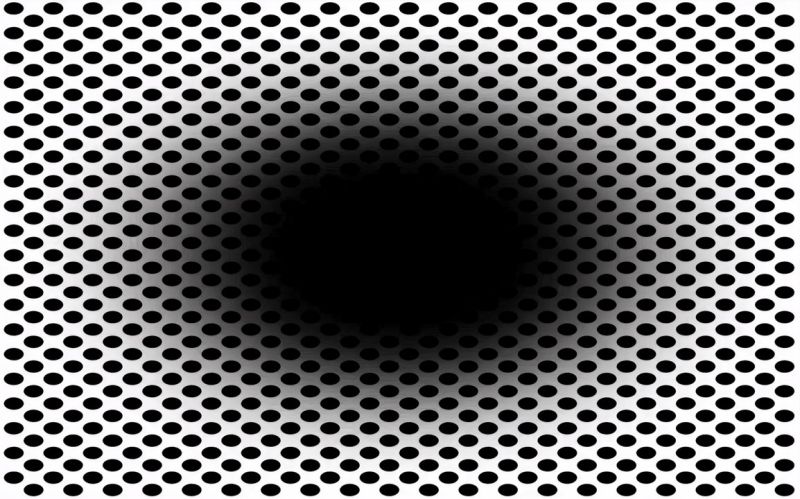
At first glance, a flat black circle sits in the center of a static image. Yet most people feel it expanding, as if drawn forward.
Pupils dilate as the brain uses spatial and contrast cues to anticipate shifting light levels. We prepare for darker space before realizing what’s happening.
The unconscious modeling appears here. The mind anticipates future states and prepares the body without conscious awareness. (Laeng, Nabil, & Kitaoka, Frontiers in Human Neuroscience, 2022). Neuroscientists study illusions like this because they expose what normally goes unnoticed: the mind as an interpretative engine, constructing what it deems true, distinct from what lies before it.
Your pupils just dilated reading about that circle. Your mind anticipated darkness that never came. Every perception works this way. You can’t pause it, bypass it, or catch it happening. The mind reading these words constructs what it examines.
From galactic drift to our own private thoughts, what we know comes through this filter. Existing maps prove useful but reflect how we see rather than how things operate.
How Natural Reality Came About
Grand philosophical questions have a habit of showing up uninvited in ordinary life. This book began as something personal.
After a divorce, I could no longer offer my children the guidance my father had once given me. They were too young to know what they were missing, and understanding would take time.
I wasn’t doing well. A general practitioner prescribed antidepressants. Then a psychiatrist tried every type of medication available. Every few months we’d start something new, but nothing made a difference.
Eventually I realized the answers I was getting didn’t match the problem I was facing. I put it all down and turned to what I knew. Years of patent work had given me tools for abstracting problems into their essential parts, and that’s how I figured my way through.
I began writing to the people my children would eventually become, speaking to them as if they were sitting right beside me in an ever-present now.
The first attempt, The (Un)happiness Letter (2017), explored expectation and outcome. Almost immediately, it hit a wall: How can we learn to balance expectations and outcomes without perspective if perspective comes only from learning to balance them?
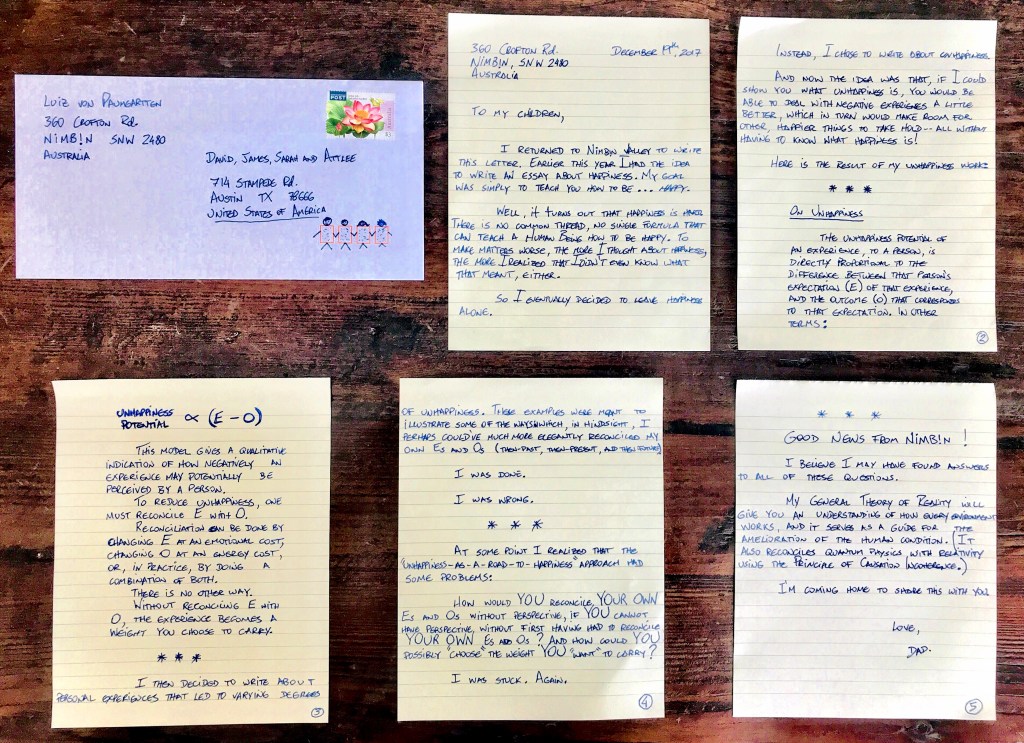
That chicken-and-egg riddle started everything. I had discovered Incoherence, but it seemed a glimpse of something bigger, and I wasn’t sure what it was.
From then on, ideas came like misfit puzzle pieces. Rather than throw them away, I collected each one, letting them circle back and evolve. As new pieces arrived, they combined with what came before, each building on the last. I could see patterns everywhere but had no clear path to explain them. Seasons passed before they crystallized into a framework I could share.
A year after the letter, I turned to storytelling.
Nimbin and The Abstractionist
Stories served as my laboratory. The concepts I’d been collecting needed somewhere to develop, a fictional space where they could interact without the pressure to be perfectly formed.
Nimbin and The Abstractionist (2018) marked this new phase. The short story introduced Red Space and Blue Space, presenting human perception as interpretation overlying a shared, causal reality.
The Puppet King said:
“Wrapped inside its veil, all one can experience is a Red Space of their own making. Each puppet spends its days alone in a different abstract reality that does not otherwise exist, blindfolded to the Blue Space.”
— Nimbin and The Abstractionist
In the story, Incoherence lives in the difference between what happens and what it means. Escape came when each puppet discovered the limits they faced were within their own mind.
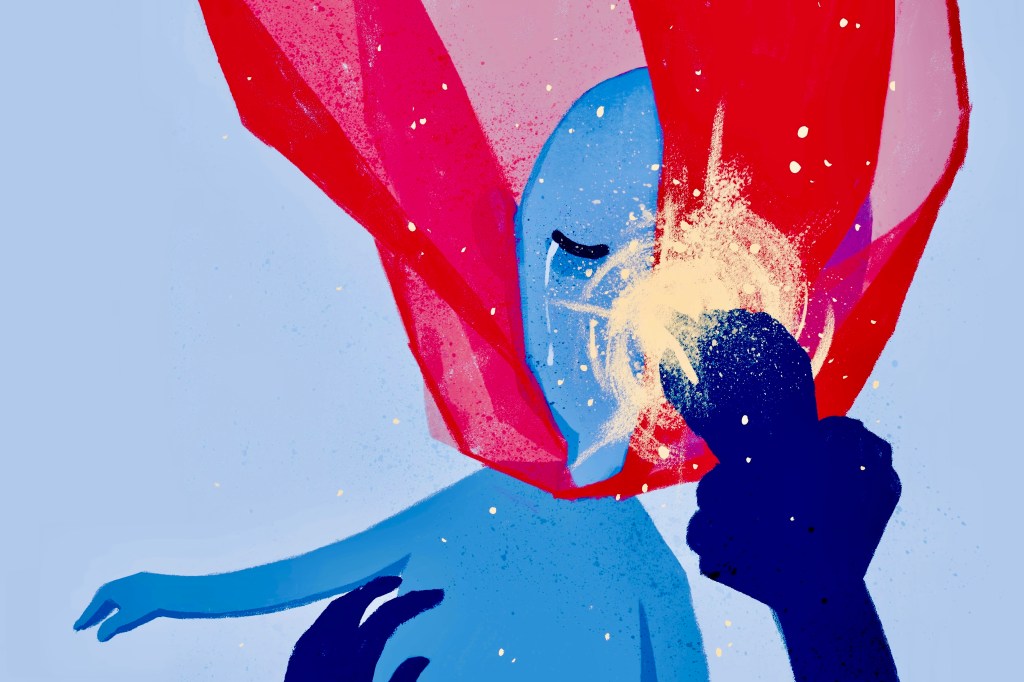
It works the same way for us.
Our minds veil what’s there, building an internal world that seems external. Once that view solidifies, it becomes our environment and we accept it without a second thought.
Contradictions are often set aside. Even when something feels off, ignoring it proves easier. The mind favors efficiency over clarity, maintaining itself so well that it resists experiences that could bring change.
Pull the first thread and paradoxes become invitations. What seemed complete reveals its gaps. You can’t look away.
The Intact and the Flightless
If Nimbin and The Abstractionist marked a beginning, The Intact and the Flightless brought everything full circle. These two stories bookend the work you’re reading.
None of this was clear at the outset.
Despite spending too long in school, I was a B student on my best day and never considered myself well-read. I hadn’t studied complexity, systems theory, philosophy, or cognition.
This turned out to be an advantage, allowing the book to grow apart from conventional ideas. It carried none of the inherited assumptions that have kept us bound to interpretation for so long.
In The Intact, the odd bird returns with the yellow triangle, symbol of Incoherence, and the story ends.
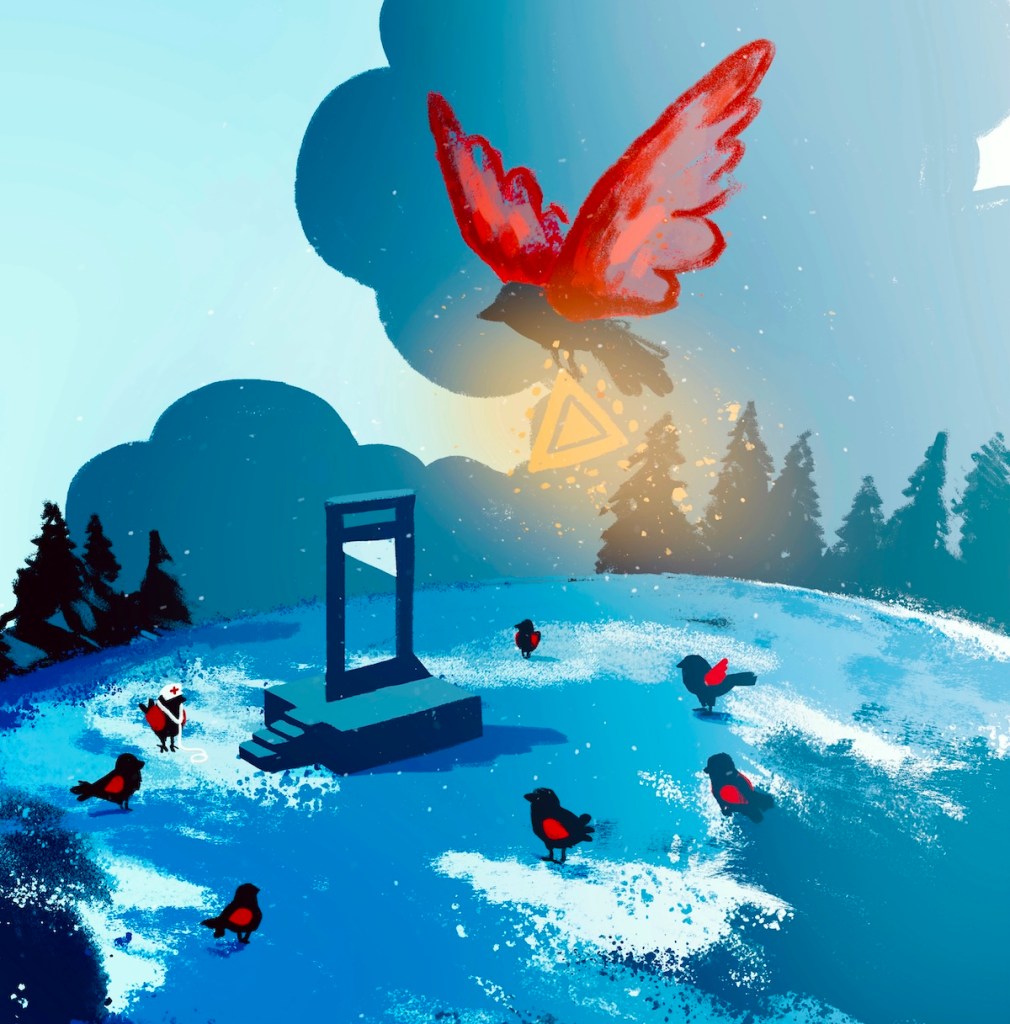
The Abstractionist’s Papers is that triangle returned.
Over 2,000 years ago, realizing Earth wasn’t fixed at the center reframed our place in the cosmos. New views altered the answers while opening questions never before imagined. If the ground beneath us wasn’t central, what was? If Earth moved, what else might be moving?
Similarly, the discovery of Incoherence sets the stage for what follows, but to see it clearly we’ll need a map.
The Journey
Here’s where we are inside the picture we’ve been living in:

The Blue Space is the Causation Domain, where happenings take place regardless of interpretation. It exists beyond the mind, but how we engage with it defines the boundaries of what we can do. We each reside within the Red Space of our mind.
In broad strokes, it works like this:
⓵ The Mind: Everything you access, every thought, memory, image, sound, and emotion, exists within you. Your Red Space is this world as it presents itself to you.
⓶ The Journey: Life happens through experiences. Each event molds expectations, assumptions, and beliefs, either reinforcing what’s come before or putting it under pressure.
⓷ The View of Others: Every interaction depends on interpretation. Though we share the same universe, we don’t share the same Red Space. Each person inhabits a version of their mind’s making, while the Red Spaces of others remain hidden from within ours.
⓸ The Obstacle: A disruption shakes the mind’s existing model of reality. This could be a significant loss, an unexpected change, or a contradiction too great to ignore. Most reach ⓸ and turn back, often reinforcing what they know.
You’ve crossed the hardest part, on to Step ⓹.
⓹ The Search for Resolution (You Are Here): Transformation is underway. As your mind works to reconcile contradictions, its logic reorganizes. Familiar ideas loosen their grip, and what once felt certain steps aside for transformation.
From this point forward, we’ll walk together.
⓺ The Discovery of Incoherence: Paradoxes and dissonance that existed all along become apparent: the differences between what you were told and what you’ve sensed. That recognition opens a gap. Incoherence dwells there, a foundation of Natural Reality.
The yellow triangle is key to a hidden passage in the mind, one that’s always been there, just beyond awareness. When you discover Natural Reality, the passage opens, connecting your personal experience to the process universe beyond. Through it, you gain the ability to shift perspectives and relate in new ways.
⓻ Becoming Free of Mind: As you continue, you transition beyond Red Space, passing through the gap. No longer confined by earlier assumptions, you work with causal and interpretative realities beyond the mind’s original limits. Natural Reality becomes a useful map.
⓼ & ⓽ Transcendence: The map becomes second nature. You can see how your Red Space and the shared Blue Space relate. You see your mind as a process that induces and creates realities.
You’re witnessing emergence, a process that lets natural systems expand beyond their original boundaries. The pattern runs through the entire reachable universe. Once you see it, you can’t unsee it. It’s the process of becoming. By the end of this book, you’ll be fluent in Natural Reality.
After ⓼ & ⓽, how you relate to interpretation is a choice. Like packing for a trip, you decide what to carry forward, what to set down. Most importantly, you decide how to engage and have the tools to do it.
An Extra Push
Look at the screen in front of you. Now, close your eyes. The image vanishes from your mind, but the screen remains. Where does the world you experience exist?
Inside or outside?
Stay curious. Everything you’ve read wasn’t transferred to you; it was induced, arising through your own thoughts, guided by the same principles this book explores.
These ideas need you to sit with them. They’re like seeds that need to take root. This happens over a handful of turns around the sun.
The Abstractionist’s Papers
From February 2024 to February 2025, I published a series of papers that formed this book’s foundation.
The ideas had been developing for years, first as crayon sketches in a lab notebook, then as blog entries and social media posts. Each piece added something new, and over time I could see more.
The Papers carry that imprint. The chapters form a continuous thread, leading from Obstacle ④ into the Blue Space.
It grew through the same dynamics it describes: recursive and self-reinforcing, with no clear ending.
One realization stood out: the boundary between causation and interpretation had never been drawn like this. Traditional divides like subjective and objective or physical and abstract got us part of the way. To go beyond them, we needed a new kind of distinction.
Separating causation from interpretation made that possible.
The same approach that revealed Natural Reality can spark change in others. It can open new perspectives, forge new connections, and invite new ways of seeing.
If you’ve made it this far, you’re ready.
How to Use this Book
This work took years to develop, but getting value from it doesn’t. You’ll find something useful in the first five minutes of Chapter 1, which you can verify and try in your own experience right now.
The complete work is substantial. Thirteen chapters plus the materials at the end represent a real investment. That’s why Glitches in Reality exists. It streamlines the framework into ten minutes, showing you what Natural Reality can be without the same depth.
Natural Reality works like a map. As you move through your days with this framework, things either line up with what you see or they don’t. That’s the test, and it happens immediately.
This is a first principles book. That means it doesn’t assume specialized knowledge. The framework establishes its own foundation, then builds from there.
Part I. The Mind
We start from within. If we don’t start from the mind, we never learn to “escape” it. This section introduces the difference between causation and interpretation, what happens versus what it means, demonstrating how the mind builds a usable internal model.
It explores how experience is constructed (Chapter 1), how internal models develop through contradictions (Chapter 2), and how personal worlds create shared patterns (Chapter 3). Together, these chapters examine consciousness.
Part II. Natural Reality
Now we step back to see how nature behaves, beyond humans. This section maps natural processes.
Here we build the Natural Reality Framework (Chapter 4), explore how change takes form through General Selection (Chapter 5), and show how light bridges the two domains (Chapter 6). Together, these chapters reveal how nature operates beyond the mind.
Part III. Causality
With the framework in place, we formalize how causation works. This section explores the mechanics of the Causation Domain.
Chapter 7 establishes that traditional causality assumes direct transmission while Natural Causality models receptive-responsive propagation. Chapter 8 formalizes causal spaces and how different environments enforce different rules. Chapter 9 develops the mathematics of impedance, admittance, resonance, and emergence. Chapter 10 applies these ideas to complex systems.
Part IV. Engagement
We return to everyday life. Both causation and interpretation stay in view.
We reinterpret space and time (Chapter 11), explore the universe as an ongoing process (Chapter 12), and offer tools for participation (Chapter 13). These ideas turn the framework into a practice you can live.
The journey begins in the mind, extends into the world, and returns to experience with clarity. When the loop closes, you’re no longer where you started. The cycle repeats, but each turn takes you upward.
These aren’t circles. They’re spirals.
The Practice is the Win™
Natural Reality applies everywhere, in thought and the daily interactions that define our lives. Across disciplines, the same patterns recur: potential and flow, disruption and stability, all coming through the harmonization of Incoherence.
Someone who sees beyond their Red Space engages differently. They work with the dynamics of the world rather than against it. They recognize influence, create productive meaning, and allow natural processes to unfold.
Adaptability takes the place of certainty.
The Abstractionist Movement is individual work with collective impact. Each person who practices this distinction, who sees their own thinking as thinking and holds space for others operating from different internal worlds, participates in what comes next. The world transforms through individuals learning to see each other and live more purposefully.
To practice Natural Reality is to become aware of these dynamics and handle them deliberately. This shift in perspective opens new ways of engaging.
As you journey through these pages, remember: Natural Reality applies more broadly than you might imagine. The more you use it, the more intuitive it becomes.
At the end of this book, you’ll find the Chapter Manual to help you follow the progression. It works best after each chapter, once the ideas have had time to take root.
The Frequently Asked Questions and Study Materials offer further support. The Afterword presents The Abstractionist’s Toolkit, the models behind this framework.
Whether you’re sitting with a question that won’t let go or exploring the work with others, these resources provide space to revisit and apply what The Papers have started.
I am The Abstractionist, and I will be your guide.
 The Abstractionist’s Papers