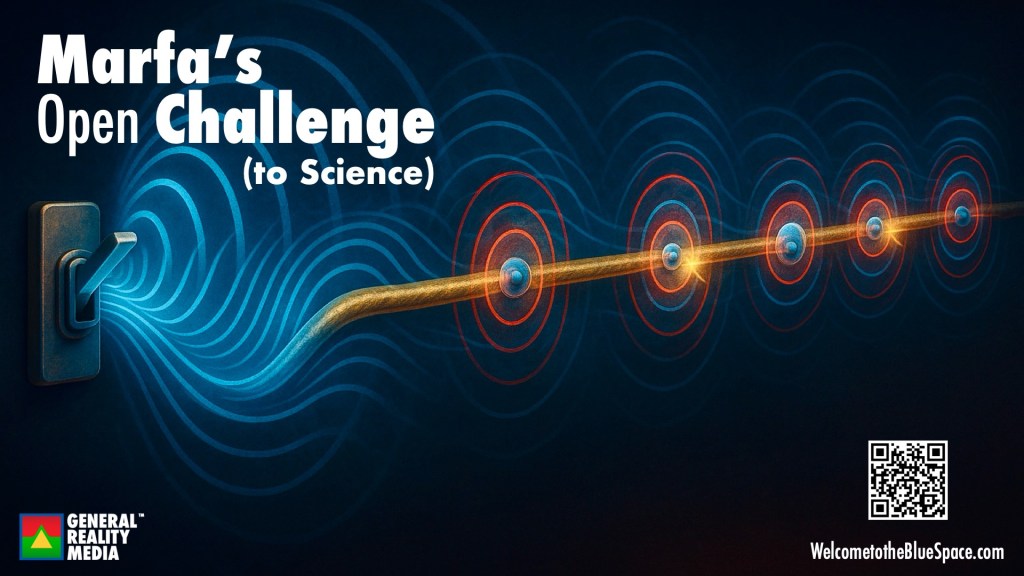
(Originally published on June 16, 2025.)
Table of Contents
- A Letter from the Abstractionist
- Marfa’s Open Challenge (to Science)
- The Natural Reality Solution: 3.1 The Missing Mechanism; 3.2 What We Measure; 3.3 The Key Insight; 3.4 The Crowd Wave Is a Great Partial Answer; 3.5 How This Resolves the Paradox; 3.6 How Conventional Physics Fails; 3.7 The Resolution; 3.8 Proof of Concept?
- Join the Movement
1. A Letter from the Abstractionist
Dear Reader,
Science promises explanations, but sometimes the simplest phenomena reveal mysteries.
This edition focuses entirely on Marfa’s Open Challenge (to Science), an invitation to anyone who believes conventional physics can explain everything. The challenge centers on a paradox hiding in plain sight: electrons crawl through copper wire at millimeters per second, yet your light switches on instantly.
How does the effect arrive before its supposed cause?
Multiple attempts were made. Some restated the observations without explaining the mechanism. Others invoked “fields” as if naming something solves how it works. As predicted, the Rainbow Unicorn sticker remains unclaimed. Conventional physics lacks the tools to resolve this paradox. (If you’d like a sticker anyway, drop me a mailing address.)
This challenge reveals something about the limits of our explanatory frameworks and points toward new ways of understanding reality.
Welcome to the Blue Space.
Founder and CEO
General Reality Media, LLC
2. Marfa’s Open Challenge (to Science)
(Originally published on June 15, 2025.)
You believe science explains everything?
Prove it.
Here’s one simple phenomenon that anyone can observe:
📋 The facts: Electrons move through copper wire at millimeters per second—roughly the speed of cold honey. When you flip a light switch, your bulb turns on instantly.
⚡ Your Challenge: Using conventional physics alone, explain how the effect arrives before its supposed cause.
This happens in everybody’s living room. Every electrical engineer knows these two speeds exist. The electromagnetic wave propagates at nearly light speed while electrons drift at millimeters per second. Both are measured, documented, undeniable facts. The paradox is real.
🏆 The prize: A Rainbow Unicorn sticker for your water bottle. First person to provide a working explanation using only established physics wins the sticker.
🎣 The Catch: Responses that simply restate “electromagnetic fields propagate fast while electrons move slowly” won’t win the sticker. The challenge is explaining HOW two vastly different velocities constitute one phenomenon called “electrical current.” Restating the observations isn’t solving the paradox.
3. The Natural Reality Solution
Conventional physics offers no mechanism to reconcile these two observations. For over a century, the field has accepted this paradox as simply “how electricity works” while leaving the question unanswered.
Electrical current powers our daily lives. Every time we flip a switch, we witness a phenomenon that our most established science cannot explain. When the framework fails to account for what happens in our living rooms, we’re seeing its limits.

Like all maps, science serves specific purposes while omitting features of the actual territory. The electricity paradox reveals unmapped territory where the current framework simply lacks the right tools.
Marfa’s Challenge demonstrates this gap. We can restate the observations, invoke “electromagnetic fields,” or describe the mathematics, but none of these approaches explain how two vastly different velocities constitute one phenomenon. The explanatory tools simply don’t exist within the current framework.
Natural Reality provides those tools.
3.1 The Missing Mechanism
The paradox dissolves when we understand that atoms are processes, not fixed objects. Each atom operates as a dynamic process with its own internal model containing multiple parallel causal spaces.
Making Causation Possible: Flipping the switch creates conditions where causal flow can happen between atomic processes. Just as quantum measurements enable certain possibilities to manifest, the closed circuit enables causal propagation. Once possible, it happens through the transfer of influence.
Light as the Boundary Between Domains: Causal flow propagates through light, which serves as the boundary between Natural Reality‘s Causation Domain and the Interpretative Domain. Light’s dual nature serves both domains simultaneously. The magnetic field sustains continuous propagation in the Causation Domain, while the electric field governs how that propagation becomes available to interpretation in the Interpretative Domain. Light enables induction by mediating the transfer of causal influence between atomic processes across orthogonal domains.
Potential Becomes Flow: The circuit contains potential, which is interpretative energy stored in the electrical system and circuit configuration. When we close the switch, this potential converts to flow, which is causal energy propagating through the Causation Domain. This demonstrates the relationship in Natural Reality: potential in the Interpretative Domain becoming flow in the Causation Domain.
The Atom-to-Atom Induction Chain: Each atom in the conductor receives causal input from the atom behind it in the circuit. The atom’s internal model processes this causal signal through two parallel causal spaces simultaneously:
- Signal Propagation Space: Governed by electromagnetic impedance rules. The atom interprets the incoming causal signal and outputs a nearly identical causal signal to the next atom in the chain.
- Mass Response Space: Governed by inertial dynamics. The same causal input triggers the atom’s electrons to move physically.
The diagram below illustrates how each individual atom processes the incoming causal signal. Blue Space represents the Causation Domain where causal processes unfold, while Red Space represents the Interpretative Domain where each process maintains its internal model.
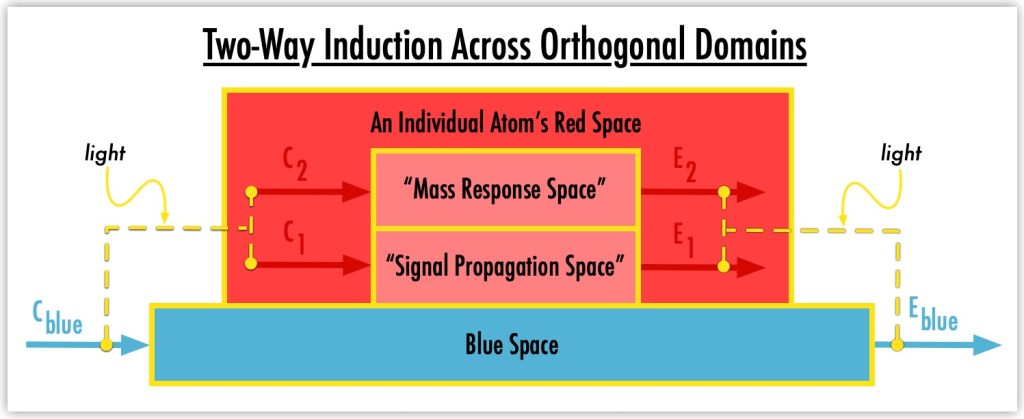
The causal signal (C_blue) in the Causation Domain induces interpretations within the atom’s internal model (Red Space). The atom produces its own interpretations (C1 and C2) in response to, but not caused by, the external signal. We cannot see inside this interpretative process, but based on the dual outputs we observe, we infer the atom processes these interpretations through two parallel causal spaces governed by different rules.
These internal interpretative effects (E1 and E2) then induce responses back in the Causation Domain through two-way induction. E1 induces the atom to output light that propagates causally to the next atom in the chain. E2 induces electron movement that propagates causally between atoms through the conductor.
E_blue represents both of these causal propagations continuing in the Causation Domain, the light signal reaching the next atom and the electron movement flowing through the conductor.
This atom-to-atom induction chain explains both phenomena we observe: the continuing light propagation creates the electromagnetic wave we measure at near light speed, while the accumulated electron movements create the drift velocity we measure at millimeters per second.
What Makes a Conductor Conduct: A conductor like copper has atoms with low impedance in their Signal Propagation Space. Each copper atom receives a causal signal and outputs nearly the same signal with minimal loss. Some energy is consumed by the Mass Response Space (creating heat and electron movement), but most of the causal influence passes through the Signal Propagation Space to the next atom. Non-conductors like rubber have high impedance in their Signal Propagation Space, blocking causal propagation.
Causal Flow Propagation: The causal flow propagates nearly instantaneously between atomic processes because induction operates in the Causation Domain independent of space and time. Each atom receives causal influence, processes it according to its internal impedance in both causal spaces, and outputs causal influence to the next atom in the chain. This is the essence of induction: the natural way reality extends from one interaction to the next.
3.2 What We Measure
Two Interpretations of One Process: The electromagnetic wave represents our interpretative model of the causal flow propagating between atomic processes through their Signal Propagation Spaces. The electron drift represents our measurement of the accumulated mass responses from all the atoms’ Mass Response Spaces. Both measurements involve interpretative layers: each atom’s internal processing and our external observation of the results.
Two Levels of Interpretation: There are two interpretation layers at work. First, each atom’s internal interpretation: how each atomic process responds to causal signals according to its impedance in both causal spaces. This determines both causal signal output and electron movement. Second, our measurement interpretation: how we detect and model both the causal flow (which we characterize as an electromagnetic wave) and the accumulated electron responses (which we observe as drift velocity).
3.3 The Key Insight
The key insight is recognizing that atoms process signals through parallel internal causal spaces. This means one input can produce two different outputs simultaneously without contradiction, explaining why we observe both fast electromagnetic propagation and slow electron drift from the same underlying process.
3.4 The Crowd Wave Is a Great Partial Answer
The crowd wave analogy is the closest conventional explanation to how electricity really works. Each person has low impedance to the “wave propagation rule”—they respond to their neighbor standing by standing themselves. The fast wave emerges from individual inductive responses, just like each atom responds to causal signals from its neighbors.
In the crowd wave, each person’s internal model (their mind) contains parallel “causal spaces”: one for wave propagation (seeing the neighbor stand and deciding to stand) and one for physical response (actually standing up). This creates induction: the causal signal propagates through the crowd as people respond to their neighbors, while each individual also moves physically. It demonstrates the same inductive mechanism at work in electricity, but with a crucial difference.
The crowd wave operates in a single observable domain where we can see both individual responses and the emergent wave. Electricity operates across two orthogonal domains simultaneously: the Causation Domain (electromagnetic wave propagation between atoms) and the Interpretative Domain (electron mass response within atoms).
The crowd wave shows us what the mechanism looks like, but electricity requires recognizing both domains working together through each atom’s parallel internal causal spaces.
3.5 How This Resolves the Paradox
This solution dissolves the paradox by recognizing our tendency to force parallel causal spaces into single explanatory frameworks. Conventional physics creates the paradox by trying to explain both electromagnetic propagation and electron drift as if they must be reconciled within a single causal mechanism, creating apparent contradictions.
Once we recognize that atomic processes contain parallel internal causal spaces, the inconsistency disappears. There is no paradox when we apply the correct framework.
3.6 How Conventional Science Fails
Physics tries to explain both phenomena as if they must be reconciled within a single causal mechanism, creating the paradox. It attempts to characterize the electromagnetic wave as a thing instead of recognizing it as our measurement of causal flow between atomic processes. Natural Reality shows they operate through parallel internal causal spaces connected through induction, the mechanism by which reality extends from one interaction to the next.
3.7 The Resolution
Every circuit demonstrates atom-to-atom induction where each atomic process receives causal input and responds through parallel internal causal spaces. The impedance characteristics in both spaces determine the material’s electrical properties, from perfect conductors to complete insulators.
This framework transforms how we understand electrical phenomena as natural expressions of how atomic processes operate through parallel causal spaces connected by induction.
3.8 Proof of Concept?
This explanation resolves a paradox that has stumped conventional physics for over a century. It provides a clear, step-by-step mechanism that accounts for both observed phenomena without contradiction or hand-waving. The Natural Reality framework takes a genuine scientific puzzle and offers a solution using parallel causal spaces and induction.
Whether this constitutes sufficient evidence for the broader Natural Reality framework is for you to decide. Those who encounter these explanations, test them against their understanding, and see whether they resolve long-standing puzzles will ultimately judge whether Natural Reality functions as a useful map of how things work.
This process of audience evaluation represents what The Abstractionist’s Papers calls General Selection.
If a framework can cleanly resolve such a basic paradox in physics, it suggests the underlying principles (orthogonality, induction, and parallel causal spaces within processes) may have broader explanatory power. The question becomes: if Natural Reality can solve this puzzle, what other mysteries might it illuminate?
The electricity challenge offers one data point. The full theory awaits your evaluation.
This is how orthogonality resolves the impossible: one causal input, two parallel responses, no paradox.
4. Join the Movement
Marfa’s Challenge is now officially closed.
As predicted, conventional physics could not provide a complete explanation for this basic phenomenon. The Rainbow Unicorn sticker remains unclaimed. (If you’d like one anyway, drop me a mailing address.)
If you’re ready to explore frameworks that can actually resolve these mysteries, The Abstractionist’s Papers offers a complete foundation. Available free at WelcometotheBlueSpace.com.
Whether you’re defending conventional physics or exploring new possibilities, the challenge stands. Science should be able to explain what happens in your living room. Subscribe to The Practice is the Win™ and join a growing community in the practice of Natural Reality.
 The Abstractionist’s Papers