(Originally published on April 28, 2025.)
Table of Contents
- A Letter from the Abstractionist
- The Deep Dive Series: The Abstractionist’s Papers
- Poem: The Dance of the Blindfolds
- Article: Why Do Squirrels Chitter?
- Join the Movement
1. A Letter from the Abstractionist
Dear Readers,
The Papers is still being edited. No major changes—just the hard work of making the writing sound right and making sure each part induces the way it should. The latest version is only, but updates continue. Some are small, others more noticeable.
Since the last issue of our newsletter, however, three important sections were added: the Reader’s Guide, the Study Materials, and the FAQ. Each one is meant to help anyone learn Natural Reality on their own, at their own pace.
Welcome to the Blue Space.
Founder and CEO
General Reality Media, LLC
PS. If you’d like an electronic copy of the entire book, please message us.
2. The Deep Dive Series: The Abstractionist’s Papers
(Originally announced here.)
Our first YouTube release is here: The Deep Dive Series: The Abstractionist’s Papers.
If you’ve ever sensed that the universe is both more mysterious and more real than we’re told—it probably is. And you’re probably in the right place—these episodes were made for you. Each track was generated by feeding the full text of the book into Google’s NotebookLM.
What came out is a podcast-style conversation about the work:
- Introduction – 16:03
- Part I: The Mind – 19:56
- Part II: Natural Reality – 23:45
- Part III: Causality – 14:11
- Part IV: Engagement – 16:29
Just know: It’s not my voice, and not always how I’d explain it. This is not a replacement for the book. It doesn’t carry the same inductive effect—not even close.
But it’s enough to open a way in.
3. Poem: The Dance of the Blindfolds
(Originally published here.)
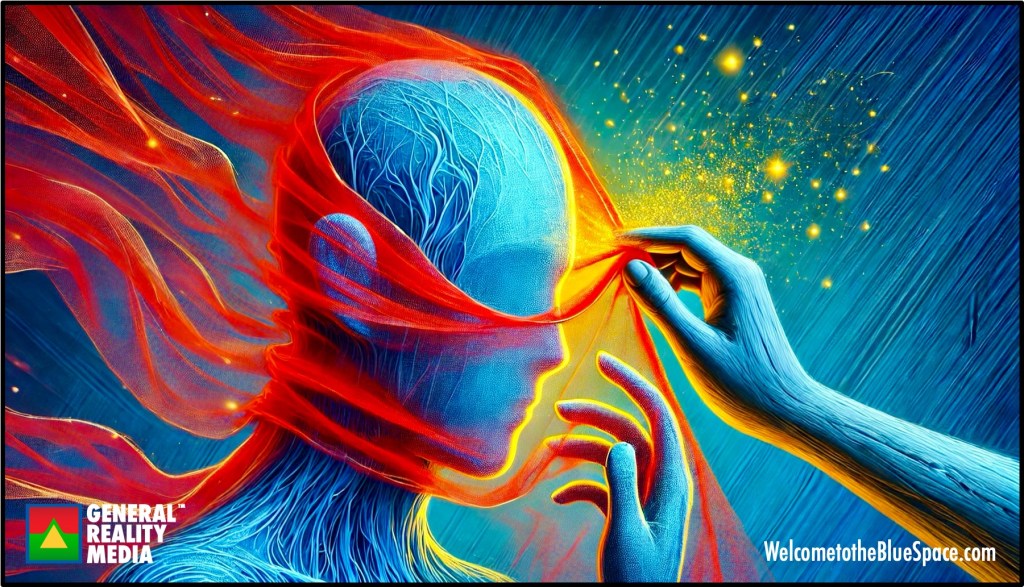
𝐓𝐡𝐞 𝐃𝐚𝐧𝐜𝐞 𝐰𝐢𝐭𝐡 𝐭𝐡𝐞 𝐁𝐥𝐢𝐧𝐝𝐟𝐨𝐥𝐝𝐬
I peeked through a keyhole one night
And saw a room of swirling light.
Eight billion danced, with perfect flair—
They couldn’t see, and didn’t care.
Each wore a red cloth round their eyes,
To find their space, to keep their time.
They didn’t know they were the glow.
With every step, they dimmed it so.
One girl paused—her rhythm twitched.
That’s when she felt something had glitched.
The music skipped, her foot slid wrong—
And in that moment, she was not alone.
First we wear our red with pride.
Then we forget the shine we hide.
Until a glitch disrupts our stride—
And helps us find the blue outside.
/Luiz 🙏
4. Article: Why Do Squirrels Chitter?
(Originally published here.)
Question
Does a squirrel mean to warn others when it chitters?
Issue
The question is whether a squirrel’s chittering—typically observed in the presence of threats—constitutes intentional communication. More specifically:
- Does the squirrel produce this vibration in order to warn others (intent)?
- Or is the meaning of the chitter something that arises elsewhere—in the minds of other squirrels, or even in our own human minds as observers?
The issue hinges on whether intentional meaning is inherent in the act itself, or if it is something that is constructed, projected, or induced.
Rule
According to The Abstractionist’s Papers, Natural Reality arises across two orthogonal domains:
- Blue Space is the Causation Domain—the world of physical processes, where signals and behaviors unfold independent of meaning.
- Red Space is the Interpretative Domain—the internal world within a mind, where meaning, awareness, and intention are generated.
Crucially:
- Meaning is never transmitted.
- Intention does not propagate.
- What crosses the Blue Space is not a message—it is only a signal.
- The meaning of that signal arises within the Red Space of the receiver.
Each mind (squirrel, human, or otherwise) has its own Red Space. These minds do not share perception or experience. There is no Red Space between them.
The Biological Blindfold makes this hard to see. We are wired to mistake internally-generated meaning for external properties. We see meaning “out there,” when in fact, it is arising in here. This leads to projection—the act of assigning our own logic or concepts to what is, in fact, a separate system.
Analysis
Let’s take this step by step.
1. The Chitter as a Causal Event (Blue Space)
The squirrel emits a chitter in response to a stimulus—let’s say a predator. This action unfolds in Blue Space: air vibrates, waves travel. Nothing about this signal contains meaning on its own. It is a causal behavior.
Whether the squirrel “means” to chitter is not visible in the behavior itself. Even if the squirrel has an internal model (a Red Space), we do not have access to it. The intent, if present, remains within that Red Space.
2. The Other Squirrels’ Responses
Other squirrels hear the chitter. Their nervous systems respond. Perhaps they flee. Perhaps they freeze. These responses are induced—not by decoding a message, but by interpreting a signal through their own internal models.
To those squirrels, the chitter means “danger”—but only because it functions that way within their Red Space.
There is no shared meaning. There is no confirmation that they experienced what the original squirrel intended (if anything at all).
This is interpretation, not transmission.
3. A Human Being’s Projection
Now, we enter our Red Space.
We watch this sequence: one squirrel chitters, others run. We assume: “Ah! The squirrel must be warning the others.”
But this assumption arises not from the Blue Space—not from the causal chain we observed—but from our own Red Space.
We project our internal model of intentional communication onto the behavior.
We treat the chitter like a human utterance: “Watch out!”
But this is anthropomorphic projection.
The concept of “warning” is a human abstraction—built inside our internal model of cooperative, symbolic behavior. That model does not apply to a squirrel without extraordinary evidence we cannot access.
In fact, even among humans, communication does not happen through shared meaning—it happens through induction, just as it does in other animals. The difference is not in kind, only in complexity and recursion.
The question “Did the squirrel mean to warn?” is a question about our own assumptions. We are not discovering something about the squirrel. We are revealing something about the way our Red Space constructs narratives around behavior.
In plain English
The squirrel might just be freaking out.
Other squirrels hear it and react—but they’re reacting based on what that signal means to them.
We’re the ones who invent the idea that it was meant as a warning.
Conclusions
Under the framework of The Abstractionist’s Papers, the answer is no—a squirrel does not “mean to warn” others when it chitters, not in any sense that implies shared, intentional communication. That meaning arises elsewhere:
- In the internal models of other squirrels, who interpret the signal as danger.
- And in our own minds, where we project human concepts onto non-human behavior.
In both cases, meaning is induced, not transmitted.
Intention, if it exists at all, remains trapped within the Red Space that formed it.
The chitter is not a message. It’s a signal.
What we make of it is ours.
Field Notes from the Deck
I live among squirrels.
This morning, I saw a baby squirrel in the tree. A raccoon walked out from under the deck toward the shed. The squirrel didn’t chitter. It didn’t move at all. It just watched—still, quiet.
Only after the raccoon disappeared did the squirrel start to move.
It followed the path—about twelve feet along the branch—and once it reached the spot where the raccoon had been, it started chittering. The raccoon was gone. The squirrel stayed there, making noise into the space it had just watched. Then it moved on.
It looked just like… practice.
The squirrel had waited, stayed silent when the threat was present. Then, once the moment passed, it ran through the motion. Replayed the response. Made the sound.
We do the same thing.
We tend to call behaviors like that instinct. But when you live around squirrels, especially the young ones, you see something else. You see them learning.
If you get the chance, watch them.
PS. For a deeper dive, see The Abstractionist’s Papers at Chapter 1 (A Natural Theory of Mind), Chapter 2 (How the Mind Works), and Chapter 3 (The Realities We Build).
5. Join the Movement
If The Abstractionist’s Papers raised questions for you, send them in. Some will be addressed here in the newsletter, others in direct conversation.
We’ve been hearing from more and more readers—even those who picked up earlier versions, back when the writing was much harder to follow.
The feedback has been encouraging. Thank you.
There are simple ways to support the movement. If the book meant something to you, recommend it. If you’d like to leave a review, please reach out.
To continue exploring these ideas, subscribe to The Practice is the Win™ and join a growing community in the practice of Natural Reality.
 The Abstractionist’s Papers