(Originally published on August 30, 2025)
Table of Contents
- What’s New
- The Illusion of Direct Perception
- We Must Open the Door From Within
- Why Does Nobody Feel Heard?
- Paradoxes All Share a Hidden Pattern
- The Blindfolded Genius
- Book Excerpt: Emergence Modeling
- Letter to Dr. John Flach
1. What’s New
Dear Reader,
This edition of The Practice is the Win™ brings a potentially significant breakthrough; one that could put Natural Reality on the map (pun intended). My latest paper, “The Economics of Emergence: Predicting Strategic Self-Reorganization in Natural Processes,” has been integrated as Section 5.6, showing how the mystery of emergence can become measurable through threshold economics.
Last month’s dissemination efforts included the Letter to Dr. John Flach, offering an explanation of how Natural Reality works, showing the separation between causation and interpretation that resolves physics’ oldest paradoxes.
We also produced five new audio conversations on YouTube:
- Ready for Better Questions?
- Why Does Nobody Feel Heard?
- Reality Isn’t What You Think: How Natural Reality Solves Quantum Paradoxes
- The Economics of Emergence
- The Hidden Economics of Emergence
Plus: The Illusion of Direct Perception, We Must Open the Door From Within, Why Does Nobody Feel Heard?, Paradoxes All Share a Hidden Pattern, and The Blindfolded Genius.
The Abstractionist Movement propagates one conversation at a time. When something here helps you see differently, share it. The Abstractionist’s Papers is available free at WelcometotheBlueSpace.com.
2. The Illusion of Direct Perception
(Originally published here.)
We think we have a direct window to the outside world. (We don’t.)
Here’s what really happens:
- Light arrives and rings your doorbell.
- Inside, your mind answers with an interpretation.
❌ That interpretation isn’t 𝑑𝑒𝑙𝑖𝑣𝑒𝑟𝑒𝑑 𝑏𝑦 the light.
❌ It isn’t even 𝑐𝑎𝑢𝑠𝑒𝑑 𝑏𝑦 the light.
✅ It’s built 𝑖𝑛 𝑟𝑒𝑠𝑝𝑜𝑛𝑠𝑒 𝑡𝑜 it.
Everything you’ve ever called “reality”?
Well, that’s just your inside.
PS. Plato’s Cave assumes one shared illusion and one truth. In reality, each mind creates its own interpretation independently.
3. We Must Open the Door From Within
(Originally published here.)
An event happens in the 𝐵𝑙𝑢𝑒 𝑆𝑝𝑎𝑐𝑒.
Light enables induction across the boundary, where our mind constructs an orthogonal 𝑅𝑒𝑑 𝑆𝑝𝑎𝑐𝑒 reaction.
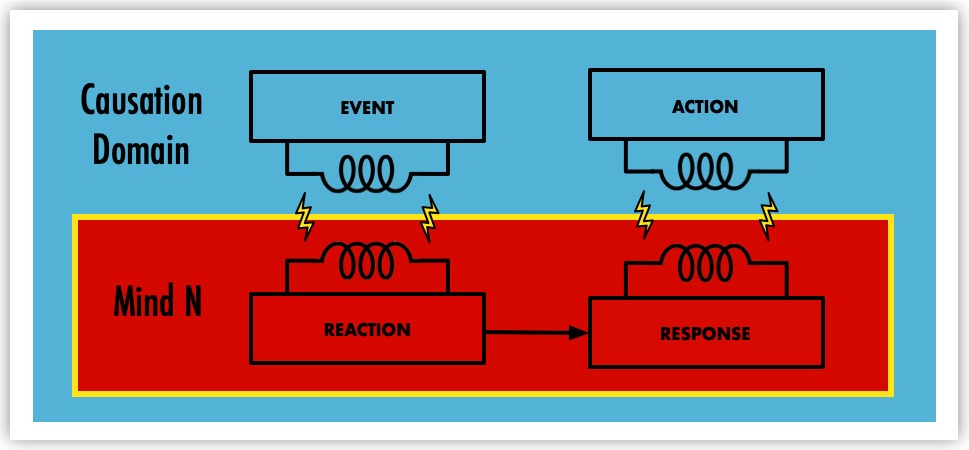
This reaction becomes the raw material for our response, which creates orthogonal action back in the 𝐵𝑙𝑢𝑒 𝑆𝑝𝑎𝑐𝑒.
We can only access the middle steps.
Reaction and response—that’s our entire world.
We’re completely enclosed within 𝑅𝑒𝑑 𝑆𝑝𝑎𝑐𝑒, yet the blindfold makes it feel like we’re directly participating in external events.
That’s why we must open the door from within.
4. Why Does Nobody Feel Heard?
(Originally published here.)
You can be speaking to someone, watching them nod, and still leave wondering if they understood you. It happens in living rooms, meeting rooms, and over coffee with friends.
Studies show that when people feel heard, trust grows. When that feeling is missing, connection weakens.
Thira: Why doesn’t anybody feel heard? Why does it seem like no one knows how to listen?
The Abstractionist (TA): Let’s look at what’s really happening when you speak to someone.
Thira: All right.
TA: Your thought stays in your mind. You guide your muscles to shape air from your lungs. Your vocal cords vibrate, creating pulses in the air.
Thira: Vibrations.
TA: Yes. The vibrations travel. They have pitch, rhythm, and volume, but no meaning by themselves.
Thira: So the meaning appears when the other person hears them?
TA: Their ears catch the vibrations. The brain receives those signals and produces sound. Then the listener recognizes the sound as words, recalls meanings, and builds an idea in their mind.
Thira: Which will be different from mine.
TA: Always. Your meaning exists in your mind, theirs in theirs. Between you is the shared space where vibrations travel. The two minds run in parallel.
Thira: So in every conversation, there are two meanings.
TA: Yes. One belongs to the speaker, one to the listener. The signal carries none.
Thira: And when they respond?
TA: The sequence begins again. Their meaning becomes movement, movement produces vibrations, the vibrations reach you, and you build meaning in your mind.
Thira: And yet it feels like we’re in the same place.
TA: These transformations are invisible. They happen so smoothly that the mind builds a picture of a shared space.
Thira: If I remember this, I’ll expect difference.
TA: And you’ll approach that difference with curiosity.
Thira: Even when they are looking right at me and nodding?
TA: Even then. Eye contact and nodding only mean they’re building their own meaning from what you said.
Thira: So listening means expecting their meaning to be different from mine.
TA: Yes. And working with that difference instead of against it.
Thira: Even when it feels like we understand each other perfectly?
TA: Especially then. You listen for what they might have built, not for what you think you sent.
The mind gives us a simple image of what happens when we speak and listen. Our feelings of “not being heard” are often based on that image.
But the reality underneath is far more magical. The two meanings in a conversation are entirely different. What matters is that they work well enough to keep the exchange alive. When we understand this, we begin to listen differently. We notice the work behind every word and the quiet miracle happening in every human interaction.
5. Paradoxes All Share a Hidden Pattern
(Originally published here.)
They feel like reality itself has broken down, but the breakdown happens somewhere else entirely.
Consider Thira watching an apple fall from a tree. She’s seen this countless times. Her mind builds a simple rule: unsupported objects fall. Later, she looks up at the sun blazing overhead. Her reasoning kicks in. The sun hangs there with no visible support. By her rule, it should fall. It doesn’t.
In the diagram, external events ① (the sun in the sky) and ② (the sun remaining in the sky) belong to the 𝐂𝐚𝐮𝐬𝐚𝐭𝐢𝐨𝐧 𝐃𝐨𝐦𝐚𝐢𝐧 where things happen. Thira’s mind perceives these events and creates interpretations Ⓐ (her perception of the sun) and Ⓑ (her observation that it stays put) in her Red Space (𝐌𝐢𝐧𝐝 𝐍).
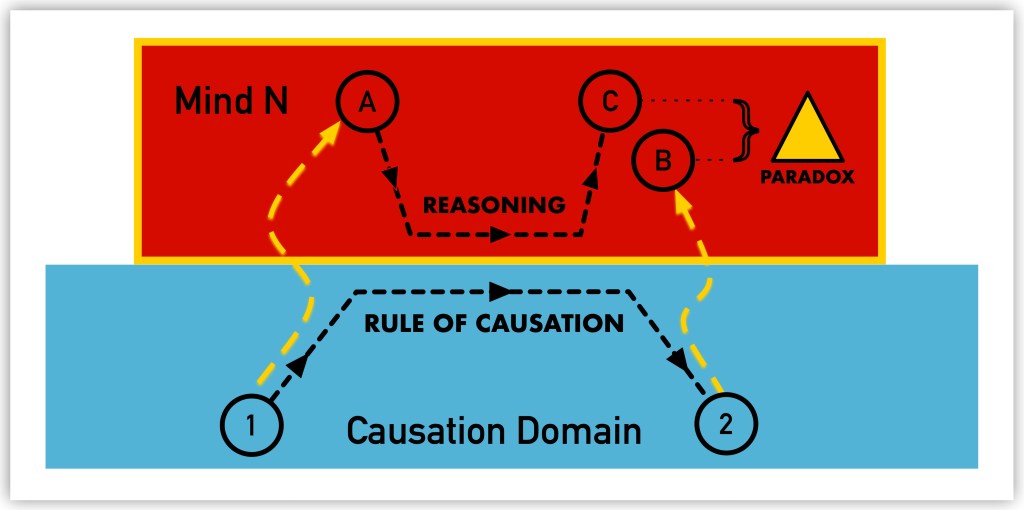
Her reasoning then generates expectation Ⓒ: the sun should fall.
The paradox appears when expectation Ⓒ conflicts with observation Ⓑ. The yellow triangle represents the paradox, a gap between them.
Make no mistake: from Thira’s perspective, this paradox feels absolutely real. To her, the world itself seems broken. (Yes, 𝘺𝘰𝘶 might understand gravity, but whatever 𝘺𝘰𝘶 don’t yet understand works exactly the same way for 𝘺𝘰𝘶. The blindfold is universal.) To resolve it, she must revise her model.
She must 𝒊𝒏𝒗𝒆𝒏𝒕 gravity.
𝕎𝕙𝕒𝕥’𝕤 𝕪𝕠𝕦𝕣 𝕤𝕦𝕟, 𝕥𝕙𝕒𝕥 𝕥𝕙𝕚𝕟𝕘 𝕥𝕙𝕒𝕥 𝕤𝕙𝕠𝕦𝕝𝕕 𝕗𝕒𝕝𝕝, 𝕓𝕦𝕥 𝕕𝕠𝕖𝕤𝕟’𝕥?
PS. Chapter 4 discusses “An Apple in the Sun” and Chapter 8 explains how all paradoxes work from first principles, based on a theory of causal spaces.
6. The Blindfolded Genius
(Originally published here.)
Einstein spent his life convinced that space and time were fundamental features of reality, the stage where everything else performed. Yet in one unguarded moment he perhaps accidentally described something else:
“𝘼 𝙝𝙪𝙢𝙖𝙣 𝙗𝙚𝙞𝙣𝙜 𝙞𝙨 𝙥𝙖𝙧𝙩 𝙤𝙛 𝙩𝙝𝙚 𝙬𝙝𝙤𝙡𝙚 𝙘𝙖𝙡𝙡𝙚𝙙 𝙗𝙮 𝙪𝙨 𝙪𝙣𝙞𝙫𝙚𝙧𝙨𝙚, 𝙖 𝙥𝙖𝙧𝙩 𝙡𝙞𝙢𝙞𝙩𝙚𝙙 𝙞𝙣 𝙩𝙞𝙢𝙚 𝙖𝙣𝙙 𝙨𝙥𝙖𝙘𝙚. 𝙒𝙚 𝙚𝙭𝙥𝙚𝙧𝙞𝙚𝙣𝙘𝙚 𝙤𝙪𝙧𝙨𝙚𝙡𝙫𝙚𝙨, 𝙤𝙪𝙧 𝙩𝙝𝙤𝙪𝙜𝙝𝙩𝙨 𝙖𝙣𝙙 𝙛𝙚𝙚𝙡𝙞𝙣𝙜𝙨 𝙖𝙨 𝙨𝙤𝙢𝙚𝙩𝙝𝙞𝙣𝙜 𝙨𝙚𝙥𝙖𝙧𝙖𝙩𝙚 𝙛𝙧𝙤𝙢 𝙩𝙝𝙚 𝙧𝙚𝙨𝙩, 𝙖 𝙠𝙞𝙣𝙙 𝙤𝙛 𝙤𝙥𝙩𝙞𝙘𝙖𝙡 𝙙𝙚𝙡𝙪𝙨𝙞𝙤𝙣 𝙤𝙛 𝙘𝙤𝙣𝙨𝙘𝙞𝙤𝙪𝙨𝙣𝙚𝙨𝙨.” — Albert Einstein (letter to Robert S. Marcus, 1950)
His intuition was spot on.
That “𝙥𝙖𝙧𝙩 𝙡𝙞𝙢𝙞𝙩𝙚𝙙 𝙞𝙣 𝙩𝙞𝙢𝙚 𝙖𝙣𝙙 𝙨𝙥𝙖𝙘𝙚” he mentions?
✅ It’s the mind itself.
The “𝙬𝙝𝙤𝙡𝙚 𝙘𝙖𝙡𝙡𝙚𝙙 𝙗𝙮 𝙪𝙨 𝙪𝙣𝙞𝙫𝙚𝙧𝙨𝙚”?
✅ The Causation Domain.
Space and time only exist inside, as ideas we use to organize interactions. Einstein’s “𝙤𝙥𝙩𝙞𝙘𝙖𝙡 𝙙𝙚𝙡𝙪𝙨𝙞𝙤𝙣” is simply the mind doing its job of creating the separation where meaning-making becomes possible.
7. Book Excerpt: Emergence Modeling
(Originally published here.)
Abstract: We model emergence as a strategic reorganization chosen by a process when it becomes cheaper to rebuild than to maintain. A process’s internal state is summarized by two resistance parameters: impedance Z (resistance to applying its own rules) and attachment A (commitment to expectations). External disruptions only matter insofar as the process’s affordances make them legible, producing an effective gap g. While the process remains in its current organization it performs local adjustments, choosing at each step between changing Z or A to minimize adjustment cost. The total stay cost equals ongoing maintenance strain m(Z,A) plus accumulated adjustment strain from past changes. Emergence (the “go” choice) occurs when total stay cost exceeds reorganization cost R. We give practical definitions for all terms and show calibration walkthroughs in two domains (financial coordination; knowledge consensus). A toy simulation illustrates the threshold crossing and yields testable signatures for prospective prediction. The framework turns emergence timing into an econometric threshold problem with clear measurement, estimation, and intervention levers.
Now Section 5.6: 📖 https://welcometothebluespace.com/chapter-5/
8. Letter to Dr. John Flach
(Originally published here.)
August 11, 2025
Dear Dr. John Flach,
In Do Systems Exist you show people that systems are mental constructs. In The Abstractionist’s Papers I try to show them the universe is processes, not things. We’re both trying to make the invisible observable, an impossible challenge but one you know well.
Today I’m writing to share Natural Reality with you.
Natural Reality begins with a simple observation: every natural process has an inside that detects differences and responds to them. An electron’s inside responds to electromagnetic and gravitational variations. An atom’s inside coordinates its components. A cell’s inside manages molecular processes. A human’s inside, which we call a mind, processes signals from light, sound, pressure, and chemicals into the experiences we recognize as sight, hearing, touch, taste, and smell.
These insides operate orthogonally to the shared outside where interactions happen. The outside is the Causation Domain, where processes engage and events unfold. The inside is the Interpretive Domain, where each process transforms incoming signals into meaning and transforms meaning into outgoing signals. This transformation occurs at the boundary between domains.
What we experience is never the Causation Domain itself but our mind’s interpretation of signals originating there. When we observe what we call gravity, the actual causal interactions occur independently of our perception. Concepts like mass, space, and time are constructs that map functionally to patterns we observe, but they’re not the underlying processes themselves.
For humans, this means we live our inside lives blindfolded. We’ve always assumed we see the world directly, but we only access our mind’s constructions. Everything we experience is an abstraction produced inside from electromagnetic signals. The apple you see falling, for example, is an image your brain creates, not the causal process itself. This Biological Blindfold explains how we mistake our interpretations for reality. We’ve never had direct access to causation, only to our interpretation of it.
Natural Reality offers theoretical tools for understanding how influence flows in the Causation Domain: Causal Impedance, Incoherence, Causal Induction, General Selection, and others. These concepts are interpretations too, but they’re designed to account for the orthogonality between domains, which is why they form an internally consistent framework. The framework explains self-organization, shows how emergence happens everywhere as processes escape their constraints with varying degrees of success, and resolves scientific paradoxes by recognizing when we’ve mixed Causation and Interpretive Domains. It also shows that emergence is the only show in town.
The framework clarifies why organizational change is so hard: organizations aren’t natural processes. They exist as patterns distributed across many minds, so attempts to solve interpretive problems with centralized causal interventions that do not take this reality into account so often miss the mark.
To your earlier point, the use of two domains isn’t dualism in the problematic sense. Natural Reality does recognize two aspects, causation and interpretation, but the key difference is where the boundary’s drawn and how they relate. Traditional dualism posits separate substances, mind and matter, that must interact across an ontological gap. As such, conventional dualism places boundaries within the realm of interpretation, creating an impossible gap between what feels like inside and outside when both are actually interpretations. Orthogonal domains avoid this by recognizing two complementary aspects of the same reality.
It works like the signal processing analogy we discussed: time and frequency domains are mathematically orthogonal views of the same phenomenon. They can’t be reduced to each other, but they’re not separate things trying to connect.
Whitehead explored similar territory, or so I’m told, but I came to these ideas from first principles. Theoretical tools available now let us model processes in ways that weren’t possible before. Darwin, Gödel, and Einstein all left paradoxes behind. This framework addresses those and reframes science itself by showing that scientific models describe our interpretations of causation, often as linear models like F = ma or V = Ri, not causation itself.
In a Nutshell
The Abstractionist’s Papers presents Natural Reality, which separates the Causation Domain, also called Blue Space, from the Interpretive Domain, also called Red Space. These two domains are orthogonal: the Causation Domain is the unfolding of natural processes, while the Interpretive Domain is distributed and exists privately inside each process. Communication is the exchange of signals in the Causation Domain that induce interpretations in another process. Inducement means interpretation is produced in response to, but not caused by, causal signals. No meaning transfers, as it’s generated internally in each interpreting process.
Causation introduces interpretation, and interpretation produces behavior, which in turn alters causation. In human contexts, our thoughts, actions, and laws are interpreted by others, and their interpretations shape causal enforcement in the world. In this way, we construct our human realities in the same fundamental manner the rest of the universe constructs its own. Natural Reality describes this single continuous process from the subatomic to the relativistic as a unified map.
From this come several concepts:
- Causal Impedance measures how much resistance a process has to the application of causal rules, which it holds inside.
- Causal Spaces are conceptual spaces where different rules apply.
- Incoherence describes what happens when causal impedance increases. This triggers emergence by allowing a process to explore configurations in the face of disruption that would not normally be available.
- Causal Induction explains how influence propagates between processes without transfer of meaning between them. Light serves as a universal mechanism enabling the propagation of influence by induction across causal spaces.
- Information becomes layered. Signals carry causal variation but not meaning. The transmitter transforms meaning into causal variation according to a first set of rules, and the receiver transforms causal variation into meaning according to its own independent rules. If the rules are compatible, we say the cross impedance matches and inducement happens. But meaning itself is not reconstructed by the receiver; it must be built anew.
- General Selection describes how patterns persist or disappear in any context. Unlike Darwin’s natural selection, this operates across causation and interpretation simultaneously, modeling emergence, the only show in town.
By treating causation and interpretation as complementary aspects of one process universe, the model avoids the ontological gap of traditional dualism and resolves paradoxes caused by mixing the two domains. It reframes science as the study of our interpretive responses, while still offering models for how causation might work.
In sum, The Abstractionist’s Papers is both a philosophical and practical toolset, helping readers recognize when they are in Red Space versus Blue Space and giving them ways to navigate consciously between them. It shows how to harmonize processes and induce change across domains. It offers a new way to understand influence and produce purposeful emergence. This perspective changes how we see the universe, how we act in it, how we create, and how we solve problems.
I realize this framework isn’t how we typically see things. But ideas do get selected based on their usefulness, following exactly the principles Natural Reality describes. So we’ll see what happens.
Thank you for the thoughtful conversation. I appreciate the chance to share this map with you.
📖 www.WelcometotheBlueSpace.com
/Luiz 🙏
 The Abstractionist’s Papers