(Originally published on March 22, 2025.)
Table of Contents
- A Letter from the Abstractionist
- A Book Excerpt
- Article: Solving the Telephone Game
- Join the Movement
1. A Letter from the Abstractionist
Dear Readers,
Our newsletter returns.
Since our last issue, The Abstractionist’s Papers has been completed—a book that gathers years of thinking, writing into a single narrative. What once lived as essays, conversations, and scattered ideas now stands as a whole.
It was released on February 24, 2025. (And it’s free.)
If you haven’t had a chance to read it yet, now’s a good time.
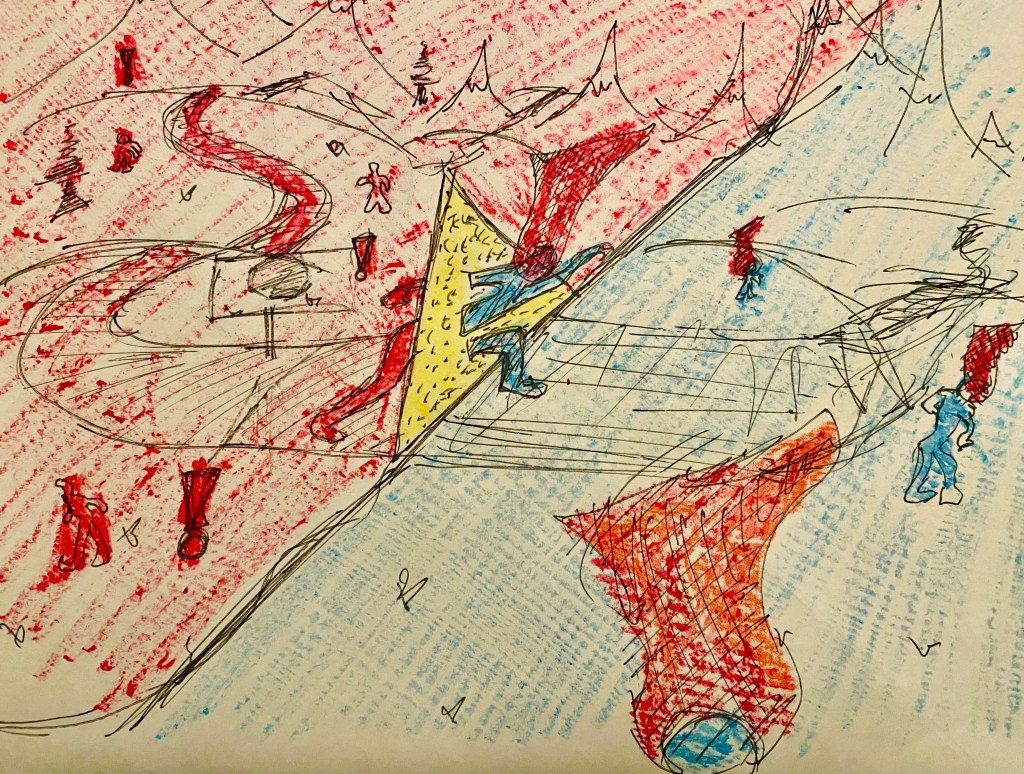
The book explores perception, causality, and emergence: how reality organizes itself, and how we participate in that process. Concepts like Red and Blue Space, General Selection, and Incoherence offer answers and an entirely different way of seeing.
It’s divided into four parts:
- The Mind — How interpretation operates, and how paradox forces internal reorganization.
- Natural Reality — A model of the observable universe based on interaction, pattern, and recursion—across physical, biological, and cognitive domains.
- Causality — How influence moves through processes, with concepts like impedance, induction, and emergence offering a new account of connection.
- Engagement — The practical application of these ideas: working with dynamics, navigating contradiction, and inducing transformation.
Those who’ve read it are already responding—with questions and applications of their own.
We’re listening.
Alongside the book, we rebuilt the website.
You can now read:
- The Baroness and the Abstractionist
- The Intact and the Flightless
- BoxLilly
- Glitches in Reality
- Principles of Natural Reality
- When a Planet Starts to Spin
These works are now free to access, side by side.
Welcome to the Blue Space,
Luiz von Paumgartten
Founder and CEO
General Reality Media, LLC
2. A Book Excerpt
(From Chapter 13, “What’s Next.”)
Natural Reality has become a set of practices, technologies, and ways of working—with our minds, and with the world around us. Ideas that were once incubated within are now being freely induced, tested, and applied in public.
Much of this began with a long pass—a line in The Baroness and the Abstractionist, aimed at a future still out of reach: “If the puppets realize they’re toys, they’ll try to escape the model.” That prediction set the trajectory for everything that followed.
Years later, in The Intact and the Flightless, a different story brought something back: a discovery, transformed into an invention, delivered to a place where it had never been seen before. Incoherence is before you. The basic mechanism of emergence is now visible.
The promise I made to my kids many spirals around the sun ago:
“Good News from Nimbin! My General Theory of Reality will give you an understanding of how every environment works, and it serves as a guide for the amelioration of the human condition. (It also reconciles quantum physics with relativity using the Principles of Causation and Incoherence.) I’m coming home to share this with you.”
—The (Un)happiness Letter (2017).
—has been fulfilled.
The Abstractionist’s Papers is the orderly version of what happened between those two stories. It is the arc of transformation itself—a natural progression that began with a question, uncovered the hidden mechanics of paradox, and emerged as a framework for understanding reality.
The Abstractionist Movement is still in its early stages. How far it takes hold will depend on how well it is selected—a process that belongs to the space. So far, what we’ve seen is consistent with the model: a quiet induction phase, slow and mostly invisible, moving toward something nonlinear.
What we can say is that Natural Reality appears to be working. Its recursiveness is unmistakable. This is a work about emergence, that itself emerged—and now helps others do the same.
To the extent these tools enable people to live better lives, the movement is expected to grow—in response to this work.
And because of you.
Nice catch.
3. Article: Solving the Telephone Game
(Originally published here.)
Ever play the Telephone Game?
One person whispers a phrase to another, who repeats it to the next, and so on. By the end, the message is unrecognizable. The words fall apart, and meaning is lost.
“The cat sleeps in the sun” becomes “The hat leaps for the gun.”
The game is meant to show the fragility of language—that every act of communication introduces errors, that meaning drifts the further it travels.
But the game gets something wrong.
It suggests that miscommunication comes from errors in the signal. But real misunderstanding does not come from garbled words—it comes from assuming that meaning exists in them at all.
Here’s a story that shows how communication really works:
The Key Is Missing
1
The guest checks his pockets. His bag. The nightstand.
Nothing.
Down at the front desk, he leans in. “The key is missing.”
The concierge looks up from his book. The Key to the Labyrinth. He’s been stuck on the same passage for an hour.
He nods, closing the book. “Thank you,” he says. “I think I understand now.”
2
The concierge stands, still turning the words over in his head.
At the hotel bar, he passes the pianist. Still thinking about his book, he mutters, “The key is missing.”
The pianist pauses mid-chord. He plays a scale, frowns. Something must be off.
He waves over the waiter. “The key is missing.”
3
The waiter, already distracted, only half-hears him.
He rushes back to the kitchen.
“So it turns out the key is missing—” He hesitates.
The chef frowns. “There’s no key for the lime pie?”
Before the waiter can explain, the custodian—pushing a mop past the doorway—nods to himself.
“Never mind. I know the key is missing. I’m on it.”
4
The guest is still at the front desk when the custodian arrives.
The custodian reaches for his keyring, then tries the handle. The door swings open.
They both stare at it for a moment.
The guest exhales. “It was never locked.”
The custodian shrugs. “Happens all the time.”
/The End.
Meaning Is Inside
Meaning isn’t in the words.
It is produced uniquely in the mind that engages with them.
People often assume communication works like copying a file—as if meaning is packaged into words, sent, and then recovered intact by the listener. But that’s not how it works.
Words don’t contain meaning.
They only trigger a process in the listener’s mind, where meaning takes is created—independently, every time.
The Telephone Game teaches that miscommunication happens when words get distorted. But in The Key Is Missing, the words were clear and unchanged—only the meaning was different. Not because the words were ambiguous, but because meaning doesn’t exist in the message at all. It exists only in the minds that interpret it.
The mind that speaks is not the mind that listens. They are separate realities. Meaning is not transferred—only signals are.
And in the end, the door was already open.
PS. For a deeper dive, see Chapter 2 (How the Mind Works) and Chapter 3 (The Realities We Build).
4. Join the Movement
If The Abstractionist’s Papers raised questions for you, send them in. Some will be addressed here in the newsletter, others in direct conversation.
Already, the ideas are finding their way into research, dialogue, and creative work. If something in the book resonated, connected, or disrupted—share it. These reflections determine how the work continues to emerge.
There are simple ways to support the movement. If the book meant something to you, recommend it. If you’d like to leave a review, please reach out. This work will spread as all natural processes do—by interaction, by refinement, by practice.
To continue exploring these ideas and practice transforming challenges into growth, subscribe to The Practice is the Win™, and join a community dedicated to embracing the practice of Abstractionism, navigating the Natural Reality framework, and becoming purposeful creators of our own experiences.
 The Abstractionist’s Papers