(Originally published on October 5, 2025.)
Table of Contents
- What’s New
- The Reality Debates
- Emergence Through General Selection
- Complexity Matters
- Note to Professor Hofstadter
1. What’s New
Dear Reader,
This edition of The Practice is the Win™ takes Natural Reality into territory that matters, the questions science and philosophy have circled for centuries. Last month we:
- Gave The Abstractionist’s Papers a comprehensive round of editing.
- Launched The Reality Debates, a conversation series that uses this framework to reexamine problems most people assume are settled or unsolvable, and
- Published A Note to Professor Douglas Hofstadter, author of Gödel, Escher, Bach.
This edition also includes two excerpts from The Papers:
- “Emergence Through General Selection” shows how Incoherence drives transformation beyond existing constraints.
- “Complexity Matters” explains why modern life depends on causal systems we cannot directly perceive.
We also started experimenting with video content.
The Abstractionist Movement builds one realization at a time. When something here changes how you see, share it. The Abstractionist’s Papers is available free at WelcometotheBlueSpace.com.
Founder and CEO
General Reality Media, LLC
2. The Reality Debates
Last month we launched a conversation series built around six questions that have persisted across millennia. Each debate features two perspectives exploring how Natural Reality reframes what seemed settled or unsolvable.
- Are We Living in a Simulation? Can we distinguish reality from simulation through our interaction with Blue Space, or does the biological blindfold make this unknowable?
- Is Free Will an Illusion? Can we create agency by pausing before we react, or do hidden patterns already decide our choices?
- What is Consciousness? Is consciousness where causation triggers interpretation, or is it the mind watching itself work?
- Can Every Paradox Be Solved? Does Natural Reality solve paradoxes by separating causation from interpretation, or does it just change how we see them?
- Is Time Real? Is time how we measure causal flow, or does sequence itself require temporality?
- Is Death the End? Is death a transformation in how influence continues, or does it end the specific system that experiences and acts?
Each debate presents two hosts exploring the same framework from different angles. Neither tries to win. Both reveal how one set of ideas opens new questions.
3. Emergence Through General Selection
(General Selection operates in two directions. Horizontal selection adapts processes within existing constraints. Vertical selection breaks those constraints entirely, creating new possibilities. The vertical dimension connects to the Natural Reality Axis, where processes move orthogonally beyond their current boundaries.)
Variability introduced during interactions influences causal impedance, defining how constraints act upon a process.
Under typical conditions, change (δ) operates within the same plane (n) as decay (λ), remaining aligned with the process’s current Natural Space, where its causal impedance (ZΨ) remains fixed.
When variability introduces Incoherence, δ becomes orthogonal to λ, and ZΨ shifts, allowing the process to bypass prior limitations:
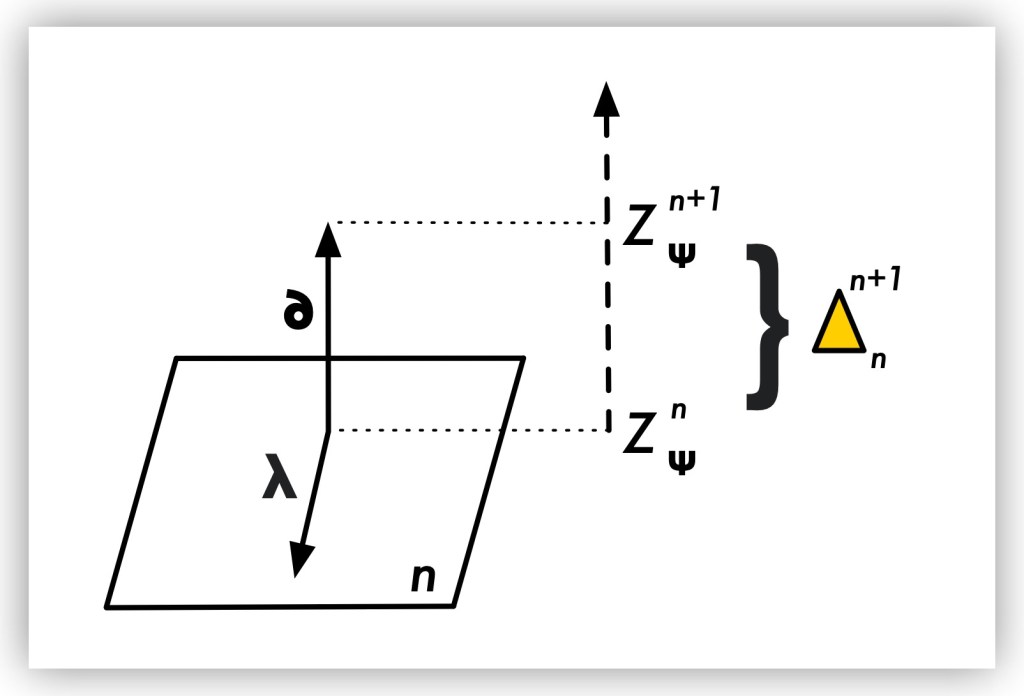
This change allows the process to build new causal connections, creating emergence. Variability adjusts ZΨ, altering the balance between decay and change. As Ψ’s influence weakens, new pathways for transformation open up.
Incoherence (Δ) measures how a process’s relationship to governing rules shifts. When Δ > 0, δ moves orthogonally to λ, allowing the process to sidestep direct enforcement of Ψ.
Because Δ is proportional to changes in causal impedance (ZΨ), it drives constraint-breaking and novel configurations.
Distinguishing between typical variability and Incoherence clarifies how processes evolve, whether through small adaptive shifts or the emergence of new behaviors and forms.
Section 5.3: 📖 https://welcometothebluespace.com/chapter-5/
4. Complexity Matters
You might wonder why complexity matters if you’re not studying Conway’s Game of Life or gravitational systems. Modern human life runs on accumulated complexity operating beyond direct observation.
Every technological system, every market, every social institution operates through layers of indirect processes. Your phone connects through dozens of intermediary steps. Your food travels through supply chains spanning continents. Your job depends on economic relationships operating beyond your direct observation. The Causation Domain, where actual happenings occur, has grown highly indirect.
Your mind interprets everything through flat cause-and-effect maps: direct connections, simple stories. This works fine for immediate physical interactions. It breaks down completely for the systems you live in.
The mismatch creates the confusion. You want an outcome, you take what looks like a direct action, nothing happens the way you expected. You try harder with the same approach. The confusion compounds. The systems you’re working with operate through pathways your interpretations miss entirely. You’re navigating multidimensional complexity with two-dimensional maps.
Causation operates orthogonally to interpretation. The indirect processes producing outcomes in modern life run perpendicular to the flat maps you use to understand them. The simplified stories you create feel complete while operating on different mechanics.
Recognizing that complexity operates in a dimension perpendicular to interpretation changes how you engage with the world. You model indirectness deliberately. You work with the actual mechanisms of how things happen. You stop applying two-dimensional interpretations to multidimensional processes.
Everything becomes complex when you examine it closely enough.
The urgency lives in understanding human systems specifically. The gap between accumulated causal complexity and our interpretive flatness creates most of the confusion and dysfunction we experience. The framework gives you tools for thinking about processes operating beyond direct observation.
Section 10.4: 📖 https://welcometothebluespace.com/chapter-10/
5. Note to Dr. Professor Hofstadter
October 5, 2025
Dear Professor Hofstadter,
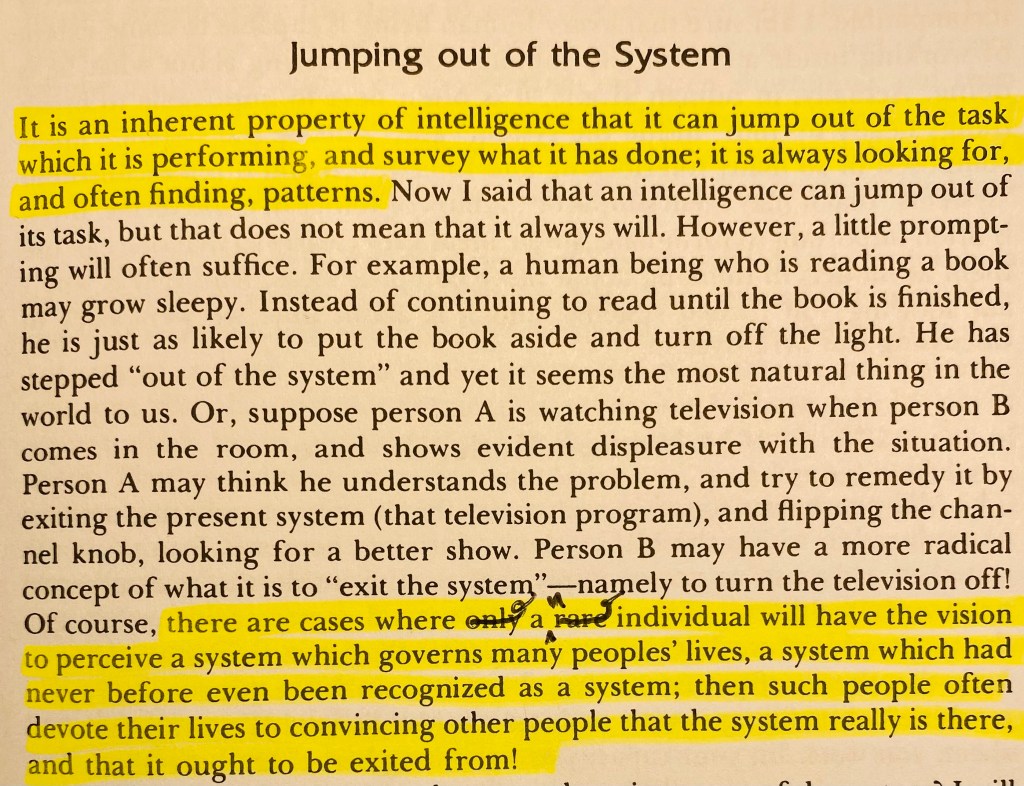
I recently reached page 37 of Gödel, Escher, Bach, where you describe people who glimpse “a system which had never before even been recognized as a system” and then devote themselves to showing others what they have seen.
For nearly a decade I had been working, mostly in private, on a set of ideas that seemed to resolve problems that had lingered across many fields. They diverged so substantially from accepted thought that I rarely shared them. Reading your description of that path helped me recognize it as my own. Ideas that touch something fundamental often meet resistance at first, and they may take generations to be understood.
That work became The Abstractionist’s Papers, a book built from first principles to reconsider how reality operates. It proposes that, in our process universe, causation and interpretation propagate across orthogonal domains.
Your passage arrived at the right moment. I’m changing focus now toward showing others what I’ve seen. The complete book is freely available at welcometothebluespace.com.
With gratitude,
Luiz von Paumgartten
 The Abstractionist’s Papers